At a glance
The first paper to treat Pashto as a national language was Siraj al-Akhbar, which Mahmud Tarzi edited in Kabul from 1911. It was printed in Persian, and Tarzi argued in it for Pashto as "the Afghan language". [6]
Anis, begun in Kabul in 1927, was written in Pashto, and Gregorian calls it in that sense the first national paper. [6] In British India the Pashto weekly that mattered was Pakhtun (پښتون), which Abdul Ghaffar Khan started in 1928. [8, 9]
Radio reached the Pashtun lands from two capitals at once. Peshawar had a transmitter in 1935 and a station inaugurated in 1936. [11] Kabul had a small transmitter in 1925 and a larger one in 1933. [12] After 1955 Pakistan used Radio Peshawar to broadcast in Pashto against the Pashtunistan demand, and the radio and press war between Kabul and Islamabad peaked in 1961 to 1963. [7]
Foreign Pashto radio came late: BBC Pashto in the early 1980s, VOA Deewa in 2006 and Radio Mashaal in 2010. Mashaal stopped broadcasting on 31 March 2026. [1–3, 17]
Private Pashto television began with AVT Khyber, which started test transmission on 1 July 2004, and with Afghan channels such as Lemar (2006) and Shamshad. [5, 21, 22, 24]
Reporters in the Pashtun lands have been killed, abducted and threatened by militants, intelligence officers and unknown gunmen. Since August 2021 the Taliban authorities have shut or restricted much of the Afghan media, and on 13 October 2026 they took BBC Pashto off FM. [27–30, 32, 33]
Siraj al-Akhbar and the first Kabul papers
Afghanistan's first newspaper, in Dupree's account, was Shams-i-Nahar, "Morning Sun", which Sher Ali Khan's government published in 1873. [7] The first one that lasted was Siraj al-Akhbar Afghaniyah, "The Lamp of the News of Afghanistan". Vartan Gregorian, who wrote the standard history of Afghan modernisation, says it was published every two weeks from October 1911 to January 1919 under Amir Habibullah, and that its editor and chief writer was Mahmud Tarzi. [6] Tarzi lithographed the first year himself, and presses from France and Turkey arrived afterwards. [7]
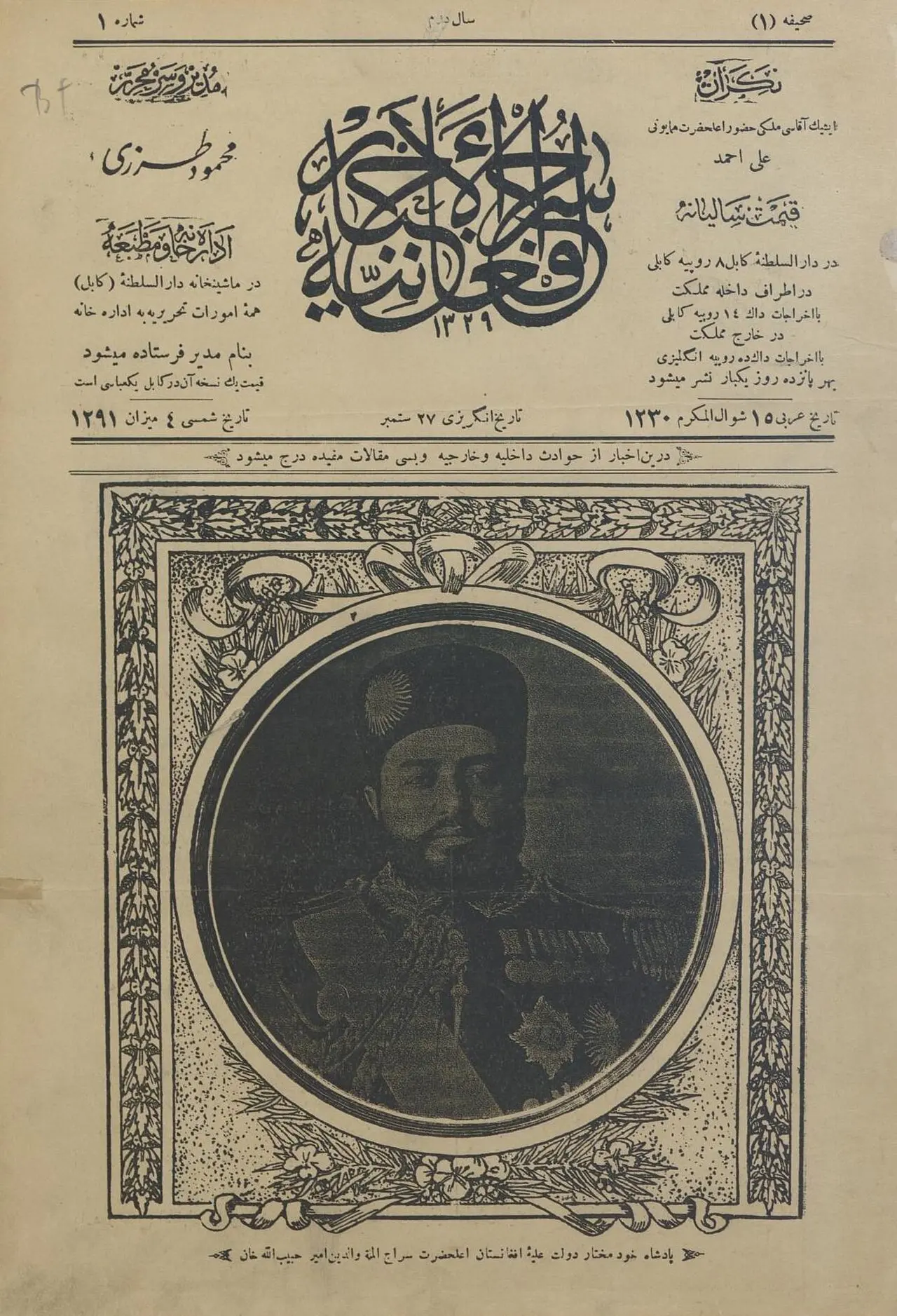
The cover of the first issue of the second year of Siraj al-Akhbar, 1912, with a portrait of Amir Habibullah Khan.
Mahmud Tarzi (editor), via Wikimedia Commons· Public domain
The paper was in Persian. [6] It still mattered for Pashto, because Tarzi argued in it that Pashto, which he and his circle called "the Afghan language" or "Afghani", should have its status raised, in contrast to Persian, the official language, and be taught to every group in the country as a true national language. [6] Tarzi made the argument for Pashto in Persian.
The press that grew up under Amanullah (1919 to 1929) was also mostly Persian. Gregorian lists Aman-i-Afghan, which took over from Siraj al-Akhbar in 1919, Ittihad-i-Mashriqi at Jalalabad in 1920, and Tulu-e-Afghan at Kandahar in 1921. He says those four papers, in Kabul, Jalalabad and Herat, were written in Persian, though they carried occasional articles and poems in Pashto. [6] Then came Haqiqat in 1923 and Anis in 1927, and of Anis Gregorian writes that it "was written in Pashto and was, in this sense, the first national paper". [6] Dupree adds that Anis ceased to be a free paper in 1931 and emerged as a government paper that is still published. [7]
Under Habibullah Kalakani the press that had blossomed under Amanullah all but disappeared, leaving one paper in Kabul, and Nadir Shah's government rebuilt it. [6] Anis returned and later became a bilingual daily, a new Pashto journal appeared, and the semi-official Islah became a daily. [6] The state now backed Pashto openly. Gregorian quotes Hashim Khan saying that by 1938 Pashto would be "the language of our officials, doing away with Persian". [6] In 1930 the question became a public quarrel: the Calcutta paper Habl-ul-Matin warned the Afghan government against "an artificial national language" and said Pashto was spoken by a minority in Afghanistan. [6] Gregorian reports that the question had become a debate between the Persian and the Afghan press, and that the new Pashto Tolana, the academy, pursued the study and promotion of Pashto. [6] Two men who worked in these papers have their own articles: Gul Pacha Ulfat, who joined the staff of Anis in the 1930s, and Qiyamuddin Khadim, listed in Adamec's Who's Who as editor of Hewad.
Two later episodes show how thin the freedom was. In 1951 and 1952, under the "Liberal Parliament", independent papers appeared overnight. Dupree names Watan, Nida-yi-Khalq and Angar, the last a Persian and Pashto biweekly published by the Kandahari Faiz Mohammad Angar, each with a circulation of about 1,500. [7] Amin Tarzi, writing for Radio Free Europe/Radio Liberty, says that experiment ended in 1953 when Mohammad Daoud, as prime minister, closed the independent papers. [10] The next opening came with the 1964 constitution and the press law of 1965, which kept broadcasting in the state's hands while independent papers multiplied; it ended with Daoud's coup of 1973. [10] The library collections that survive from these decades are mostly of the state papers: Princeton's Afghan Central Press collection presents Anis, Hewad (هيواد, "Homeland") and Islah as its Pushto publications, beside the English-language Kabul Times. [13]
Pakhtun, the paper of Charsadda
On the Indian side of the Durand Line there was no Pashto political paper until 1928. [8] Abdul Ghaffar Khan, later Bacha Khan, decided to start one. In Tendulkar's biography he is quoted saying the Pashtuns had no love for their own language, that educated men asked "What is there in Pakhtu worth reading and learning?", and that mullahs told people Pashto was the language of hell. [8] The magazine he started, Pakhtun, became popular, he said, "not only in the land of Pakhtuns but all over the world where a Pakhtun lived", and the Pashtuns in America gave the largest help in circulating and financing it. [8]
An editorial in the paper said that Pashtuns "including those in Afghanistan, form one nation" and regretted that Afghanistan had no Pashto journal, since its state language was Persian. [8] The issues carried articles on the threat to tribal territory, the boycott of the Simon Commission and Amanullah's tour of Europe and the Soviet Union, notes on hygiene, and verses sent by readers, men, women and schoolchildren. [8] Tariq Rahman adds that the paper raised the question of language planning, and that in August and September 1929 Abdul Ghaffar Khan wrote that British schooling alienated the people and that Pashto should be the medium of instruction in primary school. A contributor asked the government for a Pashto Academy with a yearly grant of 40,000 rupees. [9]
The British banned it in April 1930, when its founder went to jail. It came out again a year later, was banned again in 1931, and appeared three times a month when he re-entered the province in 1937. It stopped in October 1942 at his arrest, returned after his release in 1945, and in Tendulkar's account was banned by the Pakistan government in August 1947, with the surviving issues destroyed. [8] Tendulkar thought no library or person held the full file, and that Kabul's library might hold some issues. [8] The paper also reached Kabul. Abdul Ghaffar Khan said it led to a Pashto paper there, Pakhtun Zhagh, under royal patronage, of which nine issues appeared before Amanullah fell. [8] Rahman names two smaller Frontier papers of the time, Sarhad (1925, in Urdu with twelve Pashto pages) and the fortnightly Angar, which had more Pashto than Urdu. [9] The poets who wrote for Pakhtun are in Poets of the Khudai Khidmatgar, and the movement is in Bacha Khan and the Khudai Khidmatgar.
Radio Peshawar and Radio Kabul
The dates for Peshawar's station differ by source. The Pakistan Broadcasting Corporation's own chronology says the North-West Frontier government set up a 250-watt transmitter at Peshawar in January 1935 "for community listening", that a station was inaugurated at Peshawar on 16 July 1936, and that the Government of India took it over on 1 April 1937. [11] The chronology also records that the station became a relay station in March 1939 and that it was formally inaugurated again, in a proper broadcasting house, on 16 July 1942. [11] Dawn, reporting the station's 82nd anniversary in 2017, quotes its regional director dating its start to 6 March 1935, and says it relayed programmes in Pashto, Hindko, Chitrali and Persian. [14] Singers describe what it did for Pashto music. Khial Mohammad said he sang his first song on it in 1958 and was paid 15 rupees, and Gul Meena Bibi said women could not sing live in public but could through the microphone. [14]
Kabul's radio is also dated two ways. A Radio Heritage Foundation history, taken from a Ministry of Information brochure of 1967, says a small long-wave transmitter was imported from Russia in 1925, installed in the king's palace, and destroyed in the unrest of 1929, with a German Siemens transmitter installed at Yakatut in 1933. [12] Khaama Press says Radio Kabul began in 1926, stopped, resumed in 1941 and was renamed Radio Afghanistan in 1963. [15]
By the 1950s both stations were fighting through Pashto. In Dupree's account, after the flag-raising ceremonies at the embassies and consulates in September 1955, Pakistan stepped up its anti-Pashtunistan propaganda on both sides of the Durand Line, and over Radio Peshawar broadcast in Pashto to the Afghan side. [7] Dupree says Afghan and Pakistani radio and press propaganda seldom again reached the pitch of 1961 to 1963. [7] Dupree adds that during the border closure the Afghan press and radio repeated over and over that the Pakistanis had closed it. [7] Radio also carried news of state. On 9 March 1963 Radio Afghanistan announced that Mohammad Daoud had resigned as prime minister, and Dupree prints the text. [7] Radio Afghanistan was also an early place for women's voices: Dupree says that a year or two before 1959 it tested female singers and announcers, and several women then joined its staff. [7] Hamza Shinwari, who wrote for radio, and the other poets who worked with it have their own articles, for example Hamza Shinwari.
BBC Pashto, Deewa and Mashaal
BBC Pashto's own page says the service began in August 1982 and soon found large audiences in Afghanistan, Pakistan and the Gulf, with news and political analysis first, then weekly programmes for young people and women and on sport, science, literature and music. [1] Some English-language accounts give 1981. The BBC page is the one read here, and Pashtuns today uses its date. The BBC said in 2016 that its Dari programmes joined the Pashto service for Afghan audiences in 2003, and that its Pashto website began in a small way in 1996. [1]
The United States opened two Pashto stations aimed at the border region. VOA Deewa ("Light") launched its first full news hour in September 2006, on FM 100.5 in some cities and on shortwave, with plans to grow to six hours a day. [2] Radio Mashaal ("Torch"), run by Radio Free Europe/Radio Liberty from Prague with a bureau in Pakistan, began on 15 January 2010 to offer "an alternative to the growing number of Islamic extremist radio stations" in the tribal areas, and shared a frequency with Deewa. [3] Its first-year programmes included a call-in show, War Stories, on which a Swat widow told of a 14-hour Taliban attack on her house, and a weekly series on tribal elders killed by the Taliban. [4] The poet Abdul Bari Jahani worked for the Voice of America.
Pakistan's government ordered Mashaal's Islamabad office closed on 19 January 2018 on the recommendation of the ISI, whose report said the station's programmes portrayed Pakistan as a hub of terrorism and presented Pashtuns as disenchanted with the state. [16] That is the state's description. Mashaal called itself "the voice of the voiceless". [17] In 2025 the American government moved to end funding for RFE/RL, and a federal judge in March blocked the cut for a time. [18] VOA staff were laid off in the same year, among them about 100 Pakistanis who worked for its Urdu and Pashto services. [19] In March 2026 a US judge ordered VOA restored. [20] Mashaal itself shut its radio, website and social pages from 31 March 2026, "citing severe financial difficulties". [17]
Pashto television
The first Pashto satellite channel was AVT Khyber. Dawn reported on 3 July 2004 that it had started test transmission on Thursday from its offices in Islamabad, through the AsiaSat satellite "beamed also for Afghanistan, Middle East and other countries", and that its director of news called it "a great moment for the 70 million Pakhtuns to have got their own channel". [21]
In Afghanistan the Taliban had banned television, and their radio, the Voice of Sharia, carried religious programmes. [26] After 2001 private stations grew quickly. The Moby Group, run by the Mohseni family, started with Arman FM in 2003 and then moved into television, with US aid money behind it. [25] Its Pashto channel, Lemar, launched in 2006 and by Moby's own account dominates the south and south-east, covering Helmand, Khost, Paktika, Paktia, Uruzgan and Zabul. [5] Shamshad TV is the other Pashto channel that comes up in the reports. Reporters Without Borders says it launched in 2004, and the Afghanistan Journalists Center says it was established in Kabul in 2006. [22, 24] The Islamic State claimed an attack on its Kabul offices on 7 November 2017; Dawn quotes the interior ministry as saying two guards were killed and five people wounded, and the attackers held the building for about three hours. [23] In 2008 the Ulema Council asked the government to stop Tolo TV and fifteen other private channels from showing Indian serials. [26]
Journalists killed in the Pashtun lands
The Committee to Protect Journalists records the killings that follow, and in several of them nobody was convicted.
Hayatullah Khan filed photographs from Miran Shah in December 2005 that contradicted the official account of how an al-Qaeda commander, Hamza Rabia, died. The next day, 5 December 2005, five gunmen ran his car off the road and took him as his brother watched. His body was dumped in the Miran Shah market on 16 June 2006. His brother Ihsanullah said a military intelligence major had warned Hayatullah to leave his profession or Waziristan or accept the government's politics, and that Hayatullah had told his tribe the government agencies would be responsible if he vanished. An inquiry by a High Court judge was completed but not made public. [27]
Musa Khankhel, a Geo reporter from Swat, was killed in February 2009 while covering a peace march led by Sufi Muhammad, during the first violation of a truce. No group claimed it. His brother told the BBC he was taken at gunpoint, and his hands and feet were bound when his body was found. He had told his bosses that the army was punishing him for his coverage of the Swat offensive and, on the day he died, that he believed the ISI meant to kill him. [28]
Mukarram Khan Aatif, who reported for Dunya News and VOA Deewa, was shot in a mosque near Peshawar on 17 January 2012 after moving from Mohmand because of threats. The Pakistani Taliban's spokesman took responsibility and said he had been warned to stop "anti-Taliban reporting". [29] Khalil Jibran, a long-time correspondent of Khyber News and a former president of the Landi Kotal press club, was pulled from his car near his home and shot dead on the night of 18 June 2024. Police said he had received threats from militants before. [30]
Since August 2021
CPJ says that after the Taliban took Kabul on 15 August 2021 they began at once to bar female journalists from the public broadcaster and to beat reporters covering protests. [34] Human Rights Watch reported in October 2025 that the intelligence service monitors content, that the morality ministry inspects newsrooms, and that media workers were detained for broadcasting women's voices or playing music. [33] CPJ adds that women's voices were banned from radio and television in Helmand, that women must cover their faces on television, and that in 2024 live political broadcasts were banned and interviews limited to a list of 68 approved analysts. [34] The 2024 vice and virtue law treats images of living beings as un-Islamic, and by KabulNow's account has shut dozens of television stations or forced them to run as radio only; the same report cites a 2024 count by the Afghanistan Journalist's Support Organization in which 68 of 248 television channels still operated. [24] In October 2025 the authorities closed Shamshad Radio and TV, which the Afghanistan Journalists Center said had failed to "defend Taliban positions" in its coverage of the border fighting with Pakistan. [24]
Foreign broadcasters lost their local outlets. In March 2022 BBC television bulletins in Pashto, Persian and Uzbek were taken off Afghan partner stations, and on 1 December 2022 VOA and RFE/RL were removed from Afghan AM and FM. [31, 32] On 13 October 2026 the Taliban suspended BBC World Service from Afghan FM, which took in its Pashto service. The BBC said it would continue by shortwave, medium wave, satellite and online. [32] HRW found that Hazara journalists faced harsher treatment, and quoted an intelligence official telling one that if he spoke Pashto his crimes would have been less. [33] The wider events are in Afghanistan and the Pashtun lands since 2021.
عام پوښتنې
When did Pashto get its first newspaper?
It depends on what counts. Anis, begun in Kabul in 1927, is described by Vartan Gregorian as written in Pashto. Pakhtun, started by Abdul Ghaffar Khan in 1928, was the first political Pashto journal on the Indian side of the Durand Line. Persian-language papers such as Siraj al-Akhbar argued for Pashto from 1911.
Which radio stations broadcast in Pashto?
Radio Peshawar, dated between January 1935 and 1936 depending on the source, and Radio Afghanistan in Kabul, whose transmitters date from 1925 and 1933. Foreign services included BBC Pashto, VOA Deewa from 2006 and Radio Mashaal from 2010, which stopped broadcasting on 31 March 2026.
When did Pashto television begin?
AVT Khyber, which Dawn called Pakistan's first Pashto satellite channel, began test transmission on 1 July 2004. In Afghanistan the Moby Group's Lemar TV launched in 2006, and Shamshad TV began in 2004 or 2006 depending on the source.
What changed for Pashto media after 2021?
The Taliban authorities restricted women's voices, music, images of living beings and political programmes, closed Shamshad in October 2025, removed VOA and RFE/RL from Afghan radio in December 2022, and took BBC off FM on 13 October 2026.
انځورونه (4)
انځورونه
4 انځورونه
Mahmud Tarzi, editor of Siraj al-Akhbar, in an official portrait of 1920.
Abdul Ghaffar Khan in 1939.
Nargas Karimi, a Radio Television Afghanistan journalist, listens to a guest during a live radio broadcast from the station's Farah City studio, 23 February 2013.
Headquarters of Radio Television Afghanistan in Wazir Akbar Khan, Kabul, 18 April 2018.
سرچینې
لومړنۍ سرچینې
په هماغه وخت کې لیکل شوې: یادښتونه، تاریخونه، رسمي اسناد او د سرشمېرنې پاڼې.
- بیرته متن تهBBC News Pashto, 'The BBC World Service and the Pashto service' (11 October 2016)
BBC Pashto's own start date (August 1982), early programmes, the 2003 Dari link and the website.
- بیرته متن تهVoice of America, 'Radio Deewa is on FM, shortwave and the Internet' (29 September 2006)
VOA Deewa's first news hour, name, frequencies and planned growth.
- بیرته متن تهRadio Free Europe/Radio Liberty, 'RFE/RL Launches Radio Station in Pakistan's Pashtun Heartland' (January 2010)
Radio Mashaal's launch on 15 January 2010, purpose, name, Prague base and shared frequency.
- بیرته متن تهRadio Free Europe/Radio Liberty, 'RFE Marks Successful First Year of Broadcasts to Pakistan' (January 2011)
Mashaal's first-year programmes, including War Stories.
- بیرته متن تهMOBY Group, 'Celebrates the 10th Anniversary of Lemar TV' (2016)
Lemar TV launched 2006, its coverage area and language.
نوې څېړنې
د تاریخپوهانو، انسانپوهانو، ژبپوهانو او جنېټیک پوهانو کتابونه او مقالې.
- بیرته متن تهVartan Gregorian, The Emergence of Modern Afghanistan: Politics of Reform and Modernization, 1880-1946 (Stanford: Stanford University Press, 1969), pp. 163-165, 175, 245, 311-312, 348, 351-352
Siraj al-Akhbar (dates, Persian language, Tarzi on Pashto), the Amanullah-era papers, Anis in Pashto, the Nadir Shah press, Pashto policy and the 1930 press debate. Read in OCR text; page numbers from the running heads.
- بیرته متن تهLouis Dupree, Afghanistan (Princeton: Princeton University Press, 1980 printing), pp. 404, 438-439, 494-495, 531, 538-539, 553
Shams-i-Nahar, Siraj al-Akhbar, Anis, the Liberal Parliament papers, Radio Peshawar in Pashto, the 1961-63 radio war, women on Radio Afghanistan and the radio announcement of 9 March 1963. Read in OCR text.
- بیرته متن تهD. G. Tendulkar, Abdul Ghaffar Khan: Faith Is a Battle (Bombay: Popular Prakashan, 1967), pp. 50-55
Why Abdul Ghaffar Khan started Pakhtun, its editorial, contents, bans and fate, and Pakhtun Zhagh in Afghanistan. Read in OCR text.
- بیرته متن تهTariq Rahman, Pashto Language and Identity Formation in Pakistan, section 2.3 'Journalistic and literary activities in Pashto' (text hosted at archive.org, from khyber.org)
Pakhtun's language campaign in 1929, Sarhad and Angar. Read in OCR text.
- بیرته متن تهAmin Tarzi, 'Afghanistan: The Brief History of Media Freedom', Radio Free Europe/Radio Liberty
The Liberal Parliament papers, their closure in 1953, the 1964 constitution and 1965 press law.
مرجع اثار
دایرةالمعارفونه، د هېوادونو څېړنې او د موزیمونو ریکارډونه.
- بیرته متن تهPakistan Broadcasting Corporation, 'Chronology of PBC' (radio.gov.pk)
Peshawar transmitter of January 1935, the station of 16 July 1936, the 1937 takeover, the 1939 relay and the 1942 inauguration.
- بیرته متن تهRadio Heritage Foundation, 'Kabul Radio Memories' (from the Ministry of Information and Culture brochure Radio Afghanistan, December 1967)
The 1925 long-wave transmitter, its destruction in 1929 and the 1933 Siemens transmitter at Yakatut.
- بیرته متن تهPrinceton University Library, Afghan Central Press collection (research guide)
Anis, Hewad and Islah described as Pushto publications.
خبرونه او مجلې
ورځپاڼې، خپرونې او مجلې، د وروستیو پېښو او نن ورځې ژوند لپاره.
- بیرته متن تهDawn, 'Function held to mark 82nd anniversary of radio Peshawar' (7 March 2017)
The regional director's date of 6 March 1935, languages relayed, and singers' memories.
- بیرته متن تهKhaama Press, 'February 13th: World Radio Day and Afghanistan's Radio History'
A second dating of Radio Kabul (1926, resumed 1941, renamed 1963) and the Taliban's Voice of Shariat.
- بیرته متن تهDawn, 'Interior ministry shuts down Radio Mashaal following ISI report' (19 January 2018)
The ministry's order and the ISI report's four themes.
- بیرته متن تهRadioInfo Asia, 'Pashto-language station Radio Mashaal shuts down after 16 years' (5 April 2026)
Closure from 31 March 2026 and the station's own statement.
- بیرته متن تهDawn, report on the temporary restraining order protecting RFE/RL funding (27 March 2025)
The March 2025 order protecting RFE/RL funding.
- بیرته متن تهDawn, 'VOA hit by more layoffs as lawsuits persist' (2 September 2025)
About 100 Pakistani Urdu and Pashto staff laid off.
- بیرته متن تهDawn, 'US judge orders restoration of Voice of America' (18 March 2026)
The 2026 restoration order.
- بیرته متن تهDawn, 'Pushto TV channel starts test transmission' (3 July 2004)
AVT Khyber's test transmission and its officials' words.
- بیرته متن تهReporters Without Borders, 'Gunmen attack TV channel in Kabul' (7 November 2017)
Shamshad TV 'launched in 2004', a Pashto-language channel, and the 2017 attack.
- بیرته متن تهDawn, 'At least 2 killed in attack on Kabul TV station' (7 November 2017)
Interior ministry's casualty figures, duration and the IS claim.
- بیرته متن تهKabulNow, 'Taliban shut down private TV in Kabul over border clash coverage' (October 2025)
Shamshad's closure, its 2006 founding by the AFJC's account, the images law and the AJSO count.
- بیرته متن تهRadio Free Europe/Radio Liberty, report on the Moby Group's expansion plans (Afghan Media)
Arman FM in 2003, USAID money and Moby's move into television.
- بیرته متن تهEuropean Journalism Observatory, 'Moby Group' profile
Television banned and the Voice of Sharia under the Taliban; the Ulema Council's 2008 request.
- بیرته متن تهCommittee to Protect Journalists, 'The Last Story: Hayatullah Khan' (September 2006)
Abduction on 5 December 2005, the body on 16 June 2006, the brothers' accounts and the unpublished inquiry.
- بیرته متن تهCommittee to Protect Journalists, profile of Musa Khankhel and 'Journalist's murder shatters peace negotiations in Swat' (February 2009)
The killing near Matta, the peace march and his warnings to colleagues.
- بیرته متن تهCommittee to Protect Journalists, 'Gunmen kill Pakistani journalist who reported on Taliban' (17 January 2012)
Mukarram Khan Aatif's killing and the Taliban claim.
- بیرته متن تهDawn, 'Journalist Khalil Jibran gunned down in KP's Landi Kotal by unknown assailants: police' (19 June 2024)
Khalil Jibran's killing and Khyber News link.
- بیرته متن تهCommittee to Protect Journalists, 'Taliban bans radio broadcasts of VOA and RFE/RL in Afghanistan' (1 December 2022)
The 1 December 2022 ban.
- بیرته متن تهCommittee to Protect Journalists, 'Taliban suspends BBC Dari, Pashto, and English FM broadcasts across Afghanistan' (14 October 2026)
The 13 October 2026 suspension and the March 2022 television order.
- بیرته متن تهHuman Rights Watch, 'Afghanistan: Taliban Trample Media Freedom' (23 October 2025)
Surveillance, detentions, women's voices and the Hazara journalists' accounts.
- بیرته متن تهCommittee to Protect Journalists, '5 years after Taliban takeover, CPJ calls for an end to deepening repression of journalists' (14 August 2026)
Women barred, Helmand ban, the 2024 broadcast rules and the 68 analysts.
اړوندې لیکنې
- Abdul Bari Jahani: Pashto poet of Kandahar and lyricist of the 2006 anthem
- Afghanistan and the Pashtun lands since 2021
- Amanullah Khan: independence, reform and the crisis of 1929
- Bacha Khan and the Khudai Khidmatgar movement
- Gul Pacha Ulfat: Pashto poet, editor and head of the Pashto Tolana, 1909–1977
- Hamza Shinwari (Hamza Baba): Baba-e-Ghazal of the Khyber, 1907–1994
- Hashim Khan and Shah Mahmud Khan: the uncles who governed Afghanistan, 1929–1953
- Kakari and Quetta Pashto: the south-eastern dialect
- Mohammad Daoud Khan: prime minister and first president of Afghanistan, 1909–1978
- Pashto academies: the Pashto Tolana, Peshawar and Kabul
- Pashto cinema and drama: from Laila Majnoon to Pollywood
- Pashto literature and oral poetry: from the Roshani writers to the landay
- Pashtuns today: cities, migration, diaspora and media
- Poets of the Khudai Khidmatgar: Pashto verse of the Red Shirt movement
- Qiyamuddin Khadim: Pashto poet, critic and editor of the awakening generation
- Standard written Pashto: one spelling for every dialect
- The Afghan Republic and the war, 2001–2021
- The Durand Line, 1893
- The landay: Pashto two-line folk verse (tappa, misra)
- The Pashto novel and short story: Rahat Zakheli, Zaitoon Bano and the first novels
- Yusuf Khan and Sherbano: the Pashto love story and its 1970 film
- Yusufzai Pashto: the north-eastern dialect of Peshawar
دا لیکنه ښه کړئ
- د سمون وړاندیز
کومه خبره مو پاتې ګڼله یا ښه ډول مو لرله؟ بدلون وړاندیز کړئ؛ مدیر یې له خپرېدو مخکې لولي.
- د تېروتنې خبر راکړئ
فکر کوئ کومه خبره، نېټه یا نوم ناسم دی؟ راته ووایاست کوم یو او ولې، که سرچینه لرئ هم ورسره ولېږئ.
- سرچینه ورزیاته کړئ
کومه کتاب، مقاله یا سند لرئ چې یو ادعا ثابتوي؟ یې زیات کړئ.
- پښتو ته ژباړه
پښتو او انګلیسي دواړه لوستلی شئ؟ د دې لیکنې په ژباړه کې مرسته وکړئ.
کومه تېروتنه یا ورکه سرچینه مو لیدلې؟ موږ تېروتنې څنګه سمې کوو


