At a glance
Amir Hamza Khan Shinwari (1907–1994), known as Hamza Baba, was a Pashto poet, playwright, translator and Sufi of the Shinwari tribe, born at Lwargai beside Landi Kotal at the western end of the Khyber Pass. [1, 3, 5]
He is called Baba-e-Ghazal, "father of the ghazal", because he is credited with bringing the ghazal to its finished form in Pashto. [3–5]
He began in Urdu and wrote in Pashto on the order of his Chishti master, Abd al-Sattar Shah. [1, 3, 5]
He wrote the story, dialogue and songs for the first Pashto film, Laila Majnoon (Bombay, 1941), and plays for radio. [3, 4]
He translated Iqbal's Javid Nama and Armughan-e-Hijaz into Pashto. [2, 4]
A son of Lwargai
The Shinwari hold the western end of the Khyber, beyond Landi Kotal, as the article on the Khyber Pass describes. Newspapers say Hamza was born at Landi Kotal in 1907. [3, 4] James Caron, a lecturer at SOAS who wrote an English essay on his life, gives the place more exactly: Lwargai, a small town in Khyber that traditionally supplied credit and mule contracts for cross-border trade and held Sufi schools. [1] Mohammad Taqi, writing in the Daily Times, says Hamza was born and raised at Lawargi, "Landi Kotal", and that his family also owned a house inside the Barizqan Gate of old Peshawar, a short walk from his master's home. [5]
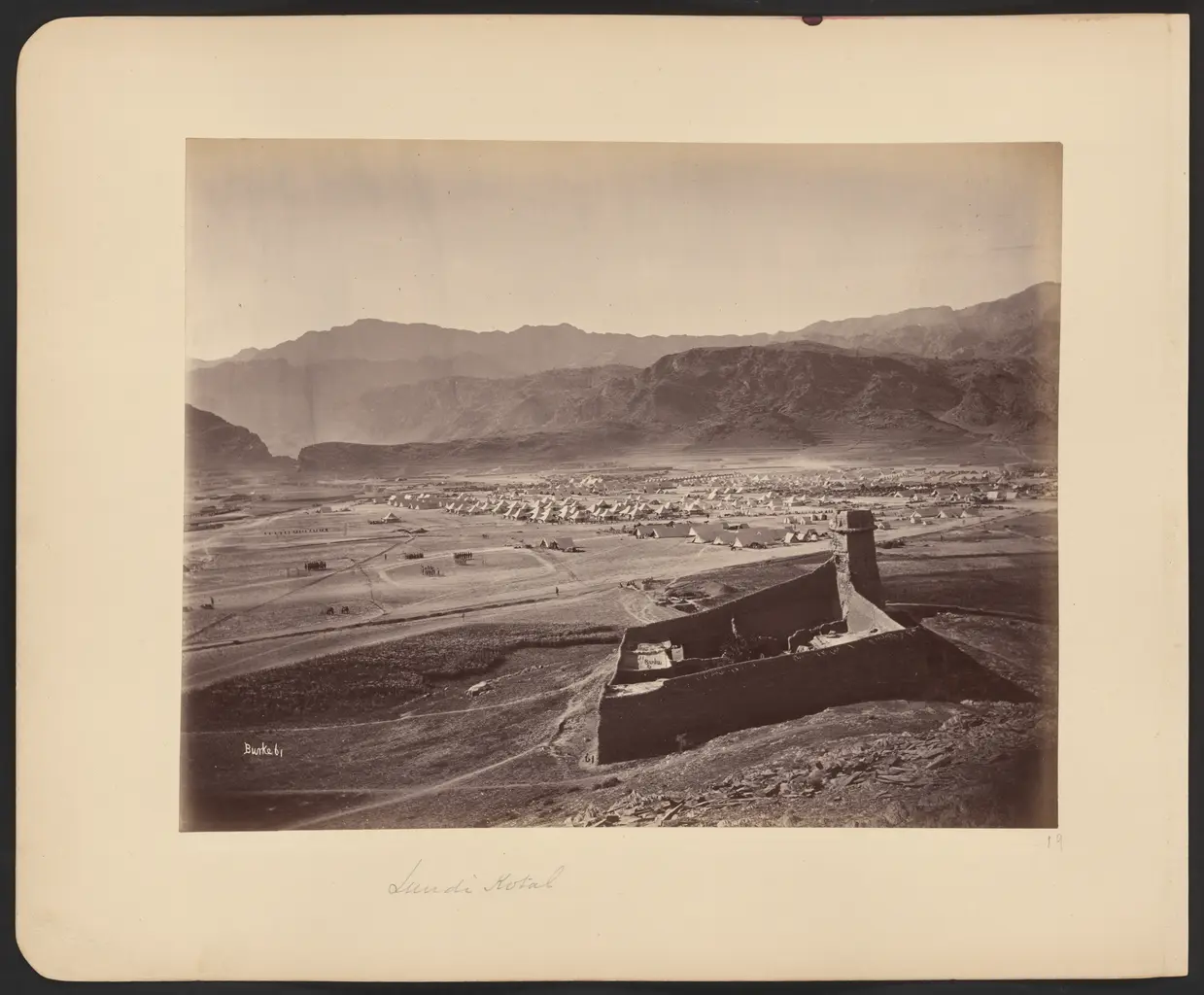
Landi Kotal, at the western end of the Khyber Pass, photographed by John Burke in 1878–80.
John Burke· Public domain
A profile in The Khyber (2013), whose author is not named, says his father was Malik Baz Mir Khan, chief of the Ashraf Khel clan of the Shinwari, and gives the birth as December 1907. [2] Caron gives the year only. [1] The same profile has him at school in Lwargai from six, then at Islamia Collegiate in Peshawar, leaving in the ninth class. [2]
His work before poetry came from the railway. Caron says he sold railway tickets in Peshawar. [1] The profile says he first served as passport officer in the British Indian Political Department and then as a ticket examiner on the railways. [2] The two do not match exactly, and both agree that the railway and its routes shaped him: Caron argues that a life on the new imperial lines mattered more to Hamza than the old pilgrim and trade paths. [1]
Bombay, Ajmer and a Sufi master
Caron places the turn of his life in his twenties. A keen student of theatre, Hamza ran away from home in 1928, took a train to Bombay and stayed with an Afridi trader while he looked for work in the young film industry. His brother was sent to bring him back, and on the way home the two visited the Chishti shrine at Ajmer Sharif. They joined a qawwali troupe, spent a period in wilderness meditation, and toured Chishti sites as far as Delhi before returning to Khyber. [1]
In 1930 Hamza took bay'ah, the pledge of discipleship, with Abd al-Sattar Shah, who encouraged him to compose in Pashto and not in the Urdu he had been using. [1] Sources give the master several names. Dawn calls him Syed Abdul Sattar Shah Baacha; Taqi says he was known in Peshawar as Badshah Jan, was the son of Syed Burhan Shah, had come from Hazara and lived inside the Dabgari Gate, and wrote verse of his own under the pen-name bay-nawa, "voiceless". [3, 5] Caron calls him Bacha Jan and describes a devotional poem of Hamza's, "Be-Khabara", that traces the Chishti line through Nizam al-Din Awliya to Mu'in al-Din Chishti. [1]
Dawn's reviewer dates his deep Sufi turn to a visit to the shrine of Khwaja Moinuddin Chishti in the late 1930s, after an early leftist leaning; Caron has him at Ajmer in 1928 and again in 1931. [1, 3] Hamza kept going to Delhi for years and took bay'ah from several teachers there, Caron says, and in time he leaned on Sufi texts more than on living teachers: Ibn Arabi and Khwaja Farid visited him in dreams. [1]
From Urdu to Pashto
Dawn says he began writing Urdu verse in the fifth class at school. Its reviewer thought him no first-rate Urdu poet, and that once he wrote in Pashto he "perfected" the Pashto ghazal, so that Pashtun critics gave him the title Baba-e-Ghazal. [3] Taqi has Badshah Jan order the change and a fellow disciple, the musician Rafiq Shinwari, set and sing the verse; Hamza "was not really happy with the marching orders but complied". [5] The Khyber profile says the title was given at a mushaira held by the Bazm-e-Adab, the Pashto literary society, under Sattar Shah's patronage in 1940. [2] That is the only source that dates the title, and it is a profile with no named author.
When Hamza began writing, Dawn says, only Rahman Baba's poetry was available to the Pashtun public. [3] Taqi, citing Professor Yar Muhammad Maghmoom's monograph on Hamza's ghazal and Pashtun mysticism, says Hamza named Mirza Khan Ansari and Rahman Baba as his poetic ancestors. Earlier Sufi poets such as Ansari and Kazim Khan Shaida carried heavy Persian influence, in Maghmoom's reading, while Hamza's images are rooted in Pashtun life and Pashtunwali. [5] Dawn's reviewer says he joined the chivalry of Khushal Khan Khattak, the humility of Rahman Baba and the romanticism of Hamid Baba in one verse. [3]
Taqi names three currents in the poetry: devotion to the ghazal itself, Pashtunwali and mysticism. He quotes a couplet that puts them together: "First be a good Pashtun and you shall become a good human being, And only when you become a good human being, will you become a Muslim." The English is Taqi's own translation. [5] Caron dates one of Hamza's best-known poems to 1954 and reads it as wistful as much as nationalist. Its line about Pashto, in Caron's translation, has outsiders calling Pashto "the language of Hell" while the poet says "it's to Heaven, with my Pashto, that I go." [1]
Caron sets the poetry against its time. He calls Hamza the master of the neoclassical ghazal, and says its formal neoclassicism and contemplative Sufism were a deliberate counterweight, in the radio and print of the day, to more radical Pashto politics, among them the followers of the Faqir of Ipi and the poetry of Ghani Khan. [1] Taqi draws a similar line between them. Ghani Khan and Ajmal Khattak wrote progressive verse, he says, while Hamza's is free of Marxist or other European influence. [5]
Radio, film and the stage
Radio Pakistan's anniversary note says that in 1935 he wrote the first Pashto drama, Zamindar, for All India Radio Peshawar. [4] Caron places his early radio dramas in Delhi, and says that by 1938 his poetry was in hot demand among the first qawwali singers on All-India Radio's Pashto broadcasts. [1] The stations are not the same in the two accounts, and neither names a script.
The film was made in Bombay. Radio Pakistan says he wrote the story, dialogues and lyrics for the first Pashto film, Laila Majnoon, released from Bombay in 1941, and that he also directed and sang playback. [4] Dawn says he was paid Rs 250 for it. [3] Dawn also credits him with 250 plays for Radio Peshawar, while the Khyber profile gives about 200, and the profile names a list of titles it says were lost or misplaced at the radio. [2, 3] The counts are the writers' estimates, and no source here lists the scripts.
Prose, translations and the columns
Dawn's reviewer says he wrote about 35 books in Urdu and Pashto. The Khyber profile says about 30 including ten in Urdu. [2, 3] Radio Pakistan calls Tajalliyat-e-Mohammadiya a seminal work in Pashto Sufi literature. [4] Taqi names a book of verse titled Baheer. [5] Dawn adds that his poem "Junghara" ("The Hut") is among his most popular and has a chapter to itself in Haroon Shinwari's English book An Introduction to Hamza Baba. [3] Caron says Hamza published his first anthology, of Sufi poetry, in the 1950s. [1]
As a translator he rendered Rahman Baba into Urdu: Radio Pakistan counts 204 ghazals, while the Rahman Baba article on this site, from a different source, speaks of the whole Diwan in 1963. [4] He put Iqbal's Javid Nama and Armughan-e-Hijaz into Pashto, which the Khyber profile dates to 1967 and 1964 respectively, and Radio Pakistan adds Nahj al-Balagha. [2, 4]
He also edited the Pashto page of the English-language Khyber Mail and wrote a daily column there titled Zhor Fikrona, "Deep Thoughts", on social and literary subjects. [4]
The literary societies
Caron says Hamza and Sattar Shah were the first to bring both the qawwali and the Urdu-style mushaira to the tribal areas, and that their first mushaira honoured Rahman Baba. [1] The Khyber profile says he founded the Bazm-e-Adab in 1937 and was its president until 1950, when it became the Olasi Adabi Jirga. [2] Caron's version differs: in the early 1950s the progressive writers around Kakaji Sanobar Husain, cut off from the movements the new state had broken up, invited Hamza, whose reputation seemed harmless, to be founding president of the Ulasi Adabi Jirga. [1] Dawn agrees that the Jirga gave Pashto writing a new direction. [3] In Caron's reading it gave Hamza a circle of face-to-face literary events, and the memoir of Ajmal Khattak shows, he says, that those gatherings stood in for political activity at a time when open organisation was impossible. [1]
Caron also says Hamza and his colleague Maulana Abdul Qadir, who founded the government-sponsored Pashto Academy in 1955, led a government-backed effort of the 1950s to fill the cultural gap left by the crackdown on the Khudai Khidmatgar movement (see Bacha Khan). He ties it to the rise of what Saadia Toor calls the "Establishment writer". [1]
Honours, death and the grave
Radio Pakistan says the government of Pakistan gave him the President's Award for Pride of Performance and the Sitara-i-Imtiaz. [4] The Khyber profile calls the Pride of Performance posthumous and also says Zia-ul-Haq gave it in his lifetime, so the year is not settled here. [2]
He died on 18 February 1994. [2, 4] The profile says a long kidney illness had taken him to Hyderabad for an operation in 1986, that he was first buried in the Ashraf Khel graveyard at Lwargai, and that about two and a half years later his remains were exhumed and reburied at Darwazgai graveyard, where the Khyber Pakhtunkhwa government began work on a memorial complex. [2] Radio Pakistan says thousands gather at his shrine each year. [4] On the 27th anniversary, in 2021, a literary gathering and mushaira were held at the Hamza Baba Complex in Landi Kotal, with poets from Khyber Pakhtunkhwa and Afghanistan. [6]
In 2011 Taqi reported the fourth militant attack on the shrine in two years, which failed when the caretaker and Khasadar militiamen refused to leave. [5]
His place in Pashto letters
Dawn's reviewer says he influenced almost three generations of Pashtun poets and writers. [3] Taqi ranks his verse with the Persian Sufi poets, and says that putting a native mystical outlook into chaste Pashto had perhaps not been attempted before him. [5] Caron treats him as a poet whose Sufism, Pashtunwali and Pashto itself drew on older networks of the borderland that colonial frontiers had cut, and calls the poem of 1954 a hope of rebuilding that community through small, intimate circles. [1] The wider history of the language is in Pashto literature and oral poetry, and the setting of his tradition in religion among Pashtuns.
Timeline
1907
Hamza Baba born at Lwargai
Is born at Lwargai beside Landi Kotal, in the Shinwari country at the western end of the Khyber Pass.
1928
Hamza runs away to Bombay
Leaves home for Bombay to look for work in films, and on the way back visits the Chishti shrine at Ajmer Sharif with his brother.
1930
Takes bay'ah with Abd al-Sattar Shah
Takes the pledge of discipleship with his Chishti master, who tells him to write in Pashto and not Urdu.
1941
Laila Majnoon released
Writes the story, dialogue and songs of the first Pashto film, released from Bombay.
18 February 1994
Hamza Baba dies
Dies and is buried at Lwargai; about two and a half years later his remains are moved to Darwazgai graveyard, now a memorial complex at Landi Kotal.
Common questions
Why is Hamza Shinwari called Baba-e-Ghazal?
Baba-e-Ghazal means "father of the ghazal". Dawn's reviewer says Pashtun critics gave him the title because he perfected the Pashto ghazal once he began writing in Pashto, and Radio Pakistan says he is believed to have introduced the ghazal into Pashto poetry. One profile says the title was conferred at a mushaira in 1940.
Who was Hamza Shinwari's spiritual master?
He was a disciple of Syed Abdul Sattar Shah, a Chishti, known in Peshawar as Badshah Jan or Bacha Jan. James Caron dates Hamza's pledge to him to 1930, and says Sattar Shah encouraged him to write in Pashto instead of Urdu.
Did Hamza Shinwari write for the first Pashto film?
Radio Pakistan says he wrote the story, dialogues and lyrics for Laila Majnoon, the first Pashto film, released from Bombay in 1941. Dawn says he was paid Rs 250 for his work.
When did Hamza Shinwari die and where is he buried?
He died on 18 February 1994. He lies at Landi Kotal in the Khyber; one profile says he was first buried at Lwargai and, about two and a half years later, reburied at Darwazgai graveyard.
Pictures (2)
Gallery
2 images
The fortress of Ali Masjid and the Khyber Pass, a lithograph by James Rattray, 1848.
Azad Khan, a Shinwari malik, drawn by William Simpson in 1878 during the Second Anglo-Afghan War.
Sources
Modern scholarship
Books and papers by historians, anthropologists, linguists and geneticists.
- Back to textJames Caron, "The Lives of Amir Hamza Shinwari", Tanqeed, issue 10 (February 2016)
Birth at Lwargai, 1928 flight to Bombay, Ajmer, bay'ah to Sattar Shah in 1930, radio, the Ulasi Adabi Jirga, Pashto Academy, and the translated line quoted from the 1954 poem.
Reference works
Encyclopaedias, country studies and museum records.
- Back to text"Profile: Ameer Hamza Shinwari", theKhyber, March 2013 (author not named)
Family, early jobs, the 1940 mushaira title, Bazm-e-Adab, play counts, the list of books, the Iqbal translations with dates, death and the reburial. Used with attribution; it is internally inconsistent in places.
News and magazines
Newspapers, broadcasters and magazines, for recent events and life today.
- Back to textReview of Haroon Shinwari, An Introduction to Hamza Baba, "Poetry: Celebrating the father of Pashto ghazal", Dawn (Books and Authors), 6 March 2011
Urdu start, Sufi master, the title Baba-e-Ghazal, Laila Majnoon and its fee, plays for radio, the Jirga, 35 books and influence on later poets.
- Back to textRadio Pakistan, "Death anniversary of Pashto poet Amir Hamza Shinwari observed", 18 February 2024
Zamindar (1935), Laila Majnoon (1941), translations, Khyber Mail column, honours, death date and the annual gathering at his grave.
- Back to textMohammad Taqi, "Baheer: three currents of Hamza Shinwari's poetry", Daily Times, 27 July 2011
His master Badshah Jan, the order to write in Pashto, the three currents of his verse, comparison with Persian-influenced predecessors, the translated couplet and the attack on the shrine.
- Back to text"Death anniversary of Pashto poet Amir Hamza Shinwari observed", The Nation, 19 February 2021
The 27th anniversary gathering at the Hamza Baba Complex, Landi Kotal.
Related articles
- Ghani Khan (Abdul Ghani Khan): Pashto poet, painter and son of Bacha Khan
- Karahi and tikka: the grill and the pan of Peshawar
- Khatir Afridi (Misri Khan): Pashto ghazal poet of the Khyber, 1929–1968
- Loanwords in Pashto: Persian, Arabic, Indic and English
- Pashto cinema and drama: from Laila Majnoon to Pollywood
- Pashto literature and oral poetry: from the Roshani writers to the landay
- Pashto radio, television and press: from Pakhtun and Anis to Mashaal and Lemar
- Qalandar Momand: Pashto poet, critic and lexicographer of Peshawar
- Rahman Baba: the Pashto Sufi poet
- Rahman Baba's mazar at Hazarkhwani, Peshawar: the shrine and its urs
- Rahmat Shah Sayel (Sail): Pashto poet of Dargai and Peshawar
- Religion among Pashtuns: Islam, Sufism and the Roshaniyya
- Spin Ghar (Safed Koh): the White Mountain on the Afghan-Pakistani border
- The Khyber Pass: landscape and connections
- The Pashto ghazal: from the Roshani poets to Hamza Baba
Improve this article
- Suggest an edit
Know something we missed, or a better way to put it? Suggest a change; an editor reads it before it appears.
- Report an error
Think a fact, date or name is wrong? Tell us which and why, with a source if you have one.
- Add a source
Have a book, paper or document that backs up a claim? Add it.
- Translate into Pashto
Read both Pashto and English? Help put this article into Pashto.
Noticed a mistake or a missing source? Here's how we correct things


