At a glance
A ghazal (غزل) is a poem of linked couplets that all end on one rhyme, usually about love, human or divine. It came into Pashto from Persian models. [3]
The first large body of Pashto ghazals was written by the Roshani poets of the late sixteenth and early seventeenth centuries. [3]
The poets most Pashtuns name first are Khushal Khan Khattak, Rahman Baba and Hamid Baba. [6]
The poet usually gives his own name in the last couplet. [2, 3]
Ghazals are sung. Raverty wrote in 1862 that many odes of Rahman and Hamid were sung "all over Afghanistan". [2]
In the twentieth century Hamza Shinwari was called Baba-e-ghazal, "father of the ghazal". [5, 8]
What a ghazal is
The ghazal began in Arabic and Persian poetry. The Uzbek scholar Abdurahim Mannonov, summarising the classical rules, describes a monorhyme poem, most often of seven to twelve couplets (bayt), in which both halves of the first couplet rhyme and the poet's pen name (takhallus) comes in the last. A refrain word after the rhyme (radif) is common. [3] Its first subject is love, but Mannonov, citing A. M. Mirzoev, adds that it can carry ethics, philosophy, Sufism, teaching and social protest. [3]
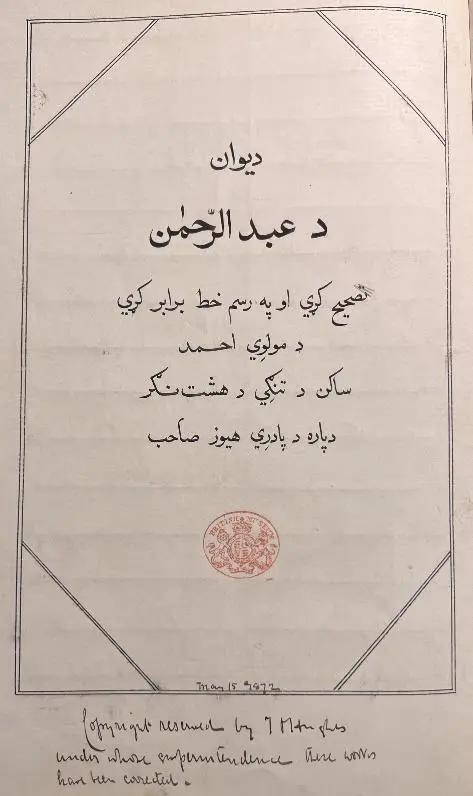
Title page of a Diwan of Rahman Baba (British Library Or 2830), scribed by the Peshawar calligrapher Ghulam Jilani and dated 4 May 1873.
Scribed by Ghulam Jilani (British Library, Or 2830)· Public domain
The collections follow the same plan. H. G. Raverty, a British officer who gathered and translated Pashto poetry in the 1850s and 1860s, wrote that a diwan is a set of odes ending with each letter of the alphabet in turn, and that most Pashto poetry was arranged this way. [1]
Take the three poets Raverty put side by side. Each closes his ghazal by naming himself. Rahman's first ode ends "O Rahman! He is neither liable to change, nor to mutation." Hamid's first ends "O Hamid!" Ashraf Khan Khattak, who wrote as Hijri, ends with the lines "The Severed had never beheld Bijapur, even in his dreams; but, at last, that presents itself, which his destiny decreed." [2] The pen name here is a word, "the Severed" or "the Exiled" in Raverty's rendering, chosen to say something about the writer. [2]
How it came into Pashto
Mannonov, writing in 2024, says the Roshani poets were the first to use the Persian-derived forms widely in Pashto: the ghazal, the qasida and the rubai. He names Bayazid Ansari (Pir Roshan, 1521 to 1572), Mulla Arzani, Mirza Khan Ansari and Daulat Lawanai. [3] Mannonov explains the ghazal's place among them by its fame among the people, its manageable length and its flexibility for Sufi and religious teaching. [3] He argues that these poets did more than put Pashto words into Persian moulds. They knew Persian well, and they knew Pashto oral verse, whose short rhymed lines he finds close to the ghazal and quatrain. [3] In his count Roshani ghazals ran longer than the Persian norm, nine to thirteen couplets and sometimes sixteen, eighteen or twenty-five, perhaps, he suggests, because Sufi argument did not fit the usual length. [3]
Mannonov also notes that the ghazal reached Pashto later than it reached other languages of the region, and that its early history in Pashto is not fully studied. [3] He points to a few ghazals that Muhammad Hotak preserved in his anthology of Pashto poets, attributed to poets of the fifteenth and sixteenth centuries, and to one poet dated to 1378 on the strength of a source Mannonov says he does not know. [3] These early dates are his reading of what other Afghan scholars have printed. They are not settled.
Another route is argued by Sher Alam Shinwari in Dawn in 2012. He writes that many forms, among them the ghazal, qasida and rubai, reached Pashto through Urdu rather than direct from Persian. [7]
Khushal Khan Khattak
Khushal Khan Khattak was born in 1613 (1022 AH in Raverty's reckoning) and became chief of the Khattak in 1640. [2] Raverty found that he had written in both Pashto and Persian, on poetry, medicine, ethics, law, falconry and his own life, and listed among his works a diwan, a kuliyat ("an immense number of poems and odes") and a book of quatrains, the rubaiyat. [1, 2] Mahmood Ali Ayub, writing in Dawn in 2025, adds that all his works except the Dastarnama were in verse, and that he served the Mughals, fought them, and spent about five years in prison at Ranthambore. [6] Raverty puts the prison at Gwalior, about seven years, and says many of the poems were written there. [2]
Raverty found in the odes Khushal wrote in exile "a spirit of patriotism and love of home and country". His translation of a verse from the Gwalior years gives the tone: "Cheer up then heart! I have by me, a healing balm for every throe; that Khushhal Khan's an Afghan true, Aurangzeb's mortal foe." [1] Khushal also wrote about Pashto verse itself. The Afghan editor Abdul Shakoor Rashad quotes a qasida from Khushal's Kulliyat (page 607), dated 1095 AH, in which the poet says of his own Pashto poetry: [4]
نه بې وزن، نه تقطیع، نه بې عروض ؤ
na be wazn, na taqṭīʿ, na be ʿarūẓ wu
It was not without metre, not without scansion, not without aruz.
Rashad cites the lines in his discussion of the Persian metres (aruz) in Pashto, and the next line of the qasida names the khafif metre. [4]
Rahman Baba and Hamid Baba
Abdul Rahman Mohmand, Rahman Baba, is the poet whose diwan Pashtuns know best. Raverty called him "one of the most popular, and probably the best known, of all the Afghan poets", a man who lived as a dervish at Hazarkhwani near Peshawar, and who wrote of divine love "with a fiery energy" and "natural simplicity". [2] Raverty also describes how the book took shape: Rahman gave copies of his poems to friends, who collected them, and after his death some friends added poems of their own with his name forged in the last couplet. Two collections existed, and the friends who knew his work kept only what was his. Raverty compared some sixty copies and found many differ, with a couplet more or less here and there, and some ghazals missing from some. [2] This is why editions of Rahman do not always agree.
Ayub says Rahman's verses were made for singing and hearing, in the hujra where poets, musicians and listeners met. He adds that Rahman's poetry is studded with verses on temporal love, on dark tresses, rosy lips and cups brimming with wine. [6] Rahman's second ode in Raverty's selection begins with weeping for the beloved who takes no notice, and ends: "I, Rahman, desire naught else than the beloved of my heart." [2] Ayub quotes a couplet in which Rahman seems to turn on pious show: "I washed my hands of piety when the musicians picked up the rabab." [6]
Raverty writes that Rahman and Khushal were not contemporaries in the sense of meeting. He judged the tale of poetic disputes between them untrue and put Rahman among the generation of Afzal Khan, Khushal's grandson. [2] Ayub also says the three great poets of this period did not seem to have been in touch, and that Pashto then had no mushaira, the poetry rally. [6]
Abdul Hamid Mohmand, Hamid Baba, of Mashokhel, is called by Raverty "the cynical poet of the Afghans", the "Shaykh Sa'di of the Pushto language", and by the Persians "Hamid the Hair-splitter". [2] Raverty gave his death as about 1732, from what the villagers of Mashokhel told him, and recorded an old village memory that Rahman heard Hamid's odes and blessed the younger poet. [2] That is a story told by an elderly man to Raverty, not a document. His odes are collected as Durr-o-Marjan, "Pearls and Corals". [1, 2] His first ode opens with a rebuke: "O thou, for ever, with the cares of the flesh, distracted!" [2] Ayub credits him with bringing colour and passion into Pashto poetry. [6]
The Khattak family
Khushal's children carried the form on. Raverty lists Ashraf Khan Hijri, Abdul Qadir, Sadr Khan, Sikandar Khan and Gohar Khan as poets, as poets. [1] Ashraf Khan, born in 1044 AH, became chief in 1093 AH and was taken to Bijapur, where he died in 1105 AH (1693). [2] In prison he arranged his own diwan, which Raverty found in his descendants' hands. Raverty says the Afghans thought Ashraf's poems hard, "without reason apparently". [2] His ode in Raverty's translation opens: "The promise of the kiss, the beloved ever putteth off for to-morrow." [2] The same ode warns the nightingale never to look at the rose, because separation will make its wounds worse. [2]
Abdul Qadir Khan Khattak wrote a diwan and also put Persian classics into Pashto: Jami's Yusuf and Zulaikha, and Sa'di's Gulistan and Bostan. [1] Kazim Khan Shaida, a great-grandson of Khushal, wrote odes that Raverty found "approach nearer than any others to the polish of the poetry of the Persians". [1]
Metre and rhyme
Mannonov finds in the Roshani ghazals six modifications of rhyme. The most common is the ordinary ghazal, rhyming aa, ba, ca and so on. Others repeat the rhyme inside the line, and he compares these to the short-line songs of Pashtun folk verse. [3] The refrain word is a mark of the Roshanis. He says it matters most in the poems of Mirza Khan and Daulat. [3]
On metre, Rashad prints in the introduction to Daulat Lawanai's diwan (Kabul, 1974) a line in which Daulat himself names the pattern, faʿilātun mafāʿilun faʿilāt, and treats his ghazals as aruz poems. [4] Rashad's title for his introduction speaks of aruz poems "three and a half centuries" old. [4]
For Hamza, Mohammad Taqi notes that he used a short metre common in Persian verse without it sounding like a transplant. [9]
Hamza Shinwari and the modern ghazal
James Caron, an American scholar of the region, gives the most detail on Amir Hamza Shinwari. Hamza was born in 1907 at Lwargai in the Khyber, wrote at first in Urdu, and in 1930 became a disciple of the Chishti teacher Sattar Shah, who urged him to write in Pashto. [5] By 1938 qawwali singers on All India Radio's Pashto broadcast were asking for his poems. [5] Caron writes that Sattar Shah and Hamza brought both qawwali and the Urdu-style mushaira to the Tribal Areas, and that the first such gathering honoured Rahman. [5] He calls Hamza a master of the "neoclassical Pashto ghazal" and also a leading voice of Pashtun nationalism. [5]
A review in Dawn of Haroon Shinwari's book on Hamza says that when he began writing Pashto verse only Rahman's was available to the Pashtun public, and that critics gave him the title Baba-e-Pashto ghazal. [8] The reviewer says he joined Khushal's fighting spirit, Rahman's humility and Hamid's refined romance. [8] Taqi writes that Professor Yar Muhammad Maghmoom, in a monograph on Hamza's ghazal, found heavy Persian influence in Mirza Khan Ansari and Shaida and thought Hamza's images and devices rooted in Pashtun life. [9] Taqi gives these lines, in his own translation: [9]
Ta ka kha Pashtun shuay no insan ba shay,
Biya ka kha insaan shuay, Musalman ba shay.
First be a good Pashtun and you shall become a good human being, and only when you become a good human being will you become a good Muslim.
The Ulasi Adabi Jirga, which Hamza was invited to lead as its first president, gave Pashto writers a circle in the early 1950s. [5] Caron names Ghani Khan as "the other towering figure in modern Pashto poetry", whose verse took aim at tradition, state and organised religion, a sharp contrast with Hamza's quiet Sufi school. [5] Taqi likewise sets Hamza apart from the progressive poetry of Ghani Khan and Ajmal Khattak. [9]
Where the ghazal sits among Pashto forms
The ghazal is a written, signed form. The landay is an oral two-line verse that nobody signs. Both are found in Pashto, and Mannonov notes that Pashtun oral verse already had short rhymed forms close to the ghazal before the Persian one arrived. [3] For the wider story see Pashto literature and oral poetry and Pashto religious literature.
عام پوښتنې
What is a Pashto ghazal?
It is a poem of linked couplets sharing one rhyme, usually on love, human or divine, and often ending with the poet's own name. Mannonov describes the classical form as a monorhyme poem of about seven to twelve couplets, which the Roshani poets took into Pashto from Persian.
Who wrote the first Pashto ghazals?
The Roshani poets, among them Mulla Arzani, Mirza Khan Ansari and Daulat Lawanai, wrote the first large body of ghazals in Pashto about 1600, according to Mannonov. He notes that a few earlier ghazals are attributed to poets of the fourteenth to sixteenth centuries, but the dating of those is not settled.
Who are the great Pashto ghazal poets?
Khushal Khan Khattak, Rahman Baba and Hamid Baba are the best known of the classical poets, with the Khattak family poets Ashraf Khan Hijri and Abdul Qadir. In the twentieth century Hamza Shinwari was called Baba-e-ghazal.
Are Pashto ghazals sung?
Yes. Raverty wrote in 1862 that many odes of Rahman and Hamid were sung all over Afghanistan, and Mahmood Ali Ayub says Rahman's verses were made to be sung and heard in the hujra. Hamza's ghazals were taken up by qawwali singers on All India Radio from 1938.
سرچینې
استعماري اسناد
د انګرېزي افسرانو او سیلانیانو ګزیټیرونه، فرهنګونه او راپورونه، 1815–1947. دوی قبیلې هغسې بیانوي لکه لیکوالو چې ولیدې، او د استعماري حکومت د اړتیا لپاره.
- بیرته متن تهH. G. Raverty, A Grammar of the Pukhto, Pushto, or Language of the Afghans, 3rd ed. (London: Williams and Norgate, 1867), Introduction pp. 26-31
Diwan arrangement, Khushal's works and verse from Gwalior, the Khattak poets, Persian translations by Abdul Qadir, Shaida, Hamid's Durr-o-Marjan.
- بیرته متن تهH. G. Raverty, Selections from the Poetry of the Afghans, from the Sixteenth to the Nineteenth Century (London: Williams and Norgate, 1862), pp. xxxi-xxxii, 1-7 (Abd-ur-Rahman), 85-88 (Abd-ul-Hamid), 142-148 (Khushhal), 249-252 (Ashraf Khan)
Notices of the poets and the first odes of Rahman, Hamid and Ashraf in Raverty's English; how Rahman's diwan was gathered; Khushal's captivity.
نوې څېړنې
د تاریخپوهانو، انسانپوهانو، ژبپوهانو او جنېټیک پوهانو کتابونه او مقالې.
- بیرته متن تهAbdurahim M. Mannonov, "Analysis of the Genre System in Afghan Poetry from the Sixteenth to Seventeenth Centuries", Proceedings of the 2nd Pamir Transboundary Conference (SCITEPRESS, 2024), pp. 1040-1043
The classical ghazal form, the Roshani poets' adoption of it from Persian, couplet counts, rhyme types, radif, themes, early Pashto ghazals.
- بیرته متن تهAbdul Shakoor Rashad (ed.), Da Dawlat Lawani Divan (Kabul, 1974), introduction pp. 27-28 (aruz in Pashto)
Khushal's 1095 AH lines on metre (Kulliyat p. 607) and Daulat's line naming his metre. Read from page images.
- بیرته متن تهJames Caron, "The Lives of Amir Hamza Shinwari", Tanqeed, issue 10 (February 2016)
Hamza's life, move from Urdu to Pashto, radio and qawwali, mushaira, Ulasi Adabi Jirga, Ghani Khan.
خبرونه او مجلې
ورځپاڼې، خپرونې او مجلې، د وروستیو پېښو او نن ورځې ژوند لپاره.
- بیرته متن تهMahmood Ali Ayub, "Essay: Three giants of Pashto poetry", Dawn, 6 July 2025
Khushal, Rahman and Hamid compared; ghazals made for singing in the hujra; no mushaira in their day; Rahman couplet.
- بیرته متن تهSher Alam Shinwari, "Urdu another attraction for Pashto writers", Dawn, 12 May 2012
The claim that ghazal, qasida and rubai reached Pashto via Urdu.
- بیرته متن ته"Poetry: Celebrating the father of Pashto ghazal" (review of Haroon Shinwari, An Introduction to Hamza Baba), Dawn, 6 March 2011
Baba-e-ghazal title, Hamza's debt to earlier poets.
- بیرته متن تهMohammad Taqi, "Baheer: three currents of Hamza Shinwari's poetry", Daily Times, 27 July 2011
Maghmoom's view of Persian influence, Hamza's short metre, the couplet quoted.
اړوندې لیکنې
- Abdul Qadir Khan Khattak: poet, soldier and translator, son of Khushal
- Arzani Khweshki: Roshani poet and disciple of Pir Roshan
- Ashraf Khan Hijri: Khattak chief and poet of exile at Bijapur
- Daulat Lawanai: Roshani poet of the seventeenth century
- Ghani Khan (Abdul Ghani Khan): Pashto poet, painter and son of Bacha Khan
- Hamid Baba (Abdul Hamid Mohmand): the Pashto poet of Mashokhel
- Hamza Shinwari (Hamza Baba): Baba-e-Ghazal of the Khyber, 1907–1994
- Kazim Khan Shaida: the Khattak poet of Rampur
- Khatir Afridi (Misri Khan): Pashto ghazal poet of the Khyber, 1929–1968
- Khushal Khan Khattak: poet and chief
- Mirza Khan Ansari: Roshani poet of Pir Roshan's family
- Pashto literature and oral poetry: from the Roshani writers to the landay
- Pir Roshan (Bayazid Ansari): founder of the Roshaniyya and author of the Khair al-Bayan
- Rahman Baba: the Pashto Sufi poet
- The landay: Pashto two-line folk verse (tappa, misra)
دا لیکنه ښه کړئ
- د سمون وړاندیز
کومه خبره مو پاتې ګڼله یا ښه ډول مو لرله؟ بدلون وړاندیز کړئ؛ مدیر یې له خپرېدو مخکې لولي.
- د تېروتنې خبر راکړئ
فکر کوئ کومه خبره، نېټه یا نوم ناسم دی؟ راته ووایاست کوم یو او ولې، که سرچینه لرئ هم ورسره ولېږئ.
- سرچینه ورزیاته کړئ
کومه کتاب، مقاله یا سند لرئ چې یو ادعا ثابتوي؟ یې زیات کړئ.
- پښتو ته ژباړه
پښتو او انګلیسي دواړه لوستلی شئ؟ د دې لیکنې په ژباړه کې مرسته وکړئ.
کومه تېروتنه یا ورکه سرچینه مو لیدلې؟ موږ تېروتنې څنګه سمې کوو


