At a glance
The first Pashto dictionaries were glossaries explained in Persian: the Riyaz al-Mahabbat of Nawab Mohabbat Khan (1806) and the Ajaib al-Lughat of Allah Yar Khan (1809), both sons of the Rohilla leader Hafiz Rahmat Khan. [1]
Bernhard Dorn of St Petersburg built his Pashto-English glossary of 1847 on Mohabbat Khan's vocabulary. Henry Raverty's dictionary of 1860 used both Persian works and then checked them with Pashto speakers. Henry Bellew's followed. [3–5]
Pashtuns began to print their own: Mohammad Gul Momand's Pashto Sind at Kabul in 1938 and the Pashto Tolana's two-volume Pashto Qamus in 1952-1955, both Pashto into Dari. [2, 8]
Peshawar's Pashto Academy, founded in 1955, took more than sixty years to publish its dictionary of Pashto in Pashto. Qalandar Momand's Daryab (1994) had already explained Pashto words in Pashto. [6, 7]
Martiros Aslanov's Pashto-Russian dictionary came out at Moscow in 1966. [2, 9]
Glossaries in Persian
Abrar Khattak, writing in the Lahore journal Bunyad in 2025, dates the start of Pashto dictionary-making to word lists made in Russia: Johann Anton Güldenstädt (1745-1781) took down Pashto words among those of many languages, and they were printed at St Petersburg in 1787. [1] Pashto-speaking compilers followed. Khattak names the Riyaz al-Mahabbat ("Gardens of Friendship", رياض المحبت), compiled by Nawab Mohabbat Khan (1750-1809) in 1221 AH, which is 1806, in two parts, a grammar and a vocabulary, with Persian as the language of explanation. [1] A second work, the Ajaib al-Lughat ("Wonders of Language"), was compiled in 1809 by his brother Nawab Allah Yar Khan. Khattak says both men were sons of Hafiz Rahmat Khan, the Rohilla leader, and that neither book was printed. [1] Their world is told in the Rohillas of Rohilkhand.

Cover of the third volume of the Pashto-Pashto Tashrihi Qamus (explanatory dictionary), Afghanistan Academy of Sciences.
Afghanistan Academy of Sciences (Commons upload via qamosona.com)· CC0
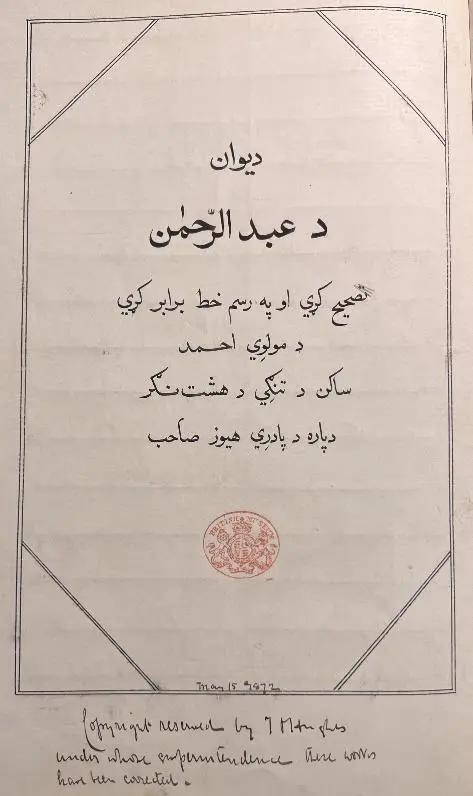
Raverty, a British officer writing in 1860, calls Allah Yar Khan a Nawab "of the Barech tribe" and Mohabbat Khan a Nawab and Hafiz, and says both works were "explained in Persian". [3] Bernhard Dorn, who knew Mohabbat Khan's book from two copies in the East India House library in London, understood that Mohabbat Khan "composed it by order of the Company", wrote that it did not give so full an account of Pashto as might have been expected from a native author, but was very serviceable for understanding the difficult formation of the Pashto verbs. [4]
Dorn at St Petersburg, 1847
Dorn printed his Chrestomathy of the Pushtu or Afghan Language, with a glossary "in Afghan and English", for the Imperial Academy of Sciences in 1847. [4] The glossary rests on Mohabbat Khan. Dorn wrote that its groundwork was the vocabulary "furnished by Muhabbat Khan" and that he left out none of its words, except tribe and place names that did not occur in his texts. To it he added words from Mountstuart Elphinstone's list and from Klaproth, Eversmann and Leach, and words he worked out himself from the Persian and Hindustani dictionaries. Where a word has vowel marks in his glossary, he wrote, Mohabbat Khan supplied them. [4] He chose English for the explanations because he expected Pashto to be studied in Britain and India. [4] The texts include poems of Rahman Baba, whose Pashto is described in Pashto literature and oral poetry. [4]
Abdul Hakim Hilali, a Kabul linguist whose book on dictionary-making compares the major Pashto dictionaries, names Dorn as the founder of Pashto lexicography in the scholarly sense and judges his dictionary better in method than most that came after it. [2] Khattak adds that it was printed again at Kabul, with a foreword by Muhammad Siddiq Rohi translated into Pashto, and that Afghan dictionaries made later followed its practice. [1]
Raverty and Bellew
Raverty's Dictionary of the Pukhto, Pushto; or, Language of the Afghans appeared in London in 1860. [3] In its introduction he lists his sources. The dictionary holds, he wrote, the result of twelve years of his own research and "the whole of the words" in the two Persian-explained works, tested wherever there was doubt against what Afghans told him, east and west. He thanks a Ghilzai molawi from near Qalat-i-Ghilzai, whose father had been qazi of Kandahar, and an old Muhammadzai akhundzada from the Peshawar district who had lived among the Bajaur, Swat and Buner tribes. [3] He gave the Eastern and Western pronunciation of the four letters that differ between the two, and for each noun its plural and its declension, and for each verb its main forms. [3]
The preface is also an argument addressed to the British government. Raverty wrote that Pashto should be learned by every officer serving beyond the Indus, and noted that the Russians already taught it at St Petersburg. [3] That was his motive and his reader. The Pashto in the book is Pashtun speech and Pashtun poetry. Khattak says a second edition came out at Calcutta in 1867 and a third in Pakistan in 1980. [1]
Bellew, an assistant surgeon in the Bengal Army, published his Dictionary of the Pukkhto or Pukshto Language with Pukkhto-English and English-Pukkhto parts; a second edition was printed at Lahore in 1901. [1, 5] His title promises that "the words are traced to their sources in the Indian and Persian languages". He left out Arabic and Persian words used unchanged by Pashtun authors, except common ones. He thanks Raverty's dictionary and says they differ over the meaning of several words. [5] Both men put the meaning in English, so neither could be read by a Pashto speaker who wanted to know what a Pashto word meant in Pashto. Qalandar Momand's preface, quoted below, says exactly that. [7]
A later English work on idiom, George Gilbertson's Pakkhto Idiom: A Dictionary (1932), is described by the Peshawar reviewer Sher Alam Shinwari as fragmentary and unscientific. [12]
Kabul: the Pashto Tolana
Pashtun dictionaries in Afghanistan begin after the royal decree of 1936 made Pashto an official language, which standard Pashto describes. Hilali counts as his second period the dictionaries made in Afghanistan and Pashtunistan from 1938. [2] The first, he says, was Pashto Sind (پښتو سیند, "Pashto Sind"), a Pashto-Dari dictionary by Mohammad Gul Momand, of about seven thousand words in two volumes. It was the first Pashto dictionary printed in Afghanistan. Hilali praises its explanations, which use living examples, and says its failings come from being first. [2]
The Pashto Tolana (پښتو ټولنه), the Pashto Society of Kabul, printed the larger work. Its Pashto Qamus (پښتو قاموس), a Pashto-Dari dictionary in two volumes, came out at Kabul between 1952 and 1955 in Hilali's account, and is dated 1951-1954 in the Glottolog catalogue. [2, 8] Hilali judges it better in size and quality than every dictionary printed before it. [2] From 1957 the Tolana also began to print the Afghan Qamus of Abdullah Afghan-Navis. [2] The Tolana and its successor are the subject of the Pashto academies.
The Afghan Academy of Sciences later published a Pashto-Pashto explanatory dictionary, Pashto-Pashto Tashrihi Qamus, in several volumes. The cover of the third volume names the Academy's scientific and research centre for languages and literature, Pashto department. [11]
Aslanov in Moscow
Russian scholars studied Pashto from Güldenstädt's time, and in the Soviet period Moscow produced Pashto dictionaries too. The best known is Martiros Aslanov's Afghan-Russian Dictionary (Pushtu), edited by K. A. Dvoriankova, Moscow, 1966. [9] A Russian-Pashto dictionary by K. A. Lebedev and others followed in 1973. [9] Hilali, who sets Aslanov beside the Tolana's Pashto Qamus, praises it more than any other Pashto dictionary for the way it shows the grammar of each word, and for marking homonyms with numbers so that unrelated words with the same spelling are not run together. [2] His criticism is that Aslanov writes the sounds of ږ and ښ in different dialects as separate letters in separate entries, against the spelling Pashto writers agreed. [2] Aslanov also printed a transcription of his own for each headword. [2]
Peshawar: the Academy and Daryab
In Pakistan the work was slower. Maulana Abdul Qadir's Pashto Academy at Peshawar University, founded in 1955, planned a dictionary from the start. The Academy's own account, in the preface to its 2018 dictionary by its director, Nasrullah Jan Wazir, says the first idea was a three-language Pashto, Urdu and English dictionary, which proved too hard: in the early years the staff managed only seventy or eighty pages. [6] Under Maulana Abdul Qadir the research officer Syed Anwar-ul-Haq gathered words, mostly for the letters alif and be. Under a later director, Syed Rasul Rasa, the plan changed to a dictionary of Pashto in Pashto, and the first volume was printed as Pashto Zhaba (پښتو ژبه, "The Pashto Language"). [6]
The staff, the preface says, went to villages and bandas of Khyber Pakhtunkhwa and took words from people's mouths, and drew on Persian, Urdu, Arabic and English dictionaries for the roots of words. [6] The set reached thirteen printed volumes; the fourteenth and fifteenth were still unprinted in 2015. Nasrullah Jan Wazir prepared them that year, and the Academy then decided to print the whole in one volume, set again by computer, because the older volumes had been written by hand in the old spelling. It was renamed Pashto Academy Dictionary (پښتو اکېډيمي لغت), compiled by the late Dr Khayal Bukhari and edited by Nasrullah Jan Wazir, and printed in 2018 with help from the provincial Higher Education Department. [6]
Its method is stated plainly. Every headword has a line of verse, a landay, a proverb or a piece of prose as its authority, mostly from classical and modern poets. Words from every tribe and every district are in it, with attention to the dialect form. Words from Arabic and Persian are written as in those languages, the spelling follows the agreed Pashto orthography, and the alphabet follows the Academy's own chart. [6] The poems and landays that supply the examples are the subject of the landay and Pashto literature and oral poetry.
The preface calls it the first Pashto dictionary written from Pashto into Pashto, which the earlier Daryab contradicts. [6, 7] Daryab (دریاب), compiled by Qalandar Momand with Farid Sahrai, was begun by the Education Department of the North-West Frontier Province in 1982 under Momand's direction and handed to the Frontier Text Book Board at Peshawar when it was finished in 1991. Three more years of quick work followed before it was printed in 1994. [7] Its preface says why: the Orientalists' dictionaries were made for government needs, are now scarce, and do not explain Pashto letters and words in Pashto, and the other dictionaries are incomplete or have no Pashto meanings. [7] Daryab explains each word in Pashto, gives a simple guide to pronunciation, adds the names of trees, plants, animals and birds as far as they could be found, and marks words taken from another language with م (mund) and words shared with it with ش (sharik, "shared"). [7]
Beside the Academy and the Board, single scholars work on idiom. Dawar Khan Daud's Sailab ("Flood"), a dictionary of phrases and idioms printed at Peshawar in 162 pages, is modelled on Daryab. It covers the first four letters and over two thousand phrases, drawing on classical poetry, and the review of it in Dawn in 2013 says work on sixteen more letters was done but awaiting linguists' review. [12]
Two problems every Pashto dictionary meets
The first is dialect. The Academy's preface says a Pashto dictionary must not tie itself to the Yusufzai, Khattak, Nangarhar or Kandahar standard alone but gather good words from all of Pashtunkhwa, and checks each root against the dialects first and then against Sanskrit, Avestan and Persian. [6] The sounds behind this are described in Pashto dialects and the spelling that hides them in standard Pashto.
The second is copying. The Academy's preface quotes a view from Urdu lexicography that most dictionaries copy one another and add a little of their own, and says Pashto's are no exception. [6] The history above shows how this happened: Dorn took Mohabbat Khan's word list, Raverty took both Persian works, and Bellew took Raverty. [3–5] Khattak's study finds the same pattern among the Pashto-Urdu dictionaries of Peshawar, arguing that Rahat Zakheli's Lughat-i-Afghani, first printed in 1926-27 and read by him in a copy dated 1958, may be a rework of Qazi Khairullah's Kher-ul-Lughat of 1906. [1] The Academy dictionary's collection of words from the speakers' own mouths is a reply to this.
Dictionaries online
Digital work has begun beyond Pashtun institutions. The Open Pashto-English Dictionary (OPED) is run by the Institute for Iranian Studies of the Austrian Academy of Sciences, with the University of Vienna. It shows entries in Pashto script or in transliteration or IPA, searches headwords, English translations or whole entries, and offers its data as an XML download. [10] Its page said in 2025 that final technical checks were still under way. [10]
عام پوښتنې
What was the first Pashto dictionary?
The earliest were word lists and glossaries explained in Persian. The Pashtun Nawab Mohabbat Khan of Rohilkhand compiled the Riyaz al-Mahabbat in 1806 and his brother Allah Yar Khan the Ajaib al-Lughat in 1809, according to the scholar Abrar Khattak. Neither was printed, and Raverty used both.
Which Pashto dictionaries did Pashtuns themselves make?
Mohammad Gul Momand's Pashto Sind (Kabul, 1938), the Pashto Tolana's two-volume Pashto Qamus (Kabul, 1952-1955), Qalandar Momand's Daryab (Peshawar, 1994) and the Pashto Academy Dictionary (Peshawar, 2018). They explain Pashto in Dari or in Pashto.
What did Raverty's dictionary of 1860 rest on?
On two Persian-explained Pashto lexicons, the Riyaz al-Mahabbat and the Ajaib al-Lughat, and on twelve years of his own work with Afghan helpers from Kandahar and the Peshawar district. He checked doubtful words against what Pashto speakers told him.
Is there a Pashto dictionary online?
The Open Pashto-English Dictionary (OPED) is run by the Austrian Academy of Sciences and the University of Vienna. It shows entries in Pashto script or transliteration and offers its data as an XML download. Its page said in 2025 that final checks were still under way.
انځورونه (1)
انځورونه
1 انځور
Cover of a student's Russian-Pashto dictionary (Uchebnyi russko-pushtu slovar).
سرچینې
نوې څېړنې
د تاریخپوهانو، انسانپوهانو، ژبپوهانو او جنېټیک پوهانو کتابونه او مقالې.
- بیرته متن تهAbrar Khattak, 'Pashto-Urdu Bilingual Dictionaries: A Critical and Comparative Examination of Kher-ul-Lughat and Lughat-e-Afghani', Bunyad 16 (Lahore: LUMS, 2025), pp. 1-4 (Urdu)
A Pashtun scholar's outline of Pashto lexicography: Guldenstadt 1787, Riyaz al-Mahabbat (1806), Ajaib al-Lughat (1809), Eversmann, Dorn, Raverty's editions, Bellew, the Pashto-Urdu dictionaries. Read as page images.
- بیرته متن تهAbdul Hakim Hilali, Pashto Qamus Likana (Kabul, 1384 SH), preface and chapter 'The history of Pashto dictionary-making' with its bibliography
Hilali's three periods of Pashto lexicography, and his judgements of Dorn, Pashto Sind, the Tolana's Pashto Qamus, the Afghan Qamus and Aslanov. Read in the archive.org OCR text, which garbles some figures.
مرجع اثار
دایرةالمعارفونه، د هېوادونو څېړنې او د موزیمونو ریکارډونه.
- بیرته متن تهH. G. Raverty, A Dictionary of the Pukhto, Pushto; or, Language of the Afghans (London: Williams and Norgate, 1860), Preface and Introductory Remarks, pp. xi-xiii, xxi-xxiv
His own account of his sources (the two Persian-explained Pashto lexicons, Afghan helpers, twelve years of work), his method, and the argument to the British government for learning Pashto. Read in the archive.org OCR text.
- بیرته متن تهBernhard Dorn (ed.), A Chrestomathy of the Pushtu or Afghan Language, to which is subjoined a Glossary in Afghan and English (St Petersburg: Imperial Academy of Sciences, 1847), Preface pp. iii and xii-xiv
What Dorn says of Mohabbat Khan's book and how the glossary was built on it. Read in the archive.org OCR text.
- بیرته متن تهH. W. Bellew, A Dictionary of the Pukkhto or Pukshto Language, in which the words are traced to their sources in the Indian and Persian languages (Lahore: Gulab Singh and Sons, 1901), title page and Preface pp. vii-xi
Title, plan, treatment of Arabic and Persian words, remark on Raverty's dictionary. Read in the archive.org OCR text.
- بیرته متن تهNasrullah Jan Wazir, preface to Pashto Academy Dictionary (Peshawar: Pashto Academy, University of Peshawar, 2018)
The Academy's account of its dictionary from 1955, its method and its features. Read in the archive.org OCR text.
- بیرته متن تهQalandar Momand and Farid Sahrai, Daryab: Pashto lughat (Peshawar: Frontier Text Book Board, 1994), preface and explanatory pages
Why the dictionary was made, its dates and features. Read in the archive.org OCR text.
- بیرته متن تهGlottolog 5.3, reference record 319814: Pashto Tolana, Paxto qamus (Kabul, 1951-1954, 2 vols)
The catalogue's dates for the Tolana's Pashto Qamus.
- بیرته متن تهV. Stetsyuk, bibliography 'A. Lexicography', Aslanov (ed. Dvoriankova), Afgansko-russkiy slovar' (Moscow, 1966) and Lebediev and others, Russko-afganskiy slovar' (Moscow, 1973)
Date and place of Aslanov's dictionary and the 1973 Russian-Pashto dictionary.
- بیرته متن تهOpen Pashto-English Dictionary (OPED), Austrian Academy of Sciences, Institute for Iranian Studies, with the University of Vienna
What the online dictionary is, who makes it and what its search offers.
- بیرته متن تهWikimedia Commons, 'File:Pashto Qamus.jpg' (cover of Pashto-Pashto Tashrihi Qamus, vol. 3, Afghan Academy of Sciences)
The cover of a Pashto-Pashto explanatory dictionary and its publisher.
خبرونه او مجلې
ورځپاڼې، خپرونې او مجلې، د وروستیو پېښو او نن ورځې ژوند لپاره.
- بیرته متن تهSher Alam Shinwari, review of Dawar Khan Daud, Sailab: A Dictionary of Pashto Phrases and Idioms, Dawn, 9 June 2013
Details of Sailab and the reviewer's remark on Gilbertson's 1932 Pakkhto Idiom.
اړوندې لیکنې
- History of the Pashto script: from the Roshani manuscripts to Unicode
- Loanwords in Pashto: Persian, Arabic, Indic and English
- Pashto academies: the Pashto Tolana, Peshawar and Kabul
- Pashto dialects: soft and hard speech
- Pashto literature and oral poetry: from the Roshani writers to the landay
- Pashto proverbs (mataluna): collections, themes and examples
- Qalandar Momand: Pashto poet, critic and lexicographer of Peshawar
- Standard written Pashto: one spelling for every dialect
- The Pashto alphabet: letters, sounds and grammar
- The Rohillas of Rohilkhand: Pashtuns in northern India
دا لیکنه ښه کړئ
- د سمون وړاندیز
کومه خبره مو پاتې ګڼله یا ښه ډول مو لرله؟ بدلون وړاندیز کړئ؛ مدیر یې له خپرېدو مخکې لولي.
- د تېروتنې خبر راکړئ
فکر کوئ کومه خبره، نېټه یا نوم ناسم دی؟ راته ووایاست کوم یو او ولې، که سرچینه لرئ هم ورسره ولېږئ.
- سرچینه ورزیاته کړئ
کومه کتاب، مقاله یا سند لرئ چې یو ادعا ثابتوي؟ یې زیات کړئ.
- پښتو ته ژباړه
پښتو او انګلیسي دواړه لوستلی شئ؟ د دې لیکنې په ژباړه کې مرسته وکړئ.
کومه تېروتنه یا ورکه سرچینه مو لیدلې؟ موږ تېروتنې څنګه سمې کوو