At a glance
Namkeen means salty, and in Peshawar's Namak Mandi it names meat cooked in its own fat with salt and very little else. Even the "salt" dishes of the market take tomatoes, green chilli and ginger, so the plainness is relative. [5, 6, 9]
Dumpukht is lamb cooked on a low flame until tender. A Shinwari cook told Dawn in 2014 that it is made with tomatoes, yogurt and fat. [9]
Rosh is a different dish from the Quetta side of the border. Dawn and the Express Tribune both call it Baloch. [10, 11]
Landi (dried salted mutton hung through the winter) is made by Pashtuns in Zhob, Pishin and Kabul, and by Baloch under other names, so it belongs to a whole region. [2, 4, 13, 14]
On Eid al-Adha the meat of the sacrifice is mostly given away, and Namak Mandi fills on the third day of Eid. [3, 8]
Boiled mutton and salt
Mountstuart Elphinstone, a British envoy whose mission reached Peshawar in 1809, described how a Pashtun household entertained. Parties of five or six dined together "as often as they can afford to kill a sheep". The dinner generally consisted of boiled mutton and its broth, "with no addition but salt, and sometimes pepper", eaten with bread soaked in the soup. [1] The food and hospitality article tells the rest of that table. This article follows the meat from that plain pot to the market, the pole and the Eid courtyard.
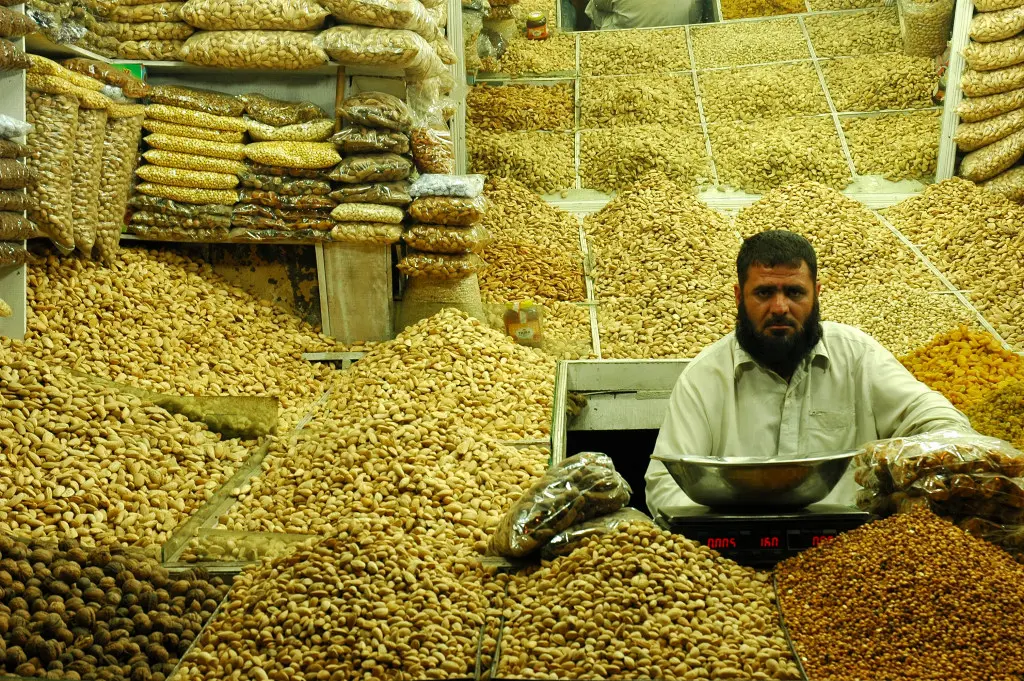
A dried-fruit seller in Namak Mandi, Peshawar, the market best known for namkeen meat.
Umair Mohsin· CC BY 2.0
Namkeen at Namak Mandi
Namak Mandi, the salt market, lies behind the Qissa Khwani bazaar in Peshawar. [8] The Express Tribune's Hidayat Khan wrote in 2014 that it takes its name from the region's salt trade and was once Mewamandi, the fruit market. [5] A home cook writing in the same paper that year gave the opposite view: despite the name, Namak Mandi "does not have anything to do with salt", and the town is known for karahi and tikka. [6] The two accounts disagree and neither cites a record.
What is cooked there is described the same way by everyone. Nasir Khan, owner of the shop called Charsi Tikka, told Hidayat Khan that his father's habit of taking charas gave the shop its name, and that Khan had made it his registered trademark. [5] An AFP report of 2019 says the shop gets its long success from using little spice. The tikka is generously salted and set on skewers between cubes of fat, then cooked slowly over a wood fire. The karahi is slices of mutton pan-cooked in chunks of white fat from the sheep's rump, with sparing green chilli and tomato, and both come with fresh naan and yogurt. [7] Customers order by the kilo and point out the cuts to a butcher. The order takes about an hour, so the tea comes first. [7]
The salt dish at home looks like this. The Tribune's home cook, a botanist, writes that Peshawari namkeen karahi has "the lack of spices", and gives the method. The meat cooks in salt until half tender, tomatoes and ginger go in until the water has boiled off, and then oil, green chilli, black pepper and chilli flakes are stirred in on a high flame. She serves it with Afghani or roghni naan. [6] Bisma Tirmizi, writing in Dawn, calls karahi a dish of Khyber Pakhtunkhwa, and says her own research points to Landi Kotal. Her father brought the recipe back from there and made it once a year with the fresh meat of the Eid sacrifice, when "the animal fat should suffice" for cooking. [15] That is her family's account, and the Dawn piece gives no earlier source for the Landi Kotal claim.
Salt-only is the claim, and cooks do not always keep to it. At Shinwari restaurants in Rawalpindi in 2014 the cooks told Dawn that they use no spices, "only yogurt, tomatoes, green chilli and ginger", and cook the lamb in its own fat. [9] The story told there was that all the restaurants showing Pashtun cooking in Peshawar once belonged to the Shinwari tribe, until imitators borrowed the name. [9]
Dumpukht: lamb on a low flame
Dumpukht appears on the same menus. In Dawn's report on the third day of Eid in 2023, the chapli kebab seller Arif Ahmad listed Peshawari pulao, paye, dampukht and lamb chops among Peshawar's popular takeaway dishes. [8] In 2014 Yasir Shinwari of Shinwari Saltish in Rawalpindi told Dawn that most of his customers wanted mutton karahi or "the traditional dumpukht", which he described as lamb with tomatoes, yogurt and fat cooked on a low flame until tender. [9]
The name is used for more than one dish. At a Quetta-style restaurant in Rawalpindi, Sadiq Khan told the Express Tribune in 2018 that dum pukht is a whole lamb roast stuffed with rice, dried fruit and spices. [11] Hidayat Khan lists dum pukht beside namkeen karahi and Kabuli pulao at the Charsi Tikka shop. [5]
Rosh: the neighbour from Quetta
Rosh is cooked in Balochistan, and the sources give it to the Baloch. Dawn's 2022 review of a restaurant on the Quetta Highway calls it "typical to Baloch culture". Large chunks of goat leg are cooked until tender and served with moong dal and tandoor naan, slightly oily, with "minimal seasoning with just salt". [10] Khalid Lehri, a cook of the Lehri tribe from Kallat and Sibbi working at a Quetta hotel in Rawalpindi, told the Express Tribune that it is a big chunk of meat cooked under pressure in animal fat for several hours, with mostly salt and black pepper. He added that lamb is the staple meat of the Baloch, who cook it in its own fat. [11]
An Arab News report from Quetta's outskirts and Kuchlak in 2021 describes the dish without naming a people. Lamb is slow-cooked in its own fat, with about five per cent oil, onions, garlic and ginger, for almost three hours on low heat. One restaurant owner said it used mountain lamb brought from Afghanistan. [12] The sources do not show whether Pashtun cooks in Quetta and Kuchlak make it the same way, so rosh stays here as a close relative of namkeen: meat in its own fat, salt and nothing to hide it.
A pit dish from the same province is claimed by Pashtuns. Rahim Bakhsh and Sarfraz Khan, in a 2020 study of Balochistan's food, write that khaddi kabab, a whole lamb or goat with raw rice in its belly, cooked in a pit over three or four hours, is "most famous in Pakhtun populated areas of Balochistan". [2]
Landi: meat hung for the winter
Landi (also lahndi, and persanda in Zhob) is the preserved side of this cooking. Rafiullah Mandokhail wrote in Dawn in 2018 that in Zhob "whether you are poor or belong to a well-off family, you must have landi" in winter. [4] The village sets one date for the slaughter. The animal has been fattened for months on grain, wheat and wild olive. The family singe the carcass, wash it, take out the bones, cut the meat, salt it and rub it with asafoetida, then hang it in a shaded yard. [4] He gives two drying times in one article, 15 days in cold enough weather and about a month for the meat strips. Some families start eating before it is fully dry. [4]
Landi is cooked, never eaten raw. It is boiled to wash off the salt and asafoetida, then pressure-cooked, or made into a soup eaten with bread, or cooked with rice, and few spices are used "as the landi has its own taste". [4] Mandokhail gives the reason as snow: remote villages are cut off from markets and have no fresh meat. [4]
The same reporting shows how far the habit reaches. In February 2023 Saadullah Akhtar of Arab News described Yaro bazaar in Pishin, where, after a January that dropped Quetta to -7.5 degrees, a butcher said he was selling 20 to 25 lambs a day instead of barely ten. Landhi was up to 2,300 rupees a kilo, and a customer from Jacobabad said of the custom: "Sindhis also eat it, Punjabis also eat it, Pashtuns also eat it." [13] Among the Baloch, Bakhsh and Khan found it called Tabaheg in Makran and Siyala or Landhi in Barkhan, Dera Bugti and Kohlu, made with salt and pomegranate in Makran and red pepper in Barkhan. They write that it keeps a year, and is a dish to offer guests and send to relatives. [2] In Kabul in 2023 Pajhwok found most families drying it at home, and the Pul-i-Kheshti seller Bismillah Rabanizada saying he sold up to 150 kilograms a day after making landi of 850 sheep that year. [14]
Kabul doctors quoted by Hasht-e Subh in 2025 disagree about its health. Some link heavy eating and added nitrites to cancer, and others say no large study has shown it. [16]
The sacrifice of Eid al-Adha
The Afghanistan Analysts Network called Eid al-Adha "the most important religious holiday in the Afghan calendar" in a 2013 guide by its researcher Christine Roehrs, who slaughtered a sheep in Kabul herself. Afghans slaughter cows or sheep in memory of the Prophet Ibrahim's willingness to sacrifice his son. [3] Poor families are given meat. Roehrs reports that one third is eaten by the family and relatives, one third goes to friends and one third to the poor, and that neighbours are brought some "as it is the custom". [3]
The meat then turns up in the dishes above. Tirmizi's father cooked his karahi from it. [15] In Balochistan, Bakhsh and Khan list tandoori kebab as a dish for weddings and Eid al-Adha, and say kebabs there and in Khyber Pakhtunkhwa are close to Afghan barbecue, seasoned with salt and coriander. [2] Dawn reported that on the third day of Eid in 2023 Namak Mandi was full of families eating chapli kebab, karahi, pulao and paye with kehwa, and one professor bought five kilograms of chapli kebab for a party at home. [8]
Meat as a mark of the guest
Elphinstone's sheep was killed for company, and the later sources keep that. Landi is "offered to family members and guests" in Zhob. [4] Baloch and Pashtun alike offer it, and the Baloch study says some dishes are made only for guests. [2] Eating out is itself an evening's outing: AFP found that in Peshawar meals last for hours after the meat is finished, over green tea. A customer, Omar Aamir Aziz, said "We've been doing this for two, three, four hundred years." That is a diner's claim, not a dated record. [7] For the guest's rights and the host's duty, see melmastia and the hujra.
عام پوښتنې
What is namkeen gosht?
Namkeen means salty, and namkeen gosht or karahi is mutton cooked in its own fat with salt, a little tomato, green chilli and black pepper. It is the Peshawar way of cooking at Namak Mandi. Recipes differ, and some cooks add tomatoes and ginger.
Is rosh a Pashtun dish?
The sources read call it Baloch. Dawn says rosh is typical to Baloch culture, and the Express Tribune's cook calls it a Balochi dish. It is made on the Quetta Highway and at Kuchlak, and its method is close to namkeen: meat in its own fat with salt.
How is landi made?
In Zhob the meat of a fattened sheep is salted, rubbed with asafoetida and hung in a shaded yard to dry through the cold, which takes 15 days to a month. It is boiled before it is cooked again, and never eaten raw.
What happens to the meat of the Eid sacrifice?
The Afghanistan Analysts Network says it is mostly given away: one third to family and relatives, one third to friends and one third to the poor. The poor of the neighbourhood come to the door, and neighbours are sent a share.
انځورونه (1)
انځورونه
1 انځور
Dumba karahi: meat of the fat-tailed sheep cooked in a karahi.
سرچینې
استعماري اسناد
د انګرېزي افسرانو او سیلانیانو ګزیټیرونه، فرهنګونه او راپورونه، 1815–1947. دوی قبیلې هغسې بیانوي لکه لیکوالو چې ولیدې، او د استعماري حکومت د اړتیا لپاره.
- بیرته متن تهMountstuart Elphinstone, An Account of the Kingdom of Caubul, vol. I (2nd ed., London, 1819), p. 373
The dinner of boiled mutton and broth with salt and sometimes pepper, when a sheep is killed for guests. Read in the archive.org OCR text.
نوې څېړنې
د تاریخپوهانو، انسانپوهانو، ژبپوهانو او جنېټیک پوهانو کتابونه او مقالې.
- بیرته متن تهRahim Bakhsh and Sarfraz Khan, "Traditional Food Delicacies across the Balochistan", Journal of Development and Social Sciences 1(4) (2020), pp. 1-11
Landhi among the Baloch, khaddi kabab, kebabs and Eid, guest dishes.
- بیرته متن تهChristine Roehrs, "Guts, Prettily Coiled: A guide to Eid sacrifices", Afghanistan Analysts Network (15 October 2013)
Eid al-Adha in Afghanistan and how the meat is shared.
خبرونه او مجلې
ورځپاڼې، خپرونې او مجلې، د وروستیو پېښو او نن ورځې ژوند لپاره.
- بیرته متن تهRafiullah Mandokhail, "Epicurious: Salted, spiced, dried", Dawn, EOS (14 January 2018)
How landi (persanda) is prepared, dried, cooked and offered in Zhob.
- بیرته متن تهHidayat Khan, "Namakmandi in Peshawar: Worth your salt", The Express Tribune (4 May 2014)
Namak Mandi's name and earlier name, Charsi Tikka's owner on the shop's name, dishes on the street.
- بیرته متن ته"Namkeen Mutton Karhai: A reminder of authentic Peshawari food", The Express Tribune blog (17 September 2014)
A home cook's namkeen karahi method and her view that Namak Mandi's name has nothing to do with salt.
- بیرته متن تهAFP, "Chewing the fat with Pakistan's BBQ masters", Arab News Pakistan (3 January 2019)
How Namak Mandi cooks tikka and karahi, ordering by the kilo, and meals over green tea.
- بیرته متن تهAPP, "Food lovers throng Peshawar's Namak Mandi on Eid", Dawn (25 April 2023)
Namak Mandi on the third day of Eid and dampukht among Peshawar's takeaway dishes.
- بیرته متن ته"'Beware of imposters, there is only one authentic Shinwari'", Dawn (29 December 2014)
Shinwari restaurants in Rawalpindi, cooking in the lamb's own fat, and Yasir Shinwari's description of dumpukht.
- بیرته متن ته"The rosh at Al-Dubai Restaurant is Quetta's love letter to foodies", Dawn Images, EOS (15 May 2022)
Rosh as a Baloch dish, how it is served and seasoned.
- بیرته متن ته"Sajji, other Balochi delights getting popular", The Express Tribune (13 March 2018)
Rosh, dum pukht and lahndi as described by cooks and restaurateurs in Rawalpindi.
- بیرته متن تهSaadullah Akhter, "In Pakistan's Balochistan, the flavours of Ramadan are slow-cooked into 'rosh'", Arab News Pakistan (5 May 2021)
How rosh is cooked at restaurants near Quetta and Kuchlak. Read through a page summary; see notes.
- بیرته متن تهSaadullah Akhtar, "Traditional meat jerky, Landhi, keeps residents warm through Balochistan's biting winters", Arab News Pakistan (4 February 2023)
Landhi at Yaro bazaar, Pishin: method, price, demand. Read through a page summary; see notes.
- بیرته متن ته"Freezing cold: Demand for dried meat up in Kabul", Pajhwok Afghan News (29 January 2023)
Landi in Kabul: home drying, sellers' figures.
- بیرته متن تهBisma Tirmizi, "Food Stories: Mutton karahi", Dawn (6 October 2014)
Karahi, the writer's Landi Kotal claim and her family's Eid karahi.
- بیرته متن ته"Landi Meat: Afghanistan's Favorite Winter Dish Caught Between Tradition and Health Concerns", Hasht-e Subh (29 November 2025)
Kabul doctors' differing views on landi and health. Read through a page summary; see notes.
اړوندې لیکنې
- Bread of the Pashtuns: naan and the tandoor
- Feast food among Pashtuns: Eid, weddings and khairat
- Karahi and tikka: the grill and the pan of Peshawar
- Melmastia: Pashtun hospitality and the guest's protection
- Pashtun food and the table of hospitality
- The hujra and the qala: Pashtun guest house and family compound
دا لیکنه ښه کړئ
- د سمون وړاندیز
کومه خبره مو پاتې ګڼله یا ښه ډول مو لرله؟ بدلون وړاندیز کړئ؛ مدیر یې له خپرېدو مخکې لولي.
- د تېروتنې خبر راکړئ
فکر کوئ کومه خبره، نېټه یا نوم ناسم دی؟ راته ووایاست کوم یو او ولې، که سرچینه لرئ هم ورسره ولېږئ.
- سرچینه ورزیاته کړئ
کومه کتاب، مقاله یا سند لرئ چې یو ادعا ثابتوي؟ یې زیات کړئ.
- پښتو ته ژباړه
پښتو او انګلیسي دواړه لوستلی شئ؟ د دې لیکنې په ژباړه کې مرسته وکړئ.
کومه تېروتنه یا ورکه سرچینه مو لیدلې؟ موږ تېروتنې څنګه سمې کوو


