At a glance
The Mahabat Khan mosque stands on a raised terrace in Andar Shahr, the "inner city" of Peshawar, now the jewellery bazaar. It is named after Mahabat Khan, a Mughal governor under Shah Jahan and Aurangzeb. [2, 3]
No inscription gives its date. Dawn writers give 1660 and 1670, a senior officer of the provincial archaeology department gives 1660–70 for the start, and Ahmad Hasan Dani places it in Shah Jahan's style without fixing a year. [2, 3, 5, 13]
The prayer hall has three fluted domes and two three-storey minarets, and the courtyard has a pond in the middle. The ground measures 30,155 square feet. [3]
The 1897–98 district gazetteer, written for the British government, records that its two minarets were "used frequently in Avitabile's time as a substitute for the gallows". [1]
The mosque nearly burnt down with Andar Shahr in June 1898. The Khyber Pakhtunkhwa archaeology directorate began restoring it in 2018. [1, 6, 10]
A governor's mosque in the inner city
Peshawar's biggest old mosque is named for a man who was not a Pashtun. Dani, the Pakistani archaeologist whose 1969 book Peshawar: Historic City of the Frontier is still the standard account of the city's monuments, says the builder was Mahabat Khan Mirza Lahrasp, whom the Mughal chronicle Ma'asir-ul-Umara lists, and that he was governor of this region twice, once in the last years of Shah Jahan and again under Aurangzeb. [2] Dani says tradition ties his name to the building and that it is not certain when he built it. [2] He also corrects two earlier writers: S. M. Jaffar had named the builder as Zamana Beg, alias Mahabat Khan, who died in 1634, and Raverty had named a Mahabat Khan the Afghan and the year 1756. Dani says Raverty was probably mistaken, and that the Mahabat Khan Jaffar named belongs to Jahangir's time. [2]
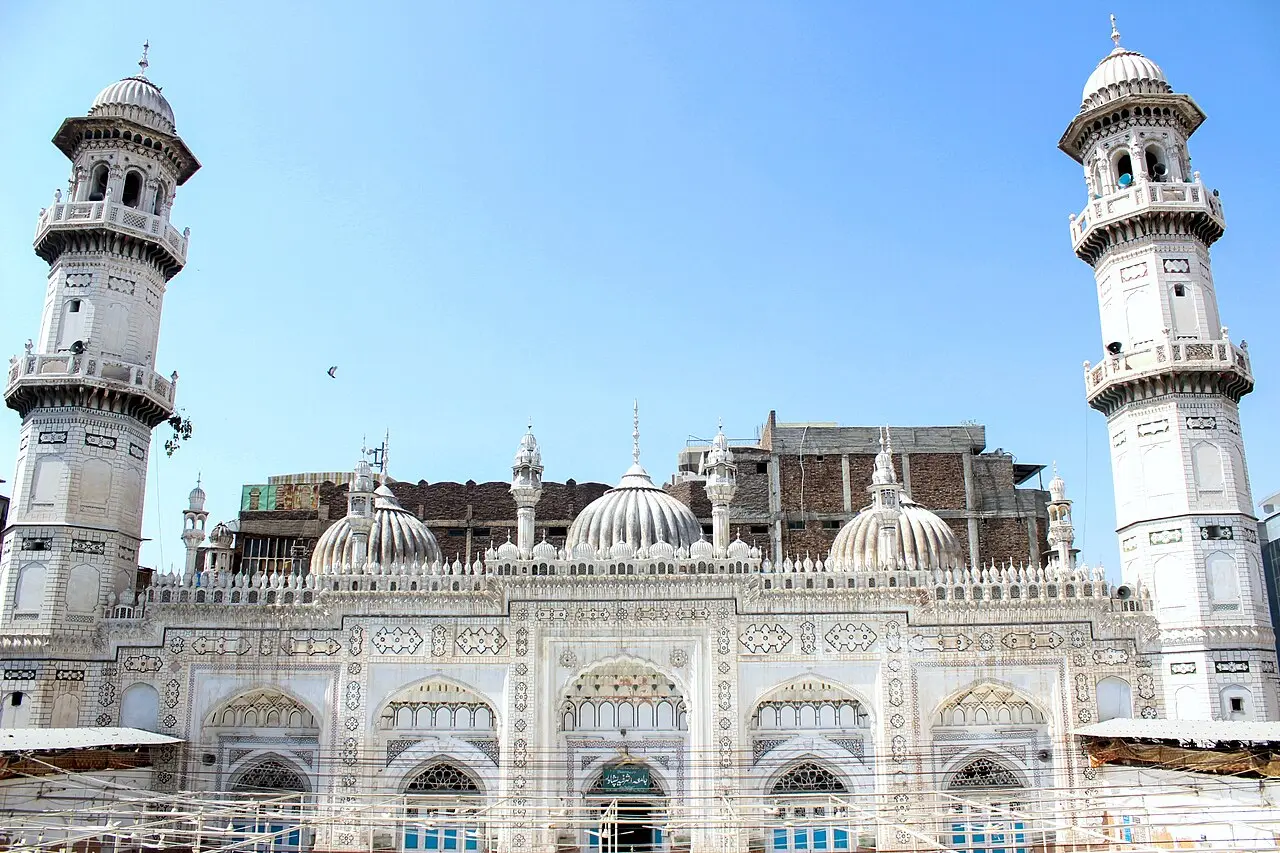
The prayer hall front with its three domes and two minarets, photographed in 2015.
Hafeezburki· CC BY-SA 4.0
The dates in print differ. Dawn in a 2021 news report and the Express Tribune in 2015 give 1660, and Sher Alam Shinwari of Dawn gave 1670 in 2008 (Shinwari adds that experts "have yet to determine the exact date of its completion in the absence of any epigraphically established details" and that most believe it was finished about 1670, in Aurangzeb's last years). [3, 5, 8] A feature from the provincial archaeology department's own senior research officer, Bakht Zada Khan, says work began in 1660–70 and ended in 1680, with Shah Jahan building a small part and Aurangzeb the larger part. [13] The Friday Times lists 1627, 1630 and 1670 and calls 1670 most likely. [11] The 1630 date there clashes with Dani's reading of the chronicle. Dani himself judges the style to be of Shah Jahan's time and says there is no truth in the idea that the builder left it unfinished. [2]
The mosque is in Andar Shahr, which Dani describes as high ground, cut off from the older, pre-Muslim part of the city by the channels that meet near Chowk Yadgar. Its name and its nearness to the Bala Hisar suggest to him that it once belonged to the citadel. [2] Dani found jewellers' shops and sellers of the Peshawari lungi turban cloth there, and Shinwari calls it the jewellery market. [2, 3] In the account of the city in 1850 that Dani quotes, the bookbinders worked in the bazaar of the mosque of Mahabat Khan and forty-five Hindu bankers and money-changers lived in the street of Mahabat Khan. [2] So the quarter was already a trading street in 1850.
Courtyard, prayer hall and painted walls
Three raised entrances, east, north and south, lead up to the courtyard. [3] Dani says only the south and east doors were in common use in the 1960s. [2] In the middle is the ablution pond. Shinwari counts fifteen low-roofed cells around it, and Dani calls them a single row of rooms down the sides, in the place of the usual arched halls. [2, 3]
The prayer hall fills the whole west side. Dani measures the mosque at 185 by 163 feet, much smaller than the Badshahi mosque at Lahore, and notes that it has no front verandah, only the single hall with a lavishly decorated interior. [2] Five arched openings on the east side open into five compartments, each with a deep arch in the west wall serving as the prayer niche, and the central arch the deepest. [3] There are three fluted domes with gilded finials, and the two minarets stand at the two ends of the hall's eastern front. [2, 3] Shinwari says each minaret has three storeys reached by a narrow stair, and that a chain of low minarets runs along the front. [3]
The interior is painted. Shinwari describes panels of different shapes decorated with mural paintings and floral patterns, with Quranic verses along pillars, ceiling, walls and the dome over the mihrab. [3] The Friday Times describes the same floral and calligraphic work and a restoration craft still practised: the old lime plaster is chipped off, fresh lime laid on, left to dry for some days, and the pattern traced on paper and copied onto the wall. Sajjad Khan, a contractor on the job, told the paper that Mughal-era techniques survive in Lahore and Multan, which is where the department found its craftsmen. [11] Much of the present decoration was renewed in the twentieth century, Dani says. [2]
The minarets under the Sikhs
Peshawar was taken from the Durranis by the Sikh army and governed in 1838–42 by General Paolo Avitabile, an Italian in Ranjit Singh's service (see Peshawar: a short history of an ancient city). The mosque's minarets are tied to his name by several tellings, and they do not agree.
The earliest in print is the gazetteer of 1897–98, written by British officials: the minarets were "used frequently in Avitabile's time as a substitute for the gallows". [1] Shinwari writing in Dawn in 2008 says Avitabile "used to hang a local tribesman each day at the top of the minaret". [3] The Friday Times in 2022 says men were thrown from the minaret and that five a day were hanged after the Sikhs took the city in 1834, which it calls a cruelty that lives on in local folklore. [11] The Express Tribune in 2015 says only "according to some accounts" that the minarets were execution sites. [8] Owais Mughal, writing on the Pakistani site All Things Pakistan in 2008, calls the story unconfirmed, notes that it appears on many websites in identical words, and names no original source. [12] The number a day and the method differ from teller to teller, and none of them names a document.
Peshawaris remembered the man in two ways. An English account of the city in 1850, which Dani quotes at length, says that the Peshawaris called him Abutabile Sahib, that he rebuilt much of the city and widened its streets, and that although he ruled with a rod of iron his name was greatly respected, because he heard every complaint himself and was thought a just man. [2] Both the memory of the hangings and the memory of the roads belong to the same governor. What the sources support is that the minarets were used for executions in his time, on the gazetteer's word, and that the rest is folklore with no source.
Shinwari adds that the mosque was "razed and plundered" under Sikh rule and that local people and later the British rebuilt it. [3] Dani does not describe the damage. [2]
Fire, neglect and the marble floor
The gazetteer of 1897–98 says the mosque "was nearly destroyed during the fire which burnt down the Andar Shahr in June 1898 and was only saved by the unremitting efforts of the faithful". [1] Dani repeats the sentence. [2] Shinwari gives June 1895 and says the fire destroyed the top of the minarets. [3] The gazetteer was printed in 1899 and the earlier year looks like a slip, so the date here is 1898.
The twentieth century was hard on it in other ways. In the 1980s, Dawn reported in 2005, the chief minister Aftab Ahmed Khan Sherpao told the Auqaf department to replace the mosque's brick floor with marble. [7] In 1982 the provincial government declared it a historic site and placed it under the Auqaf department, the body that runs religious endowments. [13] Conservators told Dawn that damp followed, that cracks were covered with mortar, and that a section of the north-east corner fell in on 25 June 2004. The project director, Nadeem Ahmed, answered that the marble floor and pond were no threat and that ventilation through the arch openings let to shopkeepers was "just a fiction". [7] Shinwari wrote in 2008 that the renovation of the late 1980s "failed miserably" as the painting began to flake. [3]
Shops did more harm. The Auqaf department rented out the openings at the base, and by 2021 forty-six shops stood inside the perimeter wall and a five- or six-storey commercial plaza had been built against the prayer hall, blocking its drain and its mihrab. A civil engineer told Dawn: "The mosque has been choked. It cannot breathe." [5] Dr Abdul Samad, director of archaeology, said the damage was man-made and reversible with scientific methods and the original materials. [5] The earthquake of 26 October 2015 cost the mosque one of its minarets, insiders told the Express Tribune, and one of the small minarets was damaged beyond repair. [8]
The restoration that started in 2018
The provincial government set aside Rs50 million in 2014–15, and in April 2016 its development working party put the work on hold because the Auqaf department had no conservation skills. [9] In May 2017 it approved Rs87.7 million for the archaeology directorate to do it over three years. [9] The work began on the night of 17 February 2018, when officials started removing garbage dumps and shops at the entrance. Dr Samad said four shops went that night and forty-three owners were told to leave within a month. [6]
It ran slowly. In October 2021 the Express Tribune reported it well behind schedule, three contractors gone and a fourth hired, a dome shaken loose by the earthquake that could not be put back, and an archaeology official's complaint that earlier contractors used modern bricks in ten minarets and changed their design. Parts were built and pulled down again. Residents said only two of ten minarets had been rebuilt, and altered, and that the pond had been demolished. The contractor said two domes and five minarets were done. [10] In November 2021 the provincial government decided to hand the whole mosque to the archaeology department, on the advice of a committee that included the Auqaf and tourism departments. [5]
An undated feature by the Associated Press of Pakistan quotes Bakht Zada Khan saying that work on the minarets, domes and ablution area was sixty per cent complete, that the budget had been raised to Rs160 million, and that the aim was completion by 2024. [13] In March 2025 Dawn reported a calligrapher, Zeeshan Minhas, painting the empty pillars and wall spaces in thuluth script as a volunteer, and said the mosque holds over 4,000 worshippers at once. [4]
A mosque Peshawaris use
The mosque is a place of prayer first. The APP feature says its courtyard can hold 20,000 to 30,000 people, a very different figure from Dawn's. It also records that Professor Ehtisham Qaiser attended the night gatherings of Ramadan there for about ten years. [4, 13]
The same feature says that after the Soviet invasion of Afghanistan in 1979 refugee tribal elders met in the mosque to unite Afghans against the Soviets. [13]
The link to Pashtun history is closer than the builder's name suggests. Dani writes that Khushal Khan Khattak, the poet and chief whom Aurangzeb had imprisoned, was released on the intercession of Mahabat Khan, and calls it unclear why Mahabat interceded. Dani suggests that both men were removed from Peshawar by the governor who replaced Mahabat or by the emperor himself. [2] The break between Khushal and the Mughals came after that. [2] For Khushal's later war see Khushal Khan Khattak: poet and chief and Pashtuns and the Mughal frontier, 1526–1707.
عام پوښتنې
Who built the Mahabat Khan Mosque and when?
It is named after Mahabat Khan, a Mughal governor under Shah Jahan and Aurangzeb, and Dani names him as Mahabat Khan Mirza Lahrasp. No inscription gives a date: Dawn writers say 1660 and 1670, and an archaeology officer says it was begun in 1660–70 and finished in 1680.
Where is the Mahabat Khan Mosque?
It stands on a raised terrace in Andar Shahr, the inner city of Peshawar, reached from Chowk Yadgar. The surrounding bazaar is now known for jewellery.
Were the minarets used for hangings under the Sikhs?
The British district gazetteer of 1897–98 says the two minarets were used frequently in General Avitabile's time as a substitute for the gallows. Later tellers give different numbers and methods and cite no document, and one Pakistani writer calls the story unconfirmed.
What damaged the mosque?
The gazetteer says it nearly burnt down with Andar Shahr in June 1898, though Dawn gave 1895. A corner collapsed in 2004, the 2015 earthquake damaged its minarets, and shops built against it weakened its base.
Is the restoration finished?
The provincial archaeology directorate began in 2018 and was behind schedule in October 2021. An undated official statement put the work at sixty per cent with completion aimed at 2024, and no source read confirms that it is finished.
انځورونه (5)
انځورونه
5 انځورونه
Worshippers in the courtyard by the ablution pond, photographed in 2012.
A minaret of the mosque seen from the bazaar, photographed in 2019.
A minaret of the mosque, photographed in October 1990.
The painted ceiling inside the mosque, photographed in October 1990.
The painted interior of the Mahabat Khan Mosque in Peshawar.
سرچینې
استعماري اسناد
د انګرېزي افسرانو او سیلانیانو ګزیټیرونه، فرهنګونه او راپورونه، 1815–1947. دوی قبیلې هغسې بیانوي لکه لیکوالو چې ولیدې، او د استعماري حکومت د اړتیا لپاره.
- بیرته متن تهGazetteer of the Peshawar District, 1897–98 (Lahore: Sang-e-Meel/Punjab Government, 1899), ch. VI, p. 363 (Peshawar city)
The colonial gazetteer's sentences on the two minarets and Avitabile and on the June 1898 fire. A British government record, used for what it says and not for its judgements. Read in the archive.org OCR text.
نوې څېړنې
د تاریخپوهانو، انسانپوهانو، ژبپوهانو او جنېټیک پوهانو کتابونه او مقالې.
- بیرته متن تهAhmad Hasan Dani, Peshawar: Historic City of the Frontier (Peshawar: Khyber Mail Press, 1969), pp. 16, 88, 91, 112–113, 115 and 174–175 (with footnotes on p. 176 and the notes)
The fullest scholarly account of the mosque: builder, uncertain date, plan and measurements, the 1898 fire, the minarets, Andar Shahr, Mahabat Khan and Khushal Khan Khattak. Read in the archive.org OCR text.
خبرونه او مجلې
ورځپاڼې، خپرونې او مجلې، د وروستیو پېښو او نن ورځې ژوند لپاره.
- بیرته متن تهSher Alam Shinwari, "Around Town: Masjid Mahabat Khan: Splendour of Mughal art", Dawn, 5 December 2008
A Peshawar journalist's description of the plan, domes, minarets and painting, the 1670 date, the Avitabile and fire statements and the failed 1980s repair.
- بیرته متن تهSher Alam Shinwari, "Calligrapher gives new look to historic Masjid Mahabat Khan", Dawn, 17 March 2025
The calligraphy volunteer and the figure of over 4,000 worshippers at a time.
- بیرته متن ته"Govt finally decides to save 'jewel of Peshawar'", Dawn, 1 November 2021
Encroaching shops, the plaza against the prayer hall, the 1660 date, the decision to hand the mosque to the archaeology department.
- بیرته متن تهSadia Qasim Shah, "Conservation work starts at Mahabat Khan mosque", Dawn, 19 February 2018
Start of the archaeology directorate's work and the removal of shops.
- بیرته متن تهSadia Qasim Shah, "Mosque conservation only 'cosmetic': experts", Dawn, 9 September 2005
The marble floor, damp, cracks and the 2004 collapse of a corner.
- بیرته متن تهHidayat Khan, "Lost splendour: Mahabat Khan Mosque effaced by neglect", The Express Tribune, 28 November 2015
The 2015 earthquake damage, the budget delay and the 1660 date.
- بیرته متن تهHidayat Khan, "K-P govt to spend Rs88m on Mahabat Khan Mosque uplift", The Express Tribune, 10 May 2017
Funding history, the hold of April 2016 and the shops around the mosque.
- بیرته متن تهShahzaib Khan, "Mahabat Khan Mosque restoration far from over", The Express Tribune, 13 October 2021
Delays, contractors, modern bricks in the minarets, the dislocated dome, residents' complaints.
- بیرته متن تهNader Khan, "Renovating Peshawar's Mahabat Khan Mosque", The Friday Times, 26 February 2022
Dates in circulation, the Avitabile story as folklore and the lime-plaster painting method. Read as a summary returned by a fetch tool, because the site refused a direct download.
- بیرته متن تهOwais Mughal, "Masjid Mahabat Khan, Peshawar", All Things Pakistan, 26 February 2008
The remark that the Avitabile story is unconfirmed and repeated in identical words. Read as a summary returned by a fetch tool.
- بیرته متن تهAssociated Press of Pakistan feature, "Mohabat Khan Mosque: A Jewel of Peshawar" (undated), quoting Bakht Zada Khan, senior research officer, Khyber Pakhtunkhwa archaeology department
The archaeology department's dates, the sixty per cent figure, the Rs160 million allocation, the 1982 declaration and the 1979 gathering of Afghan elders. Read as a summary returned by a fetch tool.
اړوندې لیکنې
دا لیکنه ښه کړئ
- د سمون وړاندیز
کومه خبره مو پاتې ګڼله یا ښه ډول مو لرله؟ بدلون وړاندیز کړئ؛ مدیر یې له خپرېدو مخکې لولي.
- د تېروتنې خبر راکړئ
فکر کوئ کومه خبره، نېټه یا نوم ناسم دی؟ راته ووایاست کوم یو او ولې، که سرچینه لرئ هم ورسره ولېږئ.
- سرچینه ورزیاته کړئ
کومه کتاب، مقاله یا سند لرئ چې یو ادعا ثابتوي؟ یې زیات کړئ.
- پښتو ته ژباړه
پښتو او انګلیسي دواړه لوستلی شئ؟ د دې لیکنې په ژباړه کې مرسته وکړئ.
کومه تېروتنه یا ورکه سرچینه مو لیدلې؟ موږ تېروتنې څنګه سمې کوو


