Ten tribes in two leagues
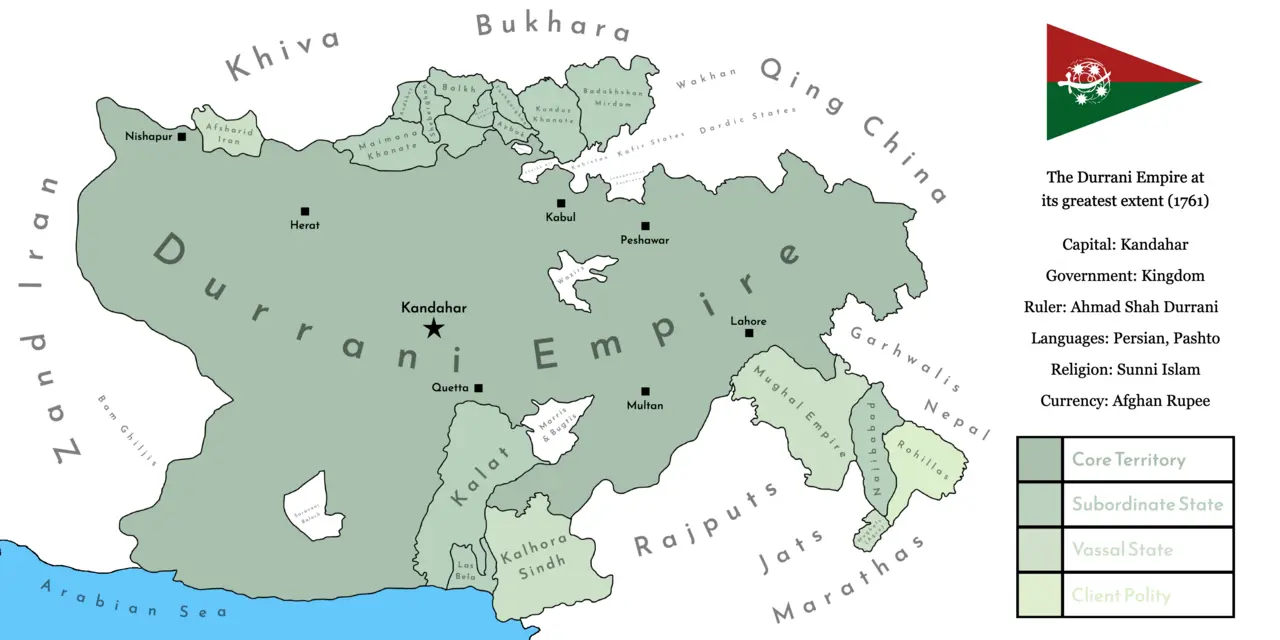
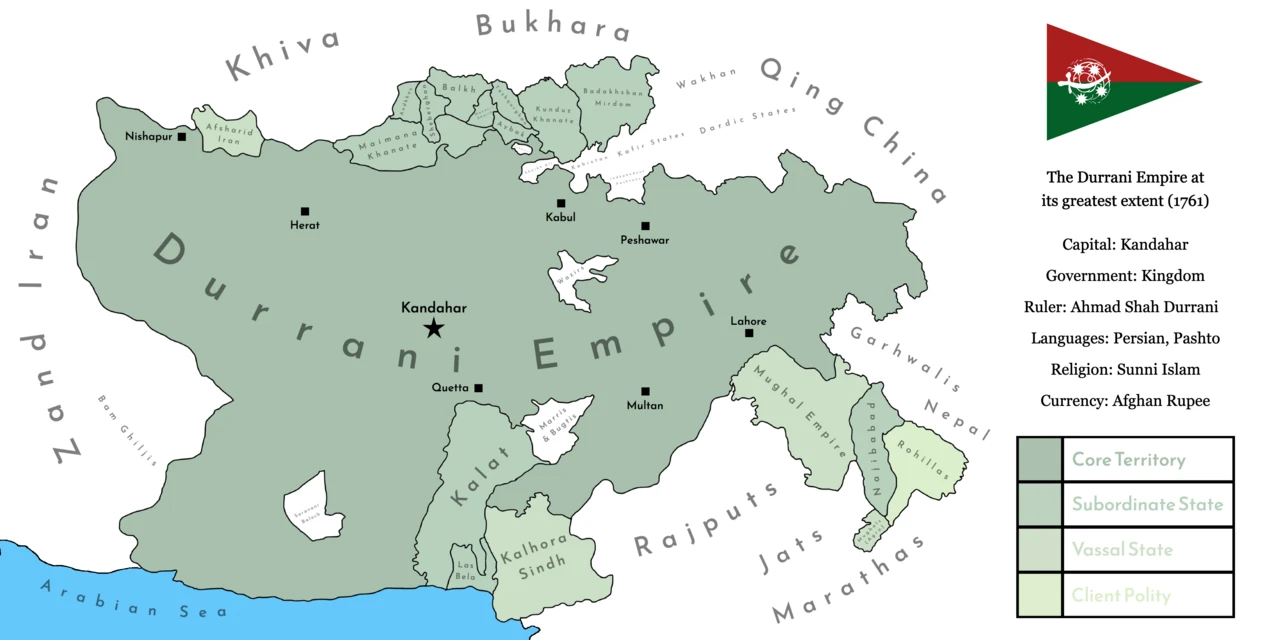
The Durrani (دراني) are the Pashtun tribes of the south-west of Afghanistan, around Kandahar, along the Helmand and out towards Farah and Herat. Daniel Balland calls them probably the most numerous Pashtun confederation. [1] Until 1747 they were called Abdali (ابدالي). In that year a jirga of their chiefs chose Ahmad Khan of the Sadozai as king, he took the title Durr-i Durran, pearl of pearls, and the tribes took the name Durrani from it. [1] His story is told in Ahmad Shah and the founding of the Durrani state.
Balland counts ten tribes, grouped in two leagues of five. [1]
Zirak (زيرک): Popalzai (پوپلزي), Alikozai (الکوزي), Barakzai (بارکزي) and its offshoot the Achakzai (اڅکزي), and the small Mastizai. [7]
Panjpai: Nurzai (نورزي), Alizai, Ishaqzai (also called Sakzai), and two smaller tribes, the Maku (Makohi until the mid-nineteenth century) and the Khugiani, not to be confused with the Khugiani of eastern Afghanistan.
Mountstuart Elphinstone, who met Durrani chiefs on his mission to Peshawar in 1809, listed nine clans, four Zirak and five Panjpai, and was told that Zirak descent was "by far the most honourable". [4] The leadership of the whole confederation has always come from the Zirak, passing between the Popalzai and the Barakzai. [1] Balland adds that people name their tribe and the confederation, but never mention the leagues of their own accord, although local chronicles always do; whether the leagues ever acted as political bodies is not known. [1]
Abdal and the genealogists
In the Pashtun genealogies the tribes descend from one ancestor, Abdal or Awdal. Charles Kieffer gives his line as Abdal, son of Tarin, son of Kharshbun, and records the tradition that he was called Abdal because he served one of the abdal, the fifth rank in the Sufi hierarchy of saints. Whether that is folk etymology or history cannot be shown. [2] The genealogists trace Abdal in turn to Qais Abdur Rashid, ancestor of all the Pashtuns; see origins of the Pashtuns. [1]
The names themselves suggest the confederation was assembled. Zirak (Pashto "intelligent") was the nickname of one Sulaiman, claimed as ancestor of all the Zirak tribes. Panjpai means "five legs", that is five septs, and names no ancestor at all. [1] The Maku and Khugiani lack the Pashto ending -zai ("sons of") that marks most tribal names, and the traditions Balland cites make the Khugiani descendants of Abdal's second wife and the Maku an adopted tribe. The Adozai, said to descend from Abdal, were never clearly part of the confederation. Balland concludes that it began as a political union, with the genealogy fitted round it. [1]
The tribes divide further. Sher Mohammad Khan's genealogy gives the Barakzai five main subtribes: Abdullahzai, Baizai, Nasratzai, Nuruddinzai and Ruknuddinzai. The royal Mohammadzai and the Achakzai both come from the Nuruddinzai. [3] Lineage names such as Khanozai and Shakarzai turn up in more than one Durrani tribe, which Balland takes as a sign of how much people moved between tribes. [3]
From Safavid clients to Nadir Shah's horsemen
Some traditions bring the Abdali into southern Afghanistan from Ghor in the early fifteenth century; Elphinstone heard stories that set their oldest home in the mountains of Toba. [1] [4] The first firm record of a confederation under that name is from the reign of Shah Abbas I of Persia (1588 to 1629), who gave its supreme command to the chief of the Popalzai. [1] Caroe names him as Malik Saddo, the ancestor of the Sadozai. [6] Ganda Singh adds that Saddo went as ambassador to Shah Abbas with a companion named Mohammad, and that Saddo's son Khwaja Khizr was revered as a saint. [5] Mohammad Khan, the companion, is the ancestor of the Mohammadzai section of the Barakzai. [3] At about the same time the Abdali drove rival tribes, among them the Yusufzai and Mohmand, out of the Kandahar country; the Mughal Ain-i Akbari describes them as sheep-herders living partly east of Kandahar. [1] For the Yusufzai side of that story see the Yusufzai.
Early in the eighteenth century Ghilzai pressure pushed the Abdali off the Kandahar lands and into the mountains of Herat. [1] [3] Elphinstone describes what followed. In 1716 the Abdali under Abdullah Khan Sadozai beat the Persian governor of Herat in the field and took the city. Abdullah was later deposed, and perhaps poisoned, by Zaman Khan, Ahmad Shah's father, who beat a Persian army twice the size of his own. By 1722 the Abdali were strong enough to besiege Mashhad. [4] Elphinstone was told that the Abdali government was "at all times democratic", run when they had no leader by a jirga of the heads of families. [4] See the jirga.
Nadir Shah subdued them from 1728 and took Herat in 1732. [4] [6] He then made them his own. He raised 12,000 Abdali cavalry under an Alizai chief, and after he took Kandahar from the Ghilzai in 1738 he gave the Abdali the Ghilzai lands. [1] The allotment made then is still broadly the tribal map. The Zirak tribes received the well-watered country around Kandahar and east of the Helmand, and became mostly farmers. The Panjpai received the drier land between the Helmand and Sistan, where herding lasted longer. [1] Ganda Singh gives some of the grants: the Arghandab valley to the Alikozai, Zamindawar to the Alizai and much of the rest to the Barakzai, who took the lower Arghestan valley on the south side of the Kandahar oasis. [3] [5] Elphinstone was told that the land was held on condition of supplying one horseman for every plough, an obligation the Durrani kings kept up. [4] The Ghilzai, who lost the land, are the subject of the Ghilzai confederation.
The tribes in Elphinstone's day
Elphinstone's Account of the Kingdom of Caubul (1815) gives a figure and a country for each clan, as his informants reported them. [4]
Popalzai: about 12,000 families, mostly farmers in the hill country north of Kandahar, "the most civilized of the Dooraunee clans". The Sadozai lived near Sher-i Surkh in the lower Tarnak valley, and a colony had settled at Multan.
Barakzai: not less than 30,000 families, south of Kandahar, in Arghestan and along the Helmand, mostly shepherds, and at that time holding most of the great offices of state.
Achakzai: separated from the Barakzai by Ahmad Shah "to reduce the formidable numbers of that clan"; they lived in the Khwaja Amran range, the wildest of the Durrani, living by "pasturage and plunder".
Nurzai: about as numerous as the Barakzai, almost all shepherds, in the western hills and the southern desert, raiding and raided by the Baluch.
Alizai: about 15,000 families in Zamindawar, mostly farmers.
Alikozai: about 10,000 families, with a country and habits like the Alizai.
Ishaqzai: about 10,000 families between Zamindawar and the desert, half farmers and half herdsmen.
Maku and Khugiani: small clans without lands of their own, many living in Kandahar.
He put the whole population of the Durrani country at 800,000 or more, of whom the Durrani made up more than half. Nadir Shah was said to have counted 60,000 Durrani families when he fixed their lands; Elphinstone thought 100,000 families a safe figure for his own time. [4] Balland notes that no serious modern count exists and suggests at least two million people. [1]
Sadozai and Mohammadzai
The Sadozai were a small section of the Popalzai, and before 1747 they had long been the khan khel, the chief's family, of the whole confederation. Elphinstone recorded their privilege: no one outside their own family could punish a Sadozai, even with death, so that the Sadozai counted almost as a separate clan. [4] The Barakzai were larger. Under Ahmad Shah their sardars sent 907 horsemen to the royal army, but by the early nineteenth century their chiefs wanted the first place, and after 1819 power passed to their Mohammadzai section. [3]
Two Mohammadzai lines then ruled in turn. The sardars of Kabul, descended from Dost Mohammad Khan, held the throne from 1819 to 1929, apart from the Sadozai restoration of 1839 to 1843. The descendants of his half-brother Sultan Mohammad Telai, the sardars of Peshawar, known as the Musahiban, followed from 1929 to the fall of the monarchy in 1973 and kept power under the first republic until 1978. [3] For a century and a half Mohammadzai and other Durrani families held the senior posts of the civil and military administration. [3] The Durrani generally stayed loyal to dynasties from their own ranks; Balland names as exceptions Ayub Khan's revolt of 1880 and 1881 and a riot in Kandahar in 1959. [1]
Chiefs, land and custom
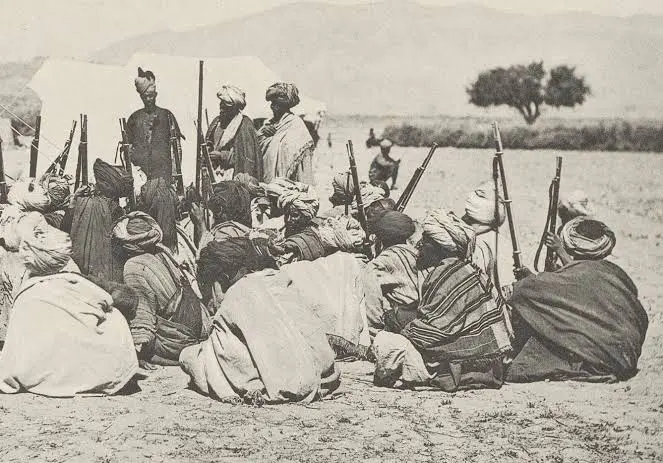
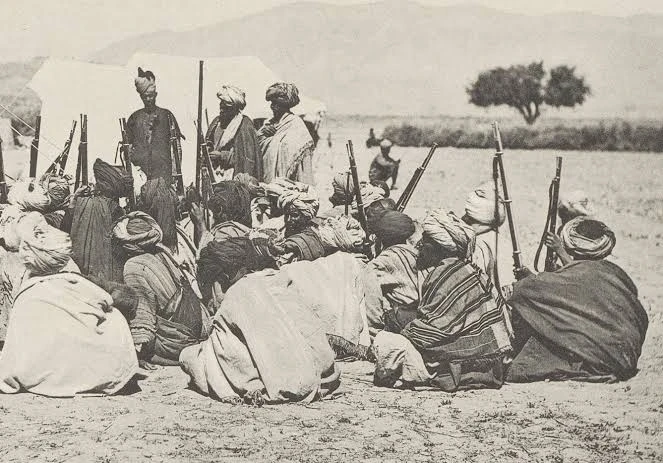
The Durrani were ruled by hereditary chiefs, sardars, who raised cavalry for the king and were paid with rent-free land grants and allowances by the number of horsemen they kept. [1] Balland and Elphinstone both describe the Durrani country as quiet, with few feuds beyond the chiefs' contests for office. [1] [4] That shows in their customs. Durrani customary law, narkh, differs from the standard Pashtunwali: the Panjpai tribes do without the maraka, the council for small disputes, and treat a jirga as an unusual event. Fortified houses, qala, are much rarer than in the rest of the Pashtun lands and belong to the landed families. [1] On the fort-house see hujra and qala.
Their speech marks them too. Balland lists the Durrani dialect of Pashto, with its "soft" consonants, among their distinctive features, and cites Herbert Penzl's 1955 grammar of the Kandahar dialect for it. [1] See Pashto dialects. Caroe wrote in 1958 that the leading Abdali families had spoken their own Persian since the eighteenth century, and that many had forgotten their Pashto. [6]
Herds and tents
Most Durrani are now farmers or townspeople, but in 1978 more than 20,000 families, about 110,000 people, still moved with their flocks, most of them Panjpai. [1] They summer in the mountains of Ghor, where the Aimaq kept control of their land, so the Durrani nomads graze there as hamsaya, clients, paying grazing fees or buying springs and fields. [1] Balland lists what sets their pastoral life apart from other Pashtun herders: a black barrel-vaulted tent like the Baluch tent, their own camel saddles and butter churns, felt cloaks and shoes of a different cut, men fetching the water while women milk, women weaving the tent cloth, and hunting with hounds. [1] The Achakzai are the exception in one respect: their clans migrate across the Afghan-Pakistan border to the Toba highlands. [1]
Beyond the homeland
The Durrani have spread far beyond the Kandahar country, nearly always for political reasons. [1] Afghan amirs settled thousands of Durrani families, mostly nomadic Ishaqzai and Nurzai, in Badghis and Afghan Turkistan in the late nineteenth and early twentieth centuries. In the north they are called "Qandahari" wherever they came from, and they held local power out of proportion to their numbers. [1] Barakzai who reached Badghis in the summer of 1886 met the hostility of the Firozkohi Aimaq and founded the largest Barakzai colony in the north. [3] The Achakzai country straddles the border between Kandahar and Quetta, and Sadozai families have lived in the Punjab since the seventeenth century, best known as the Multani Pathans. [1] In 1988 a survey found that nearly three-quarters of the Afghan refugees in southern Khorasan in Iran, about 280,000 people, were Durrani. [1]
Where this tribe sits
- Part of
- Tarin
- Branches beneath it
- Zirak
- Panjpai
Abdali (Durrani) tribe profile
Where the sources disagree
The Makhzan-i Afghani gives Abdal three sons, Barik, Popal and Ali. The Khulasat al-Ansab gives two, Firak (father of Popal, Barek and Alekko) and Isa (father of the five Panjpai clans), and Elphinstone, Bellew and Encyclopaedia Iranica use the Zirak and Panjpai leagues.
At a glance
- Population
- about 100,000 families (estimate) (1815, Durrani country (Kandahar, Helmand, Farah and Herat borderlands))9
- Countries
- Afghanistan, Pakistan
- Where they live
- Kandahar Province, Helmand Province, Farah Province, Herat Province, Pishin and Chaman (Balochistan), Multan
- Language
- Pashto (Kandahari dialect)
- Religion
- Sunni Islam
- Main clans
- Zirak, Panjpai, Popalzai, Alikozai, Barakzai, Achakzai, Nurzai, Alizai, Ishaqzai
- Other names
- Durrani, Abdal, Avdal, Bor Tarin, Abdaulee, Dooraunee
Homeland
- KandaharMir Wais Hotak overthrew Safavid rule here in 1709, and Ahmad Shah Durrani built a new city here as his capital. Roberts beat Ayub Khan outside it on 1 September 1880.
- HeratShah Abbas I moved Abdali families here from Kandahar. Dost Mohammad Khan died here on 9 June 1863 after taking the city, and Ayub Khan marched from it to Maiwand in 1880.
- Mausoleum of Ahmad Shah DurraniOctagonal tomb under a blue-tiled dome in Kandahar where Ahmad Shah was buried in 1772, beside the shrine he built for the Cloak of the Prophet.
- ZamindawarDistrict on the Helmand four days from Kandahar, taken by Mir Wais in 1713 and later granted by Ahmad Shah to the Alizai. Ayub Khan gathered tribesmen here in 1880.
Notable people
Abdullah Khan Sadozaifl. 1716
Abdali leader who took Herat from the Safavid governor in 1716.5
Allahyar Khan Abdalifl. 1725–1732
Elected leader of the Abdali in 1725–26 and governor of Herat, exiled to Multan by Nadir in 1732.7
Zulfiqar Khanfl. 1730s
Elder brother of Ahmad Shah who led the Abdali rising against Nadir and defeated Nadir's brother Ibrahim.5
Ahmad Shah Durrani1722–1772
Sadozai Popalzai crowned at Kandahar in 1747, founder of the Durrani state.6
Dost Mohammad Khanreigned 1826–1839, 1843–1863
Muhammadzai Barakzai amir of Kabul, founder of the Barakzai dynasty.6
Mohammad Zaher Shahreigned 1933–1973
Muhammadzai Barakzai and the last king of Afghanistan.4
Tribes of the Abdali (Durrani)
Tribe · Abdali (Durrani)
Achakzai
The Achakzai live in Toba, Pishin, Chaman and around Kandahar. Elphinstone and Encyclopaedia Iranica count them as a Zirak clan of the Durrani, and the Loralai gazetteer notes that the old name Abdal is still used for them.
Tribe · Abdali (Durrani)
Alikozai
The Alikozai are a Zirak Durrani tribe of the Arghandab, Jaldak, Panjwai and Zamindawar. Bellew gives their sections as Kaso, Sarkani and Ziyura.
Tribe · Abdali (Durrani)
Alizai (Durrani)
The Alizai are a Panjpai Durrani tribe of Zamindawar and the Helmand.
Tribe · Abdali (Durrani)
Barakzai
The Barakzai are a Zirak Durrani tribe of Kandahar, the Helmand and the Arghandab, descended in tradition from Barik, son of Abdal. Their Muhammadzai section supplied Afghanistan's rulers from 1826 into the 1970s.
Tribe · Abdali (Durrani)
Ishaqzai
The Ishaqzai are a Panjpai Durrani tribe of the Helmand, Sistan and Farah, also known as the Sahak or Sakzai.
Tribe · Abdali (Durrani)
Khugiani (Durrani)
The Khugiani of the Kandahar region are one of the five Panjpai clans of the Durrani. They are a separate group from the Karlanri Khugiani of Nangarhar.
Tribe · Abdali (Durrani)
Nurzai
The Nurzai are a Panjpai Durrani tribe of the west, in Farah, the Helmand and Herat. The Khulasat al-Ansab, as printed by Dorn, calls them Turzai.
Tribe · Abdali (Durrani)
Popalzai
The Popalzai are a Zirak Durrani tribe of the Tarnak valley around Shahr-i Safa, of Kandahar, and of the Helmand up to Khakrez. In the Makhzan-i Afghani their ancestor Popal is a son of Abdal. Their Sadozai section was the royal house from 1747 to 1818.
Sources for the tribe profile
- Makhzan-i Afghani, tr. Dorn, Part II p. 43
- Khulasat al-Ansab, quoted in Dorn, Part II annotations p. 123
- Elphinstone, An Account of the Kingdom of Caubul (1839), vol. II pp. 84–97
- Encyclopaedia Iranica, "Abdali" (C. M. Kieffer), vol. I/2 pp. 175–176
- Elphinstone, An Account of the Kingdom of Caubul (1839), vol. II, Appendix A, pp. 279–284
- Encyclopaedia Iranica, "Afghanistan x. Political history" (D. Balland), vol. I/5 pp. 547–558
- Encyclopaedia Iranica, "Allahyar Khan Abdali" (J. R. Perry), vol. I/8 p. 893
- Baluchistan District Gazetteer, vol. II, Loralai (1907), p. 81
- Elphinstone, An Account of the Kingdom of Caubul (1839), vol. II pp. 99–104
- Encyclopaedia Iranica, "Barakzi" (D. Balland), vol. III/7 pp. 742–745
Sources
- Daniel Balland — Dorrani, Encyclopaedia Iranica
Tribal composition, historical development, and the distinction between genealogical and political organization. Published 1995; consulted 7 October 2026. Older population estimates are not reproduced.
- Charles M. Kieffer, "Abdālī", Encyclopaedia Iranica, vol. I, fasc. 2 (1982), pp. 175-176
The genealogy Abdal son of Tarin son of Kharshbun, the Sufi abdal tradition, and the division into Zirak and Panjpai. Consulted 14 October 2026.
- Daniel Balland, "Bārakzī", Encyclopaedia Iranica, vol. III, fasc. 7 (1988), pp. 742-745
Mohammad Khan and the Mohammadzai, the Barakzai lands in Arghestan, the 907 horsemen under Ahmad Shah, the Kabul and Peshawar lines of the dynasty, Barakzai subtribes and shared lineage names, and the Barakzai of Badghis from 1886. Consulted 14 October 2026.
- Mountstuart Elphinstone, An Account of the Kingdom of Caubul (London: Longman, 1815), pp. 396-401 and appendix A, pp. 541-542
The nine clans and their countries and family numbers, Zirak precedence, Sadozai privilege, the Achakzai separation, the Durrani population, Nadir Shah's count, land held for a horseman per plough, and early Abdali history from 1716 to 1728. Consulted 14 October 2026.
- Ganda Singh, Ahmad Shah Durrani: Father of Modern Afghanistan (Bombay: Asia Publishing House, 1959), chs. II-III
Nadir Shah's grants of Arghandab to the Alikozai and Zamindawar to the Alizai in 1738, and Saddo's embassy to Shah Abbas with Mohammad. Consulted 14 October 2026.
- Olaf Caroe, The Pathans, 550 B.C.-A.D. 1957 (London: Macmillan, 1958), ch. XVI, pp. 252-254
Malik Saddo as head of the Abdali under Shah Abbas, Nadir's war with the Abdali and the taking of Herat in 1732, and the Persian speech of the Abdali leading families. Caroe was a British colonial official. Consulted 14 October 2026.
- Pashto Wikipedia, "بارکزي"
Used only for the Pashto spelling of the tribe names Barakzai, Popalzai, Alikozai, Achakzai and the Zirak branch. Consulted 14 October 2026.
Noticed a mistake or a missing source? Here's how we correct things
Related articles
- Ahmad Shah and the founding of the Durrani state
- Dost Mohammad Khan: the amir who rebuilt Afghanistan
- Gharghasht
- Kandahar: an oasis city and its long history
- Origins of the Pashtuns: tradition and evidence
- The Ghilzai: a major Pashtun confederation
- The Hotak dynasty: Ghilzai rule from Kandahar to Isfahan, 1709–1738
.png)