The Popalzai are a Zirak Durrani tribe of the Tarnak valley around Shahr-i Safa, of Kandahar, and of the Helmand up to Khakrez. In the Makhzan-i Afghani their ancestor Popal is a son of Abdal. Their Sadozai section was the royal house from 1747 to 1818.
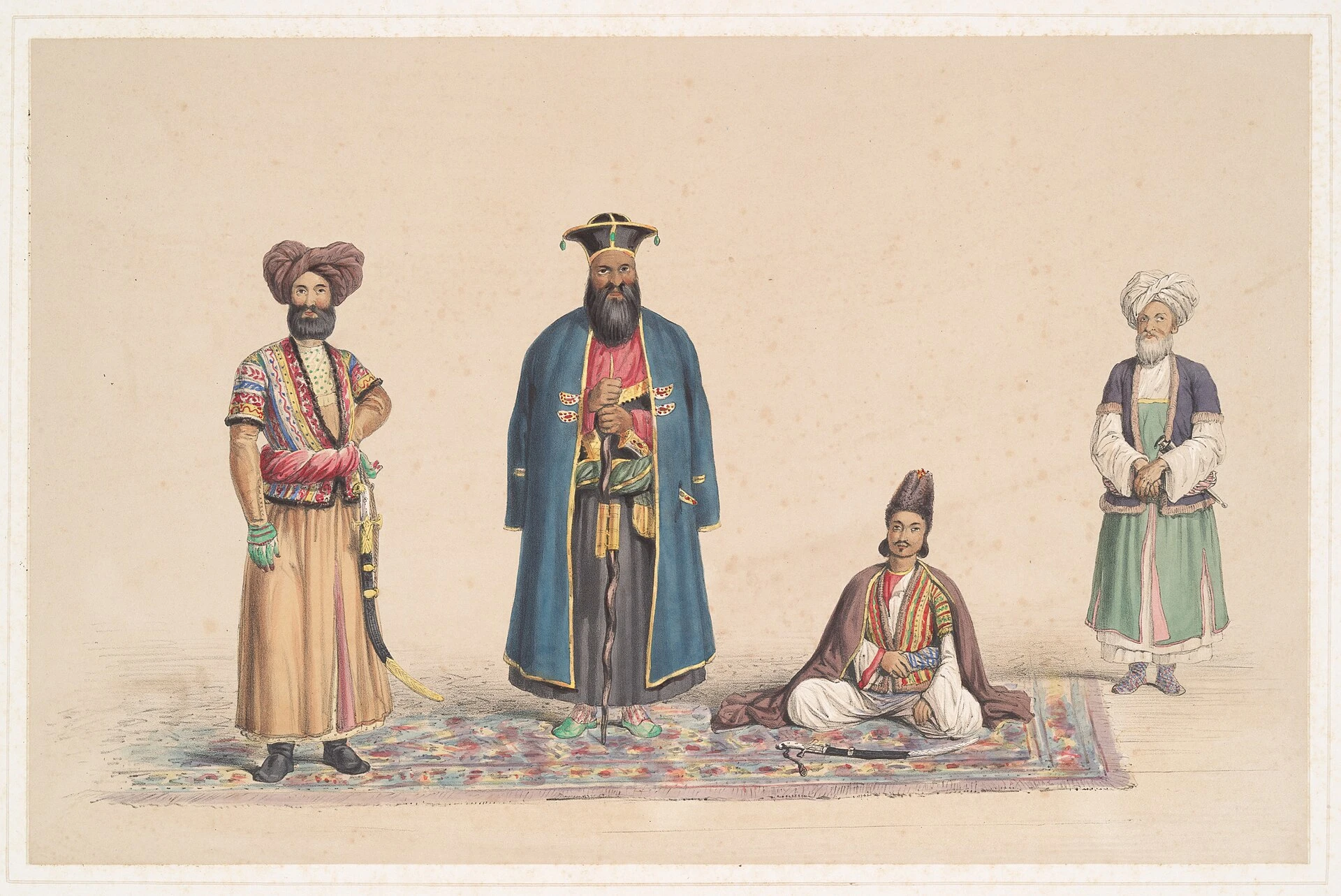
Shah Shuja, the Sadozai king, at his court, from James Atkinson's Character and Costumes of Afghaunistan, 1843.
Zaman Shah Durrani on the throne, gouache by Ghulam Mustafa, probably Lahore, 1799.
The entrance to the tomb of Ahmad Shah Abdali (Durrani) in Kandahar, photographed by Benjamin Simpson about 1880.
Popal and the Zirak
In the Makhzan-i Afghani (1609–11) Popal is a son of Abdal, son of Tarin, with his brothers Barik and Ali. The Khulasat al-Ansab places him one generation lower, as a son of Abdal's son Firak, with Barek and Alekko. In the Zirak and Panjpai scheme used by Elphinstone, Bellew and Encyclopaedia Iranica, the Popalzai head the Zirak league.
Bellew (1891) lists Popalzai sections including Ayub, Badu, Bahlol, Bami, Habib, Hasan, Ismail, Ma'ruf, Nasrat, Sado, Salih, Umar and Zinak. The Sado section became the Sadozai, the royal house, and grew quickly in numbers and wealth after 1747. Ahmad Shah came from its Khwaja Khidar subsection. Elphinstone adds that the grand vizier was always to come from the Bamizai division of the Popalzai.1,2,3,4
Tarnak, Kandahar and Khakrez
Elphinstone placed the Sadozai near Shahr-i Safa in the lower Tarnak valley, with some at Kandahar and a large colony at Multan. The other Popalzai lived mainly in the hill country north of Kandahar, were mostly farmers, and numbered about 12,000 families by the most moderate native estimates. Bellew gave about 13,000 families, partly farmers and partly herders, around Kandahar and up the Helmand to the Khakrez district.3,4
The Sadozai house, 1716–1842
Elphinstone calls the Sadozai the long-standing khan khel, or head family, of the Popalzai and of all the Durrani. The earliest evidence he found was a patent from one of the early Safavid kings appointing the Sadozai chief to command the Abdali. Sadozai persons were held sacred: no one outside the family could punish one of them, and even the head of the Abdali could not sentence a Sadozai to death. In 1716 Abdullah Khan Sadozai led the Abdali in taking Herat.
Ahmad Khan, born in 1722 to a Sadozai father and an Alikozai mother, served Nadir Shah and was crowned at Kandahar in October 1747. Ahmad Shah gave most of the great offices of state to Popalzai. His son Timur Shah (r. 1772–1793) moved the capital from Kandahar to Kabul in 1775. Timur's sons then fought over the throne. Mahmud ousted Zaman Shah in 1800, Shah Shuja replaced Mahmud in 1803, and Mahmud returned after defeating Shah Shuja at Nimla in 1809. The killing of the Barakzai leader Fateh Khan in 1818 by Mahmud's son Kamran started a feud with the Muhammadzai, and Mahmud lost Kabul in 1819. Kamran kept a Sadozai principality at Herat until his death in 1842. The British restored Shah Shuja in 1839, and he was killed on 5 April 1842.3,5,6
After the Sadozai
Popalzai chiefs joined Barakzai, Achakzai and Ghilzai chiefs in the Kabul rising of November 1841 against the British occupation. Under the Barakzai amirs the Popalzai kept marriage links to the throne: Amir Sher Ali Khan (r. 1868–1879) had a Popalzai mother.
In the twentieth century the Karzai family led the Popalzai. Hamid Karzai, born in Kandahar in 1957, was the son of the Popalzai chief; he took the leadership after his father's assassination in July 1999 and was the first elected president of Afghanistan, from 2004 to 2014.8,6,9
Homeland
Shaded areas are present-day districts and provinces, drawn from geoBoundaries. They are administrative lines, not tribal borders, which have never been surveyed. Helmand, Kandahar, Zabul.
The genealogy follows the Makhzan-i Afghani and the Khulasat al-Ansab, as Caroe tabulates them. It records tradition: where sources place a tribe differently, the note above says so.
_alt.jpg)