The Hotak are a western Ghilzai tribe of Kalat-i Ghilzai and Kandahar, and the tribe of Mir Wais. Bellew gives their divisions as Malikyar, Yusuf, Daulat and Arab, and places Mir Wais in the Shah Alam khel under the Malikyar.
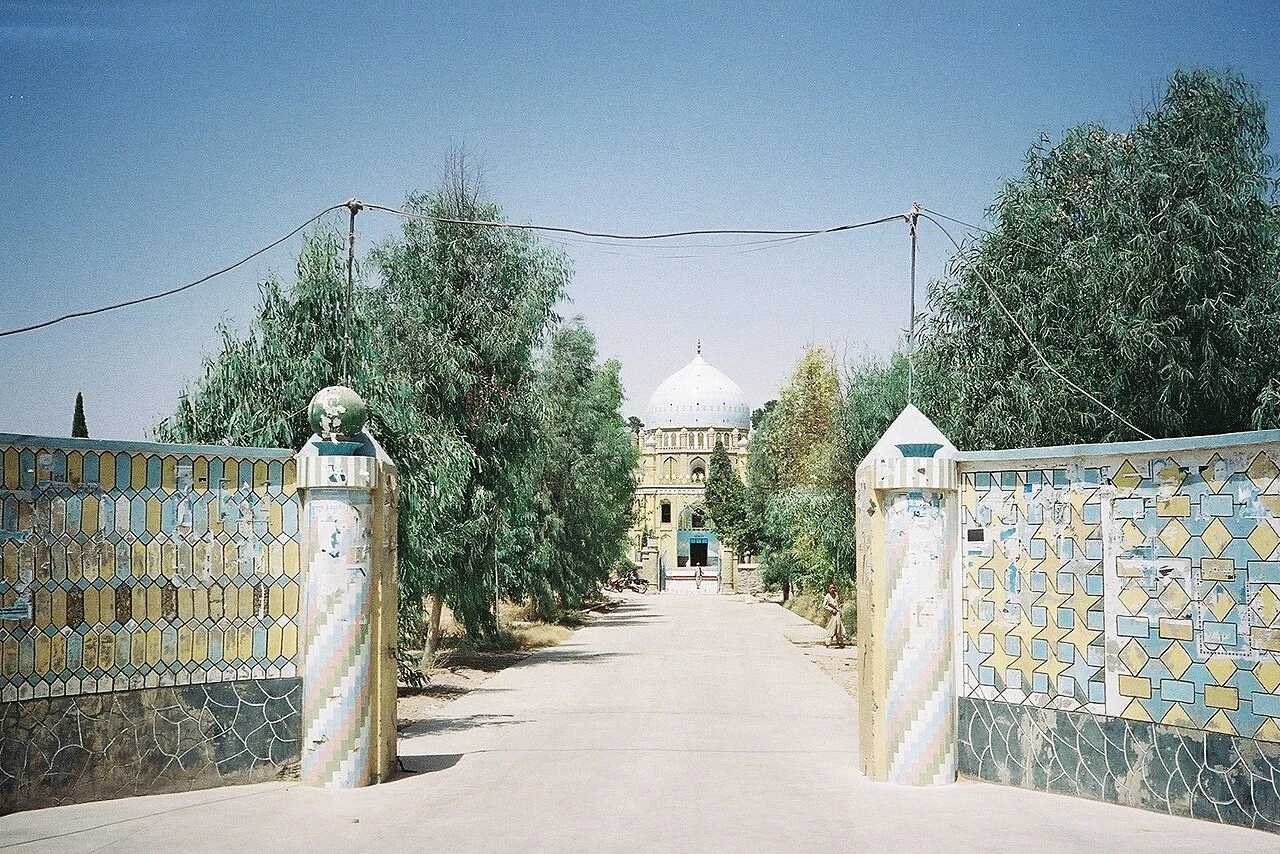
The tomb of Mirwais Khan Hotak (died 1715) in Kandahar.
The country around Qalat, the old Kalat-i Ghilzai, on 20 April 2009. Elphinstone places the Hotak in the tract south of here, mixed with the Tokhi.
The old fort above Qalat in Zabul, 15 May 2010.
Genealogy
The Hotak are a western Ghilzai tribe of the Turan branch. The Khulasat al-Ansab, quoted by Dorn, gives the line as Turani son of Ghilzai, then Babu, whose sons were Takhi (Tokhi) and Hottak. Hottak had four sons, Yusuf, Arab, Daulat and Malikyar, and Mir Wais descended from Hossain son of Malikyar. Bellew's lists of 1891 agree in outline: Turan has two clans, Hotak and Tokhi, together called Barn; the Hotak have four divisions, Malikyar, Yusuf, Daulat and Arab; and the Shah Alam khel, under the Husen branch of the Malikyar, was the family of Mir Wais and Shah Mahmud.
Elphinstone calls Turan the elder Ghilzai family and writes that the kings of the Ghilzai dynasty came from the Hotak and its viziers from the Tokhi. The Nasar pawindahs claimed descent from Hotak. The Hotak told Elphinstone, and later Ibbetson, that the Nasar had been their dependants, not their kin, and some called them Baloch.1,2,3,5,9
Mir Wais and the Hotak kings, 1709–1738
In the sixteenth and seventeenth centuries the Safavids and Mughals fought over Kandahar. Encyclopaedia Iranica writes that after Shah Abbas I (1587–1629) moved the Abdali to Herat, the Ghilzai, and the Hotak in particular, became the dominant people of the Kandahar country. In 1709 Mir Wais, a Hotak chief, killed the Safavid governor, the Georgian prince known to Afghan writers as Gurgin, took the city and declared it independent. The sources differ on the year: Elphinstone gives 1708, the Loralai gazetteer about 1709, and the Khulasat al-Ansab the hijri year 1110 (1698–99).
Mir Wais died in 1715 and his brother Abd al-Aziz succeeded him. Mir Wais's son Mahmud killed Abd al-Aziz in 1717, took Kirman in 1720 and in 1722 captured Isfahan, the Safavid capital. In 1725 his cousin Ashraf, son of Abd al-Aziz, overthrew him. Ashraf defeated an Ottoman army, and in 1727 the Ottomans recognised him as shah. Nadir Quli Khan, the future Nadir Shah, defeated Ashraf in 1729 and drove him out of Persia. Mahmud's brother Husain held Kandahar until 1738, when Nadir took it on his way to India. Husain and large numbers of Ghilzai were deported to Mazandaran, where their descendants, though assimilated, still claimed Ghilzai descent when Iranica's article was written.4,6,7,8,1
After the dynasty
Elphinstone found the Hotak reduced to five or six thousand families. They farmed and traded, kept large flocks and lived much in tents, mixed with the Tokhi south of the Mukur range. Their capital was Kala-i Abdur Rahim Khan in the small district of Ghwurra Murgha, a fort of little strength surrounded by black tents, and it was the chief seat of the descendants of the Ghilzai kings. The royal standing of the Shah Alam khel was still acknowledged across the tribe.
Abdur Rahim Khan, the representative of the royal family, held a pension from Shah Zaman besides his family estates. When the Ghilzai chiefs rose against the Durrani government in 1801, they offered him the crown, and he accepted with reluctance. His men were beaten near Kabul in November 1801. In the spring of 1802 the Ghilzai rose again, Elphinstone was told with fifty thousand men, and Abdur Rahim led the column sent against Kabul from the south. The Durrani won all three battles, and the last Ghilzai stand was broken at Mulla Shadi on 11 May 1802.10,11
Later records
Encyclopaedia Iranica names the Hotak, with the Tokhi and Kharoti, as the main western Ghilzai tribes. British records outside Afghanistan show only small numbers. The 1901 census of Loralai district in Baluchistan counted 90 Hotak among 3,184 Ghilzai there, and the district gazetteer names Sardar Muhammad Shah Khan Hotak as the most important Ghilzai headman settled in the district.4,12
ټاټوبی
سيوري شوې سيمې د نن ورځې ولسوالۍ او ولايتونه دي چې له geoBoundaries څخه اخيستل شوي. دا اداري کرښې دي، قومي پولې نه دي. Kandahar, Zabul.