The Barakzai are a Zirak Durrani tribe of Kandahar, the Helmand and the Arghandab, descended in tradition from Barik, son of Abdal. Their Muhammadzai section supplied Afghanistan's rulers from 1826 into the 1970s.
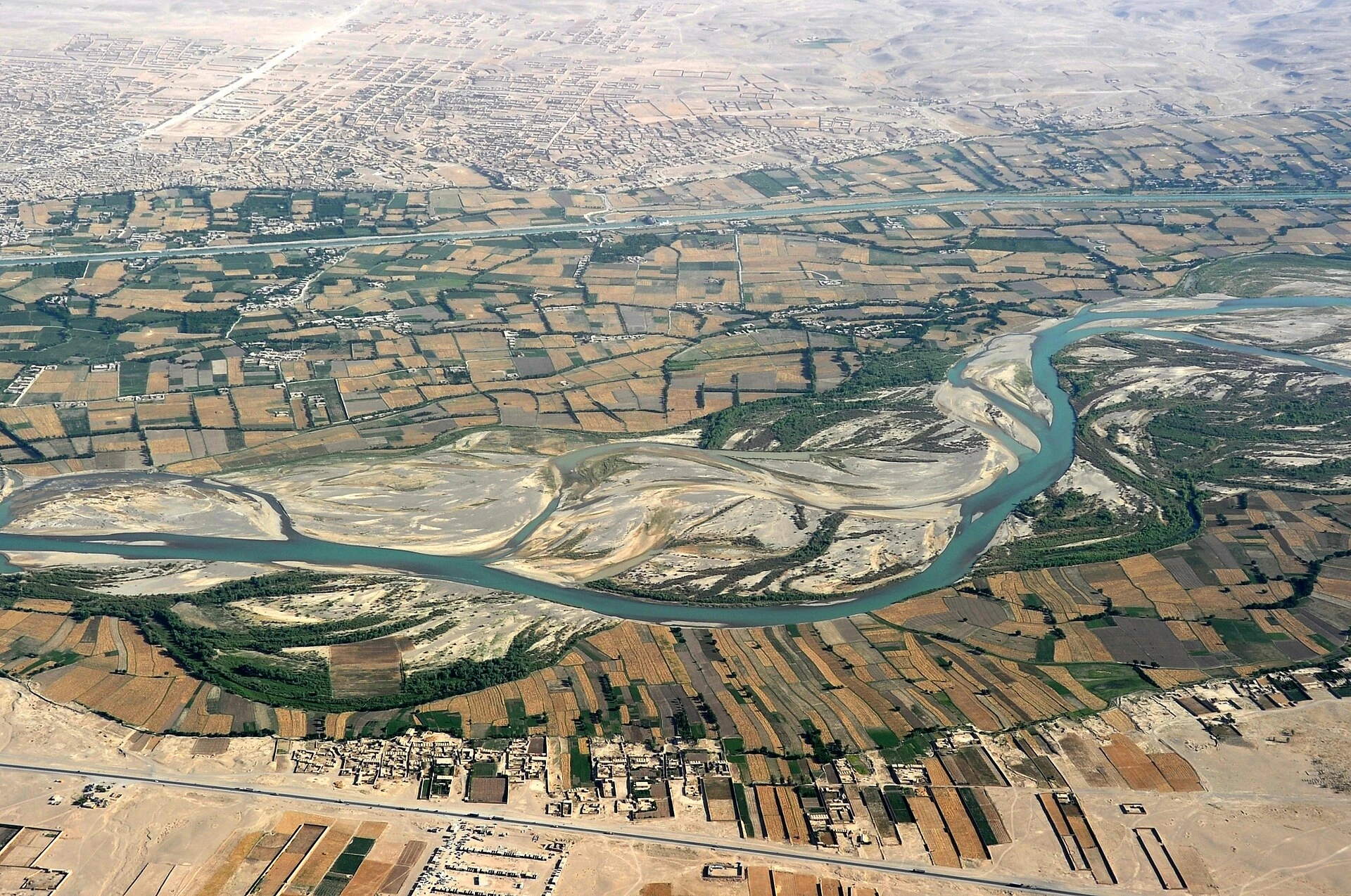
The Helmand river with the Boghra canal and the town of Gereshk beyond, May 2011.
Dost Mohammad and his youngest son, a lithograph from James Rattray's 'Afghaunistan' (drawn 1841, published 1848).
Amir Sher Ali Khan (1825–1879), a son of Dost Mohammad who succeeded him, photographed by John Burke in 1869.
Barak and the Muhammadzai
In the Makhzan-i Afghani (1609–11) Barik is a son of Abdal, son of Tarin. The Khulasat al-Ansab makes Barek a son of Abdal's son Firak. Elphinstone and Bellew count the Barakzai among the four Zirak clans of the Durrani.
Encyclopaedia Iranica (D. Balland, 1988) finds the name Barakzai at seven levels of the Pashtun genealogies, and only the Durrani tribe is well documented. Afghan genealogists place Barak in the fourteenth century, perhaps as a contemporary of Timur. The tribe's name is first attested under the Safavids, when a Barakzai notable, Mohammad Khan, went on a mission to Shah Abbas I; he is the eponym of the Muhammadzai section. Balland rejects Bellew's derivation of the name from the Baraki of Logar on philological grounds and prefers a link with the Turkish name Barak. He gives five subtribes: Abdullahzai, Baizai, Nasratzai, Nur-al-Dinzai and Rukn-al-Dinzai. The Nur-al-Dinzai produced both the Muhammadzai and the Achakzai.1,9,2,3,4
Arghasan, the Helmand and the south of Kandahar
In the Safavid period the Barakzai retreated with the other Abdali towards Herat. After Nadir Shah took Kandahar in 1738 they received large tracts in the lower Arghasan valley on the southern edge of the Kandahar oasis. Elphinstone, writing in 1815, placed them south of Kandahar, in the Arghasan valley with its castles of Barakzai khans, on the banks of the Helmand and in the dry plains on either side. Most were then shepherds, and they numbered at least 30,000 families. Bellew described the same lands, from the Toba and Margha plateaux west to the Garmsir and south to Shorawak.4,7,3
From Sadozai allies to rulers, 1747–1978
The Barakzai sardars helped put Ahmad Shah on the throne in 1747 and supplied 907 horsemen to his army. Their chief Payanda Khan, of the Muhammadzai, was Zaman Shah's main ally until Zaman had him killed in 1799 on a charge of conspiracy. The tribe then backed Zaman's half-brother Mahmud, whose mother was a Muhammadzai, and Payanda Khan's eldest son Fateh Khan became Mahmud's chief adviser. Elphinstone wrote that in his time the grand vizier and almost all the great officers of state were Barakzai. In 1818 Mahmud's son Kamran killed Fateh Khan, and Fateh Khan's half-brother Dost Mohammad drove Mahmud from Kabul in 1819. Dost Mohammad secured Kabul in 1826 and took the title amir al-mu'minin in 1836.
The British removed Dost Mohammad in 1839. Barakzai chiefs were among those who led the Kabul rising of November 1841, and Dost Mohammad returned in 1843 and reigned until 1863. His line, the sardars of Kabul, ruled until 1929. The rival line, descended from his half-brother Sultan Mohammad Telai of Peshawar and known as the Musahiban, took the throne with Nader Shah in 1929. It held it until 1973 and kept power under the republic of Mohammad Daud until 1978. Balland reckons the Barakzai held power for about a century and a half, during which the Muhammadzai filled the upper ranks of the civil and military administration and settled in Kabul and the provincial capitals.4,5,7,8,6
Where the Barakzai live
Balland describes three areas of Barakzai settlement. The oldest, between Herat and the Helmand, held 1,264 Barakzai families in Herat province in 1885; by 1978 the remaining nomads there had largely shifted from Pashto to Persian. The main centre is the Kandahar oasis and the middle Helmand. A 1975 sample census made them about 21 per cent of the settled population of Helmand province, between 70,000 and 100,000 people, and nearly half the population of the Gereshk, Lashkar Gah and Shamalan districts. A central quarter of old Kandahar bears their name. A third, smaller group of 1,294 nomadic and seminomadic families lived in northern Afghanistan in 1978, around Kunduz, Baghlan and the Balkhab.4
ټاټوبی
سيوري شوې سيمې د نن ورځې ولسوالۍ او ولايتونه دي چې له geoBoundaries څخه اخيستل شوي. دا اداري کرښې دي، قومي پولې نه دي. Helmand, Herat, Kabul, Kandahar.