At a glance
The tomb of Ahmad Shah Durrani, called Ahmad Shah Baba in Afghanistan, stands on the west side of Kandahar's central north-south street, on a basalt platform under a blue-tiled dome. [4, 5]
It is octagonal. Nancy Dupree's guide of 1977 describes beige brick walls outlined in tile, small minarets round a drum, and a dome of blue tile. [4]
The Kherqa Sharif shrine, which holds the cloak believed to be the Prophet's, stands just in front of it. Both stand on the west side of the central street, between the Shah Mosque and the Idgah gate. [5]
Who built it is not settled: the Encyclopaedia Iranica says the king built it as part of his plan for the new city, and the Impart encyclopedia says his son Timur Shah probably oversaw the work. [5, 7]
Raverty wrote in 1862 that no one dared touch a man who had taken refuge at the tomb. [2]
A tile inscription inside gives the date of his death as 1186 AH (1772). [4]
The king laid out the city and the tomb
Ahmad Shah's life and the founding of the kingdom are told in Ahmad Shah and the founding of the Durrani state, and the city he built is described in Kandahar: an oasis city and its long history. Here the subject is the building.
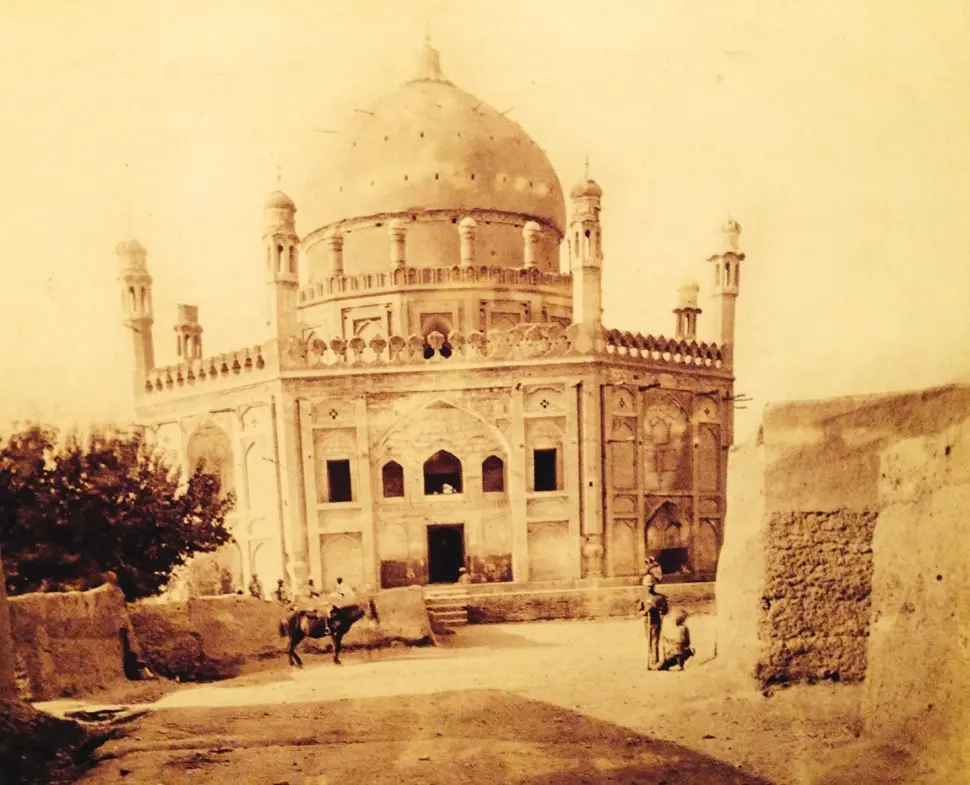
The entrance to the tomb of Ahmad Shah Abdali (Durrani) in Kandahar, photographed by Benjamin Simpson about 1880.
Benjamin Simpson· Public domain
Gérard Fussman, writing in the Encyclopaedia Iranica, says the octagonal mausoleum was built by the king himself as part of his plan for the new city. [5] The Impart encyclopedia of South Asian art gives a more careful account. It says the tomb and the shrine were probably overseen by his son and successor Timur Shah, on a site Ahmad Shah had chosen, and that Ahmad Shah was buried in a mausoleum whose building was already under way. [7] The two do not quite agree, and neither names a mason or a year for the finish.
Dupree notes something else about the king's building. At Sher Surkh, south-east of the city, where he had been crowned, he raised a dome over the tomb of a saint. She calls that village shrine a symbol of the simple beginnings of a tribal chief, and the Kandahar mausoleum, "highly ornate", a memorial to the achievements of an empire builder. [4] That is her reading, not a quotation from the king.
The shape of the building
Dupree's guide, written when the building was open to visitors, gives the fullest description. The octagon stands on a basalt platform. Its plain beige brick walls are broken by niches of different heights and depths, outlined in yellow and green, and green and blue, tile. Tall minarets joined by a floral balustrade rise from the main body. Behind them a second set of short minarets stands on shallow niches outlined in blue, round a drum that carries a dome of blue tile. [4]
The Impart entry adds measurements: fired brick under lime plaster, a lower octagon with a much smaller second tier, a dome about 9 metres across and a total height of about 24 metres. [7] It describes honeycomb vaulting under several arches, in gold and lapis paint, and a white parapet of merlons on the lower storey with a minaret at each of the eight corners. [7] Dupree says the undersides of the main arches carry the same honeycomb pattern, with half circles centred in lapis and gold to resemble flowers. [4]
Inside, the plain outside gives way to colour. Dupree finds carpets on a marble floor, a painted and gilded floral dome, and a dado of blue-green tile with touches of yellow and brown that she says was made in Kandahar and differs from the tile of Herat. [4] The cenotaph is of Kandahari marble under a gold-embroidered cloth of deep wine velvet. [4] Impart says it sits a little off the centre of the chamber and is cut from a white limestone quarried at Maiwand, and that the graves of the king and his family lie in a chamber below. [7] Beside it, Dupree saw copies of the Quran on a table and, in a glass case, a gold-inlaid helmet, gauntlets and a silver-inlaid sceptre with a two-headed bird, the arms with which, Dupree says, he went to battle. [4]
What the tiles say
On the eight cornices under the corner niches runs an inscription in white on lapis-blue tile. Impart says it is in nastaliq script and praises the king and records the year of his death. [7] Dupree gives it in English:
The king of high rank, Ahmad Shah Durrani, was equal to Kisra in managing the affairs of his government. In his time, from the awe of his glory and greatness, the lioness nourished the stag with her milk. From all sides in the ear of his enemies there arrived a thousand reproofs from the tongue of his dagger. The date of his departure for the house of mortality was the year of the Hijra 1186. [4]
Kisra is Khosrow, the Persian king of proverbial justice. The year 1186 AH falls in 1772, which Dupree adds in her own brackets. The exact day of his death differs between the historians, as the founding article says.
The Cloak of the Prophet
The tomb cannot be told apart from the shrine beside it. The Kherqa Sharif, in Pashto خرقه شريفه, Da Kherqa Sharifa ziarat, "the shrine of the noble cloak", houses the garment that Afghans believe belonged to the Prophet Muhammad. Fussman gives its building as about 1770, and says it was embellished about 1908 and is covered in green marble and twentieth-century tiles. [5]
How the cloak came to Kandahar is told several ways. Dupree says Ahmad Shah received it from Murad Beg, amir of Bokhara, in 1768, as part of a treaty fixing the northern boundaries. [4] Abdul Hai Habibi, the Afghan scholar who edited the king's Pashto poems in 1940, writes in his short life of the king that he brought the cloak to Kandahar from Badakhshan. [1] Afghans told the American journalist Steve Inskeep in 2002 a story of a promise: the keepers in Bokhara would let the king borrow the cloak only if he did not take it far from a certain stone, so he had the stone dug up and carried to Kandahar with it, and it now stands on a pedestal near the shrine. Inskeep gives this as a legend whose truth he could not vouch for. [9] M. Jamil Hanifi says only that the cloak is popularly believed to be the Prophet's and is said to have been brought by Ahmad Khan Abdali. [6]
The Impart entry adds a debate about the tomb itself. Its authors say the cloak reached Kandahar in 1769, and that scholars suggest the king or Timur Shah meant it to hang under the tomb's dome, because the relic carried a claim to rightful rule. They point to the off-centre cenotaph as a sign that the middle of the chamber was kept for it. They say that religious scholars objected to using the cloak as a political tool, that a separate shrine was built in 1776, and that a fatwa later forbade moving it. [7] That is a modern interpretation and Dupree and Fussman do not mention it.
Dupree records how seldom the relic is seen. It was shown when King Amanullah tried to rally the tribes in 1929, and in 1935, during cholera in Kandahar, it was carried in procession to the Idgah mosque north of the city for prayers. [4] The Taliban leader Mullah Omar wore it at a public rally in 1996, a move that Inskeep calls propaganda meant to link himself with the Prophet. [9]
A sanctuary
The tomb has long been a place to take refuge. Raverty, a British officer who published his translations of Pashto poetry in 1862, wrote that the tomb of Ahmad Shah stood near the palace at Kandahar, was held in great esteem by the Durranis and was respected as a sanctuary, no one venturing to touch a man who had taken refuge there. He added that men of the highest rank often gave up the world and spent their lives at the king's tomb. [2] The Impart entry says the British chronicles written after the first Anglo-Afghan war record that the tomb and the Kherqa Sharif were believed to be asylums outside the reach of the law. [7] The later British newsletters that show Hindus and Muslims taking sanctuary at the Kherqa shrine under Abdur Rahman are described in Kandahar: an oasis city and its long history.
Through the wars
The tomb appears in the first photographs of Kandahar. Benjamin Simpson photographed its entrance about 1880, during the second Anglo-Afghan war, when a British army held the city, and the National Army Museum keeps his print. [8] The French officer Ferrier, who crossed Afghanistan in the mid-1840s, wrote that the mosque containing Ahmad Shah's tomb was the only fine monument in the town. [3] That is his judgement of the building, not a verdict on the city.
Dupree reports that the shrine was repaired and its whole outside embellished under Amir Habibullah while Mohammad Usman Khan governed Kandahar: tile from the workshop of the master tile-maker Nek Mohammad, and arches gilded and painted by Sufi A. Hamid in 1908. A new door inlaid with lapis, travertine and silver was fitted in 1974. [4] Impart says the mausoleum was restored extensively between 1960 and 1967, and that Western agencies reportedly paid for work on it, the Kherqa Sharif and the Shah Maqsud shrine in the early 2000s. [7] Inskeep saw the shrine in January 2002 in a bomb-damaged city, with fresh graves near the tomb. [9]
The tomb was also a model. Mir Wais Hotak's mausoleum at Kokaran, outside the city, was built in 1930 on the pattern of Ahmad Shah's and is smaller. [5] Dupree says it has no interior decoration and replaced a bare grave inside a low mud wall. [4] The stories of the two men are in Mirwais Hotak: the Ghilzai chief who freed Kandahar in 1709.
Visiting it
Dupree describes the visit as it was in the 1970s. Shoes are removed before entering. The interior was generally open on Thursdays and at times closed to non-Muslims. The fee for the mausoleum and the Kherqa Sharif together was 20 afghanis, and she says a gift to the caretaker on leaving is appropriate. Visitors could not see the relic. [4]
Baba
In Afghanistan the king is Ahmad Shah Baba, "Father Ahmad Shah". Dupree says that after his campaigns against Lahore, Delhi and Kashmir and in the north he won an empire and this title, "the Father of Afghanistan". [4] The title is on the 1940 Kabul edition of his poems, edited by Habibi for the Pashto Tolana: Loy Ahmad Shah Baba aw da de winawi, "Great Ahmad Shah Baba and his sayings". [1] The poems themselves are the subject of Ahmad Shah Durrani's diwan: the king's Pashto poems.
Habibi's long introduction shows how a modern Afghan scholar read him. A section deals with the king's love of country, and another with national unity. There Habibi writes that Ahmad Shah gathered the peoples of Afghanistan under one name and saved them from the divisions and quarrels between Ghilzai and Durrani, Pashtun and Tajik. [1] Whether that is a fair picture of an eighteenth-century Durrani king or a view shaped by Habibi's own time is a question for historians. The article on the Durrani confederation sets out how the Durrani and Ghilzai stood towards each other.
Kandahar's later place fits the same memory. Hanifi writes that Kandahar kept its standing as the cultural and symbolic home of the Durrani and western Ghilzai confederations, with the tombs of Ahmad Khan Abdali and Mir Wais Hotak, one inside the city and one at Kokaran. [6] Ferrier wrote that Kandahar lost its title of capital under Timur Shah for having supported his brother Suleiman Mirza's claim to the throne. [3] The court left for Kabul and the tomb stayed. How the court's move to Kabul changed the city is the subject of Kabul and its Pashtuns, and the later Sadozai kings are in Timur Shah, Zaman Shah and the Sadozai kings.
Common questions
Where is Ahmad Shah Durrani buried?
He is buried in an octagonal mausoleum in the centre of Kandahar, on a basalt platform under a blue-tiled dome. It stands just behind the Kherqa Sharif, the shrine of the cloak believed to be the Prophet's.
Who built Ahmad Shah's tomb?
The Encyclopaedia Iranica says Ahmad Shah built it himself as part of his plan for Kandahar. The Impart encyclopedia says his son Timur Shah probably oversaw the work, which was already under way when the king died in 1772.
What is the Kherqa Sharif?
It is the shrine beside the tomb that holds a cloak Afghans believe belonged to the Prophet Muhammad. Dupree says Ahmad Shah received it from the amir of Bokhara in 1768, while Habibi writes that he brought it from Badakhshan. It is shown very rarely, as in 1929, 1935 and 1996.
Why is he called Ahmad Shah Baba?
Baba means father, and Afghans call him Ahmad Shah Baba, the Father of Afghanistan, as Dupree notes. Abdul Hai Habibi used the name in the title of his 1940 edition of the king's poems and wrote that the king united the people of Afghanistan under one name.
Was the tomb a sanctuary?
Raverty reported in 1862 that no one dared touch a man who had taken refuge at the tomb, and that men of high rank sometimes gave up the world to live there. Later British records describe the tomb and the cloak shrine as asylums.
Pictures (3)
Gallery
3 images
Kandahar in February 1879, with the mausoleum of Ahmad Shah in the distance.
The Kherqa Sharif shrine in a Library of Congress photograph of about 1879 to 1880.
The Friday Mosque of Kandahar, whose compound also holds the tomb of Ahmad Shah Durrani and the shrine of the Cloak of the Prophet, photographed in 2010.
Sources
Primary sources
Written at the time: memoirs, chronicles, official documents and census returns.
- Back to textAbdul Hai Habibi (ed.), Loy Ahmad Shah Baba aw da de winawi (Kabul: Pashto Tolana, 1319 AH / 1940), introduction
The title with Baba; the sections on love of country and national unity; the cloak brought from Badakhshan; burial at Kandahar. Page images read for the front matter and some pages; the passages used come from the OCR.
Colonial records
Gazetteers, glossaries and reports by British officers and travellers, 1815–1947. They describe the tribes as their authors found them, and for the uses of the colonial government.
- Back to textH. G. Raverty, Selections from the Poetry of the Afghans (London: Williams and Norgate, 1862), p. 293
The tomb as a sanctuary and a place of retreat. Raverty was a British officer; used as a witness. Read in the archive.org OCR text.
- Back to textJ. P. Ferrier, Caravan Journeys and Wanderings in Persia, Afghanistan, Turkistan and Beloochistan (London: John Murray, 1856), chapter XXII, Kandahar
His remark on the mosque that holds the tomb, and Kandahar losing the title of capital under Timur Shah. A French officer's account; read in the archive.org OCR text.
Modern scholarship
Books and papers by historians, anthropologists, linguists and geneticists.
- Back to textNancy Hatch Dupree, An Historical Guide to Afghanistan (Kabul: Afghan Tourist Organization, 1977), pp. 55, 282–284, 293–294
The Baba title, the building's description, the inscription in English, the cenotaph and relics, the cloak (1768), repairs of 1908 and 1974, the relic shown in 1929 and 1935, the Sher Surkh dome, Mir Wais's tomb and visiting rules. Read in the archive.org OCR text; the page numbers come from its running heads.
Reference works
Encyclopaedias, country studies and museum records.
- Back to textGérard Fussman, 'Kandahar ii. Pre-Islamic Monuments and Remains', Encyclopaedia Iranica, vol. XV, fasc. 5 (2010), pp. 475–477
Built by the king as part of his city plan; basalt platform and blue dome; position behind the Kherqa shrine; shrine date c. 1770 and 1908; Mir Wais's tomb of 1930 as a copy. Read through a Wayback copy.
- Back to textM. Jamil Hanifi, 'Kandahar vi. 20th Century, 1901–73', Encyclopaedia Iranica, vol. XV, fasc. 5 (2010), pp. 487–490
Kandahar as the symbolic home of the Durrani and western Ghilzai; the two tombs; the cloak as popular belief. Read through a Wayback copy.
- Back to textImpart Encyclopedia of Art, 'Tomb of Ahmad Shah Durrani, Kandahar' (8 May 2024)
Probable oversight by Timur Shah, measurements, materials, the off-centre cenotaph and the cloak debate, the 1776 shrine, sanctuary reports, restoration in 1960–67 and the early 2000s. Read through a Wayback copy.
- Back to textBenjamin Simpson, 'Ahmed Shah's Tomb, from Khirka Sharif', 1880, National Army Museum, NAM 1951-01-43-24
The photograph of about 1880.
News and magazines
Newspapers, broadcasters and magazines, for recent events and life today.
- Back to textSteve Inskeep, 'The Cloak of the Prophet', NPR, 10 January 2002
The stone legend, the cloak shown in 1996, the shrine in January 2002.
Related articles
- Ahmad Shah and the founding of the Durrani state
- Ahmad Shah Durrani's diwan: the king's Pashto poems
- Kabul and its Pashtuns: the capital from Timur Shah to the Taliban
- Kandahar: an oasis city and its long history
- Mirwais Hotak: the Ghilzai chief who freed Kandahar in 1709
- The Durrani confederation
- Timur Shah, Zaman Shah and the Sadozai kings, 1772–1826
Improve this article
- Suggest an edit
Know something we missed, or a better way to put it? Suggest a change; an editor reads it before it appears.
- Report an error
Think a fact, date or name is wrong? Tell us which and why, with a source if you have one.
- Add a source
Have a book, paper or document that backs up a claim? Add it.
- Translate into Pashto
Read both Pashto and English? Help put this article into Pashto.
Noticed a mistake or a missing source? Here's how we correct things


