The Tarkalani (Tarkani) are the tribe of Bajaur, with a section left in Laghman. In the Makhzan-i Afghani Tarkalani is a son of Sheikha (Khakhay) and a brother of Yusuf.
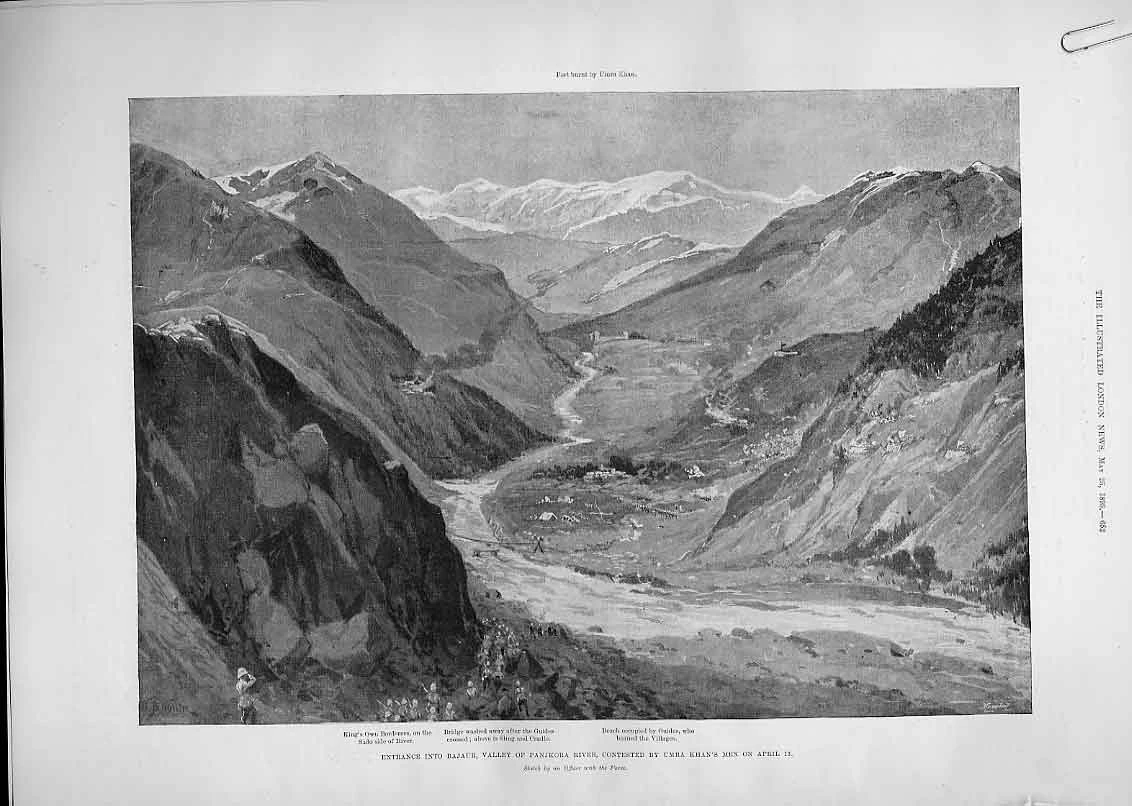
The entrance to Bajaur by the Panjkora valley, contested by Umra Khan's men on 13 April 1895, from the Illustrated London News.
Babur receiving prisoners after taking the fort of Bajaur in 1519, Mughal painting of about 1590.
Map of Mamund tehsil, Bajaur district, the Watalai valley of the Mamund clan (2024).
Qalacha in the Laghman valley, May 2018. Laghman was the Tarkalani home before Bajaur.
A Khakhay tribe and its four clans
In the Makhzan-i Afghani (1609–11) Tarkalani is a son of Sheikha, the ancestor called Khakhay in other genealogies, and so a brother of Yusuf, whose descendants are the Yusufzai. The Khulasat al-Ansab gives Khak'hai three sons, Mandar, Muk and Tarkalan, and counts among the Tarkalani "Mahmud, who is known by the name of Momund". This is the Mamund clan of Bajaur, a different people from the Mohmand. Bellew (1891) rejects the Afghan descent and calls the Tarkalani a mixture of Turkish clans who took up Pashto and Pashtunwali. None of the genealogies supports him.
The 1910 Dictionary of the Pathan Tribes, which spells the name Tarkani or Tarklanri, gives four clans: the Isazai of the Jandol valley, the Mamund of the Watalai valley, the Salarzai, and the Ismailzai, also called Samilzai.1,2,10,4,11
From Laghman to Bajaur
Ibbetson tells how the Khakhay tribes, driven from Kabul by Ulugh Beg in the second half of the 15th century, moved into Ningrahar, where the Tarkalani took Laghman. Elphinstone likewise says Laghman was then in Tarkalani hands. Caroe describes them sending an advance party into Bajaur and turning back the Gigiani, who also wanted land there. When the Yusufzai and a Khalil section fought the Dilazak chief of Bajaur, Malik Haibu, about 1517, the Tarkalani joined the battle and a Tarkalani named Burhan killed Haibu with one sword stroke. In the later war against the Ghoria Khel, the Tarkalani, "not yet effectively settled in Bajaur", sent 200 horsemen to the Yusufzai army.
By the 16th century, the Imperial Gazetteer says, the Gigiani and Tarkalani were established in Bajaur. Elphinstone thought the Tarkalani took the country "some years afterwards" from the Deggauns. A section of the tribe stayed behind in Laghman, where Ibbetson records them still living in his day.6,5,7,8
Bajaur under its khans
Elphinstone (1815) describes Bajaur as an undulating plain about 25 miles by 12, as fertile as Peshawar, with two towns, Bajaur and Nawagai, of about a thousand houses each. He counted the Tarkalani at ten or twelve thousand families, living among converted Kafirs in the upper hills, Hindki speakers lower down and mixed cultivators on the plain. Their chief, called the Bauz, had great power over the tribe: he took tribute and rent worth a hundred thousand rupees a year, kept some hundreds of horsemen and sent 500 men to the Durrani army. When Elphinstone wrote, two nephews of the late Bauz were disputing the chiefship and the tribe was split between them.
The Imperial Gazetteer (1908) names five valleys in Bajaur: Chaharmung and Babukara held by the Salarzai, Watalai by the Mamund, and the Rud and Sir Kamar valleys with mixed populations. The Khan of Nawagai was the nominal hereditary chief of all Bajaur, with minor khanates under his relatives, but tribal business was settled in the jirga of the party in power, where every landowner had a vote.3,8
Umra Khan, 1897 and the Mamund valley
From 1877 Bajaur was drawn into the wars that followed the death of the Akhund of Swat. Umra Khan of Jandol, the valley of the Isazai clan, conquered much of Dir in the 1880s. In 1887 a coalition that included the Salarzai and the Mamund fought him and lost. His defeat in the Chitral campaign of 1895 sent him to Kabul in 1896.
In the frontier rising of 1897 the Malakand Field Force sent a column into the Mamund valley. On 16 September 1897 the 2nd Brigade under Brigadier-General Jeffreys entered the valley from its camp at Inayat Kila to burn the fortified villages and met heavy resistance. Churchill, who was with the brigade, describes the Mamund as anxious for peace afterwards, while allies from across the border wanted to fight on. The Imperial Gazetteer records only that columns were sent to enforce the submission of the Mamund. In 1910 the Dictionary of the Pathan Tribes gave the Mamund 12,000 fighting men in the Watalai valley, with villages on both sides of the Durand Line.8,4,9,11
ټاټوبی
سيوري شوې سيمې د نن ورځې ولسوالۍ او ولايتونه دي چې له geoBoundaries څخه اخيستل شوي. دا اداري کرښې دي، قومي پولې نه دي. Bajaur, Kunar, Laghman.