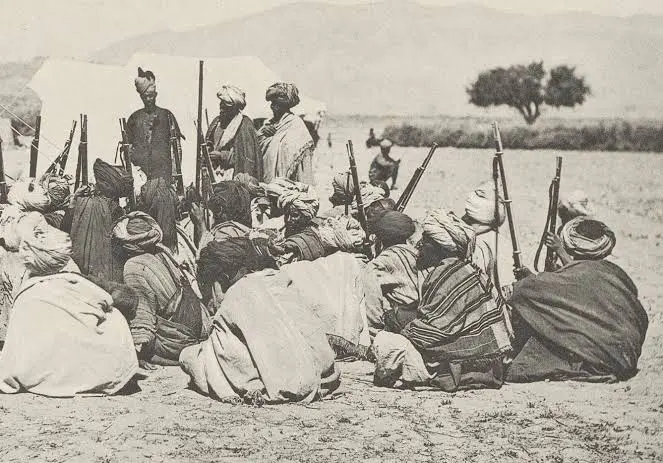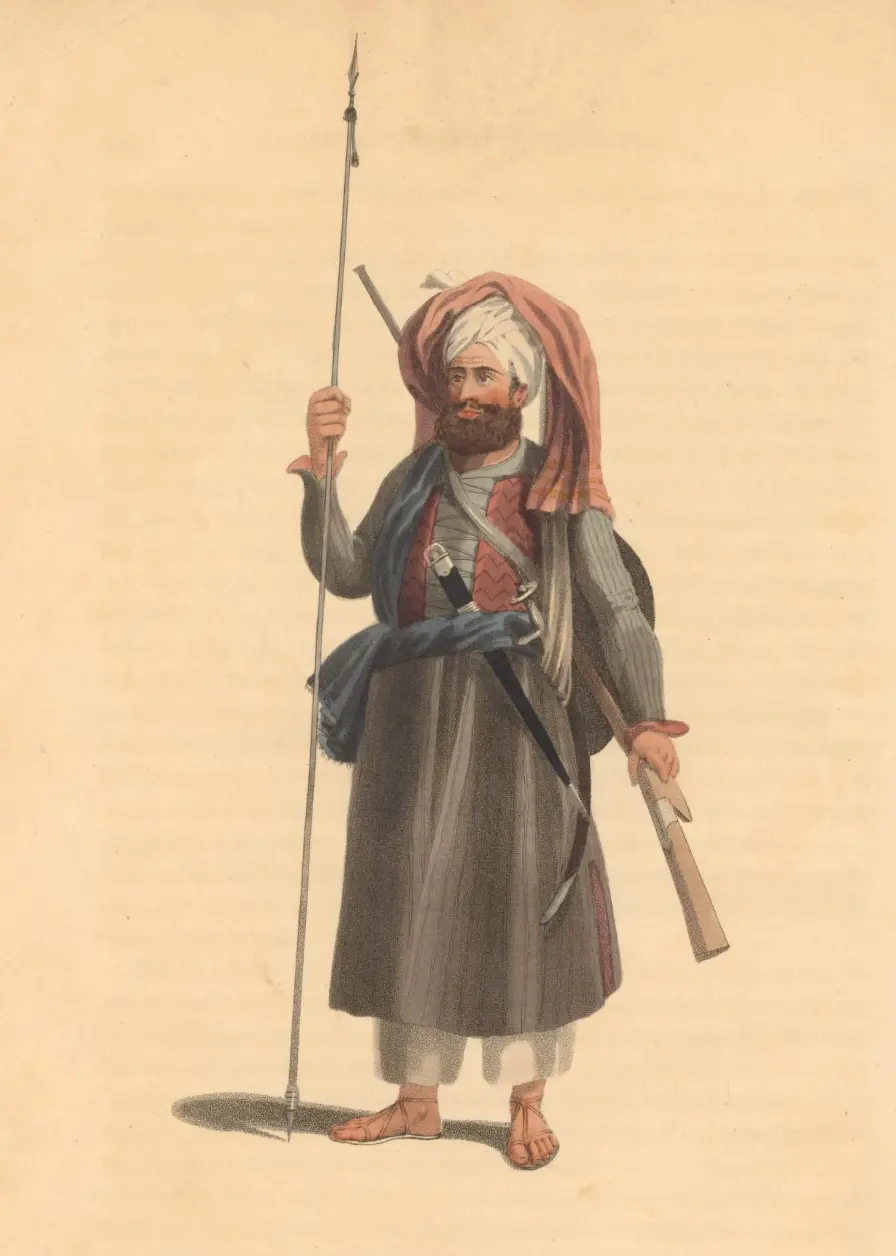
The Ormur (Aor-marr اورمړ) or War-mur, also known as Baraki, is an ancient tribe of Afghans. The name Ormur literally means "fire extinguished" in Pashto. According to the genealogies, the Urmar Afghans are descended from Amar-ud-Din or Amar Din, son of Sharkabun, and are near kinsmen of the Duranis [1]. Raverty cites the Afghan tradition as follows:
"The derivation of the name Aor-Mar is as follows, for it is but a by-name. His mother, who was his father's first wife, was the daughter of a blacksmith, or, rather, one who worked in iron; and his step-mother sometimes, in anger, when he did not do something or other to her satisfaction, would say, by way of reproach, 'The blacksmith's "fire (اور—aor) is gone out (مړ شه — mar shah)"; and by degrees the name of "Aor-Mar clung to him.'" [2]
Other explanations of the name were recorded. Henry Bellew, writing of his 1857 mission to Afghanistan, said the Ormur had been fire-worshippers whose priest put out the sacred fire at the end of their weekly worship and called out "Or mar"; Raverty dismissed the story, remarking that fire-worshippers were not supposed to extinguish their fire [2]. Rose's Glossary called the derivation from ur "lamp" and mar "extinguisher" untenable [10]. Charles Kieffer, in the Encyclopaedia Iranica, gives the traditional reading "extinguishers of fire" from Pashto ôr "fire" and mər "dead, extinct", and suggests it may have been an unfriendly allusion by the Ormurs' neighbours [7].
According to Khulasatul-Ansab of Hafiz Rahmat Khan (1710-1774):
"Amerdin had one son, called Ormar : from Ormar, Amerdin's son, numerous issue sprang, which they call Ormar. The name of Amerdin, Ormar's father, has fallen into oblivion.'The Ormars have also khails among them ; but they have not been mentioned, because they are but little known. They all reside in the town of Kanigoram, contiguous to the Lohanis. Both the Bokies and Ziracks are descendants from him." [3]
The genealogies also make an Ormur the adoptive father of the Karlanri tribes. In one version recorded by Rose, two men of Urmur's family, Abdulla and Zakaria, were out hunting when one found an abandoned baby boy and the other a shallow iron cooking pot (karahai); they exchanged their finds, and the boy was named Karlanai [11]. The Khattak historian Muhammad Afzal Khan made Urmur himself find the child and later give him a girl of his family as a wife [11]. Olaf Caroe took the story as a sign that the Karlanri hill tribes sprang from an older stock that was not Pashto-speaking [9].
Kaniguram, Logar and Peshawar
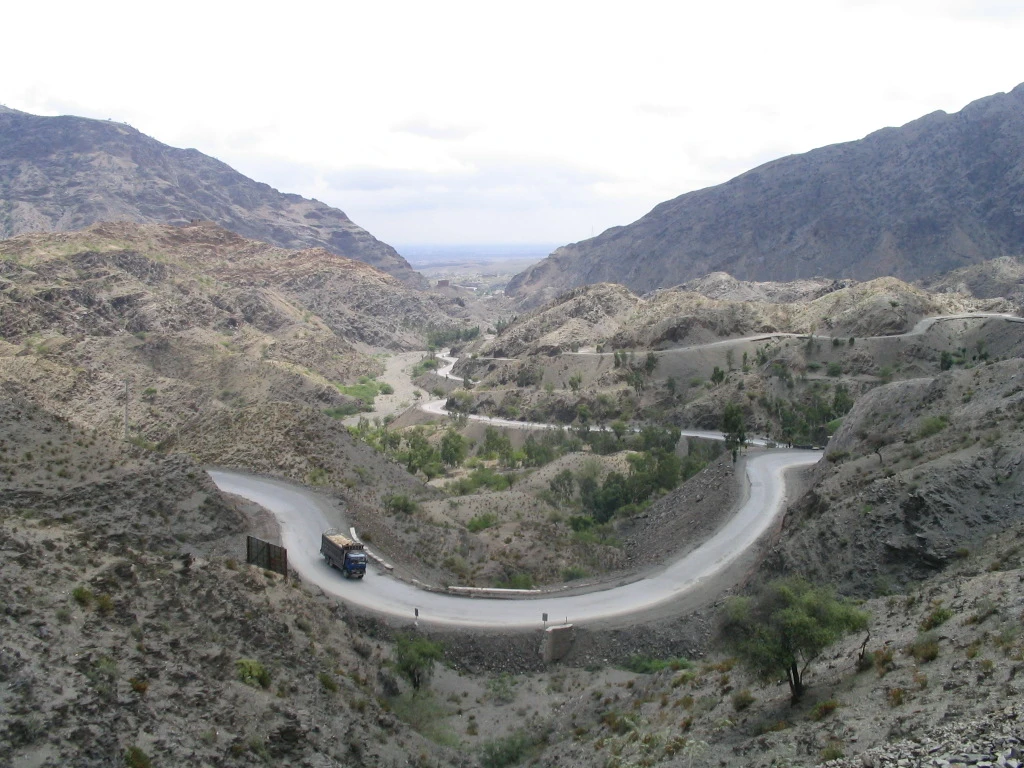
Although Karni-Gram (South Waziristan) is within the Mahsud territory, it is inhabited by Ormur Afghans, who formerly possessed the country round, were ousted from all else besides by the Waziris. Kani-guram still contains representatives of five Ormur branches, viz., the Khaikani, Kharin Jani, Malatani, Bekani and Jerani. The remainder of the Ormurs, pressed by want and the encroachments of Mahsuds, left their early homes centuries ago and settled in Logar, 80 km south of Kabul, where they still hold the village of Burki-Barak, and elsewhere [1]. They also have their three villages named after them in Peshawar district near Nowshera and Budbair.
Rose's Glossary tells the same story from the Wazir side: when the Wazirs moved east, they drove the Urmur out of the hills south of the Tochi to take refuge in the Logar valley, and the Mahsud seized the country that had belonged to them [10]. Caroe, who knew the Peshawar Ormurs, counted 400 Ormur houses and some 3,000 people at Kaniguram, where they were the trading community of the area. The three Peshawar villages are Urmar Bala, Urmar Miana and Urmar Payan, about ten miles south-east of Peshawar; their people speak only Pashto and have merged with the Mohmands and Khattaks around them, while keeping the belief that they are of older stock [9]. Smaller groups lived at Wana, at Butkhak and Chakari near Kabul, at Ormur-kalay and Hakim-khel in Wardak, and as far away as Maymana [7]. Rose recorded a Barak clan at Jalandhar (Jullundur) in the Punjab that had come from the Logar valley together with the Ansari shaikhs [11].
Burki-Barak is today's Baraki Barak, a village in Logar province of about 3,000 to 4,000 people before 1979. It was the seat of the local governor from the mid-nineteenth century until about 1970, when the administration moved to Pul-i-Alam, and it gives its name to a district of 329 square kilometres. Most of its Ormurs have now been absorbed into the Persian-speaking Tajik population, and the last Ormuri speakers in Afghanistan live in the fortified farmhouses (qalas) nearby. They call the place Gram, "village" [8].
Early accounts
The earliest information about Ormur or Baraki people comes from Babur (1483-1530). In his memoirs he writes:
"There are many different tribes in Kabul country ; in its dales and plains are Turks and clansmen and Arabs ; in its towns and in many villages, Sarts ; out in the districts and also in the villages are the Pashai, Parachi, Tajik, Baraki and Afghan tribes." [4]
In Annette Beveridge's translation the name is spelled Birki, and Babur also lists Birki among the eleven or twelve languages spoken in Kabul [4].
The author of Hayat-i-Afghani (completed in 1865) remarks:
"Being widely scattered and without cohesion, they are lightly esteemed in Afghanistan, where their peaceableness and orderly industrious habits, win for them only contempt. Those of Logar are wholly engaged in tillage, to which those of Peshawar add trade. The Ormurs of Kani-guram are both agriculturalists and artisans (chiefly spearmakers), but are very poor and much down-trodden by the Wazirs (i.e Mahsuds) among whom they live." [1]
Mountstuart Elphinstone, who visited the kingdom of Kabul in 1808, erroneously identified the Barakis of Logar as Tajiks. He writes:
"The next class of Taujiks are the Burrukees, who inhabit Logur and part of Boot-Khauk. Though mixed with the Ghiljees, they differ from the other Taujiks, in as much as they form a tribe under chiefs of their own, and have a high reputation as soldiers. They have separate lands and castles of their own, furnish a good many troops to government, closely resemble the Afghauns in their manners, and are more respected than any other Taujiks. Their numbers are now about eight thousand families." [5]
Elphinstone added that all their traditions agreed that Sultan Mahmud of Ghazni settled them in their lands at the beginning of the eleventh century, and that they claimed Arab descent, though others said they came from the Kurds [5].
In 1837 Agha Abbas of Shiraz visited Kaniguram and described it as follows:
"26th Shawal— Arrived at Kaneeguram, which is the capital of the Wuzeeree country. The cultivation is carried on by running streams. The inhabitants are Sayads [i.e. Ormurs], who are the spiritual fathers of the Wuzeerees. The houses are upper storied, and amount to four hundred. There are two large towers for the protection of the town. There are thirty-two shops, as follow; viz. sixteen of Hindoos, seven blacksmiths and cutlers, three goldsmiths, two scabbard makers, and four dyers. The headmen are Durvesh Khan, Sarwar Khan, Mulook Khan, Abdukahman Khan, Raim Khan, and Noor Khan. The amount of fighting men is five hundred. The Sayads are farmers; the Wazeerees are independent, and are mostly herdsmen." [6]
Pir Roshan of Kaniguram
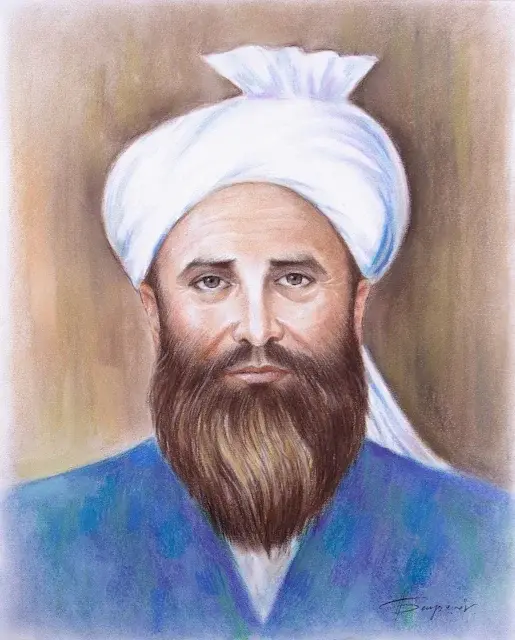
Bayazid Ansari, the founder of the Roshaniyya movement, known to his followers as Pir Roshan, "the Saint of Light", was born at Jalandhar in the Punjab in about 1525 to parents whose home was Kaniguram. His father was named Abdullah, and the family returned to Kaniguram soon after his birth [9]. Rose's Glossary says his father lived at Kaniguram and his mother's family at Jalandhar, and that Bayazid later lived as a hermit in a cave at Kaniguram, where he took the title Pir-i-Roshan [10]. Raverty wrote that Pir Roshan came from among the Aor-Mar tribe [2]. Bayazid claimed descent from the Ansar of Medina; Caroe thought the claim was made to raise his religious standing and called him "most certainly an Urmar by background if not by descent" [9]. Rose described him instead as a Tajik who had lived among the Barakki [10]. His life and teaching are covered in Pir Roshan and music.
Ormuri language
Ormuri is also known as Baraki, the endonym of its speakers. The native designation Bargista seems no longer used for the language [7]. Muhammad Hayat Khan described their language as "a peculiar Pashto which is mixture of Persian, Pashto and Hindi" [1]. Ormuri together with Parachi constitutes the Southeast Iranian language group [7]. The Ormur men of Kanigram are all bilingual or trilingual, speaking Ormuri, Pashto, and Urdu.
Ormuri has two dialects, those of Kaniguram and of Baraki Barak, about 160 km apart. In the 1970s, the last period for which Kieffer had reliable figures, Kaniguram had 2,000 to 3,000 speakers, for whom Ormuri was the home language of a prosperous community; they also spoke Pashto and Hindko or Sindhi. Around Baraki Barak fewer than fifty of the 300 to 400 Ormurs still spoke it, and scarcely a dozen fluently, mostly older people; Kieffer described the Logar dialect as becoming extinct [7]. Like Parachi, Ormuri keeps the initial voiced stops b-, d- and g-, the feature that marks the Southeast Iranian group, where Pashto has fricatives; its grammar shares so much with Pashto that Kieffer saw signs of a long coexistence [7].
The first word lists came from Lieutenant Robert Leech in 1838 and from Raverty, and George Grierson wrote the first full description of the Kaniguram dialect, based chiefly on a work by Ghulam Muhammad Khan [12]. In 1924 the linguist Georg Morgenstierne, working in Kabul, was told that Baraki was no longer spoken at Barak-i Barak; the Afghan Foreign Office brought an old man, Din Muhammad, from the village, who said he was one of the few people there still speaking pure Ormuri. Din Muhammad told him the Ormurs were Sayyids descended from Mir-i Barak, who came from Yemen. Morgenstierne gave little weight to the Arab and Kurdish origin stories but thought the tradition of a migration from Barak to Kaniguram was probably true [12].
دا قوم په کومه برخه کې دی
- د دې برخه
- Sharkhbun
د Ormur قوم پېژندنه
چېرته چې سرچینې سره توپیر لري
Lee's copy of the Makhzan and the Khulasat al-Ansab make Ormar a blacksmith's daughter's son. Rose says their customs prove they are not Afghans, and Caroe writes that the Urmars are not Pathans.
لنډه پېژندنه
- ټاټوبی
- Kaniguram in Waziristan, Logar, and three villages south-east of Peshawar
- نور نومونه
- Ormar, Urmur, Urmar, Aormar, Urmuria
د قوم د پېژندنې سرچينې
سرچینې
- Barmazid - Ormur tribe
- H. G. Raverty (1888), Notes on Afghanistan and Part of Baluchistan, p. 383 and note
Blacksmith's-fire derivation of Aor-Mar; Bellew's fire-worshipper story and Raverty's rejection; Pir-i-Roshan from the Aor-Mar tribe. Consulted 14 October 2026.
- Bernhard Dorn (trans.), History of the Afghans, translated from the Persian of Neamet Ullah, Annotations on Part II, p. 122
Quotes the Khulassat Ulansab on Amerdin, Ormar and the Ormars of Kanikoram. Consulted 14 October 2026.
- A. S. Beveridge (trans.), The Babur-nama in English, vol. I (1921), p. 207
Babur's list of the peoples of Kabul including the Birki, and of its eleven or twelve languages including Birki. Consulted 14 October 2026.
- Mountstuart Elphinstone, An Account of the Kingdom of Caubul, 2nd edition (1819), vol. I, pp. 498-499
Elphinstone on the Burrukees of Logar, their settlement by Sultan Mahmud and claims of Arab or Kurdish descent. Consulted 14 October 2026.
- Agha Abbas of Shiraz, 'Journal of a Tour through parts of the Panjab and Affghanistan, in the year 1837', arranged and translated by Major R. Leech, Journal of the Asiatic Society of Bengal 12, part 2 (1843), p. 588
The 26th Shawal entry describing Kaneeguram. Consulted 14 October 2026.
- Charles M. Kieffer, 'ORMURI', Encyclopaedia Iranica (2017)
Name and endonym, speaker numbers and locations in the 1970s, Logar dialect near extinction, Southeast Iranian classification, other Ormur settlements. Consulted 14 October 2026.
- Charles M. Kieffer, 'BARAKI BARAK', Encyclopaedia Iranica, vol. III, fasc. 7, p. 741
Baraki Barak village and district in Logar, its population, governor's seat until c. 1970, assimilation of its Ormurs, the name Gram. Consulted 14 October 2026.
- Olaf Caroe (1958), The Pathans 550 B.C.-A.D. 1957, pp. 23 and 200-201
The three Urmar groups (Kaniguram, Logar, Peshawar), Kaniguram's 400 houses, the Karlanri adoption story; Bayazid Ansari's birth at Jullundur to Kaniguram parents and Caroe's view that he was an Urmar. Consulted 14 October 2026.
- H. A. Rose, A Glossary of the Tribes and Castes of the Punjab and North-West Frontier Province, vol. III (1914), pp. 335-336, 483, 494
Bayazid's parents at Kaniguram and Jullundur and his hermitage there; the Urmur entry rejecting the ur/mar etymology; the Wazirs driving the Urmur to Logar. Consulted 14 October 2026.
- H. A. Rose, A Glossary of the Tribes and Castes of the Punjab and North-West Frontier Province, vol. II (1911), pp. 65, 476-477
Barak clan of Jullundur from Logar with the Ansari shaikhs; the Karlanai foundling story involving Urmur's family. Consulted 14 October 2026.
- Georg Morgenstierne (1929), Indo-Iranian Frontier Languages, vol. I: Parachi and Ormuri, introduction to Ormuri, pp. 307-311
Early descriptions of Ormuri (Leech, Raverty, Grierson), Morgenstierne's 1924 informant Din Muhammad of Barak-i Barak, origin traditions. Consulted 14 October 2026.
کومه تېروتنه یا ورکه سرچینه مو لیدلې؟ موږ تېروتنې څنګه سمې کوو