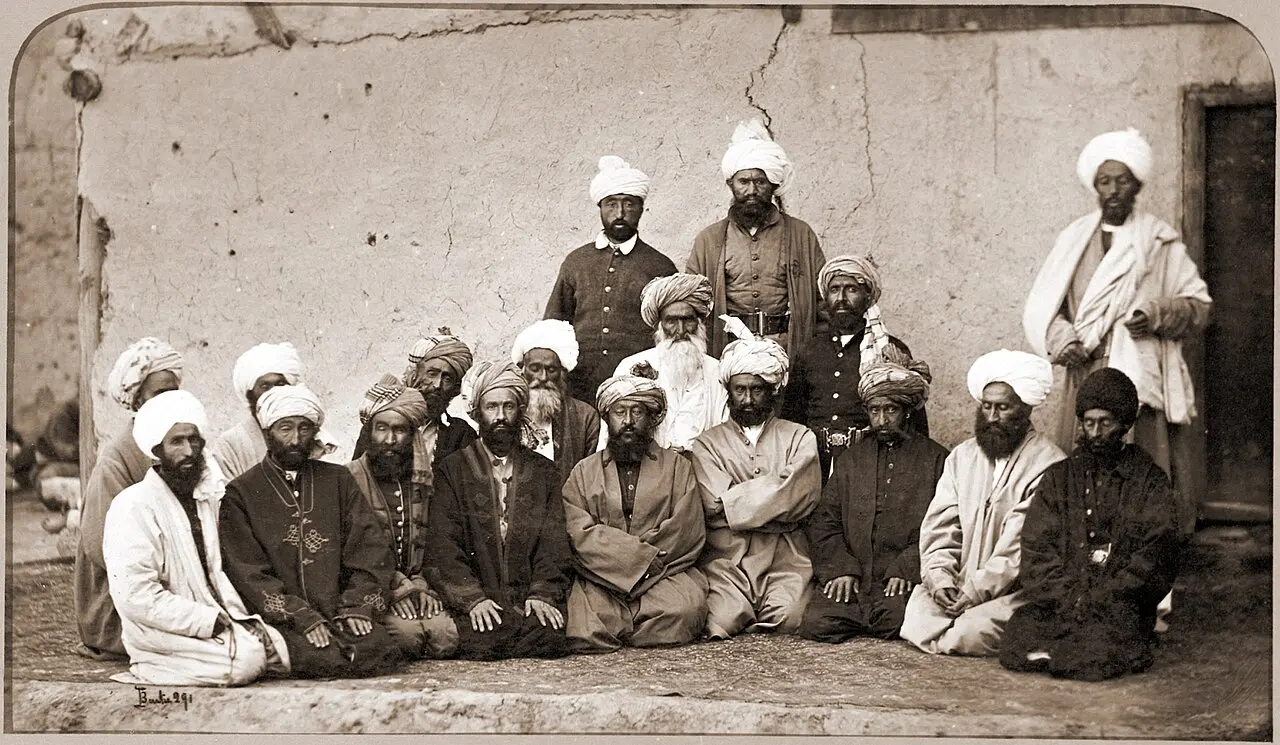
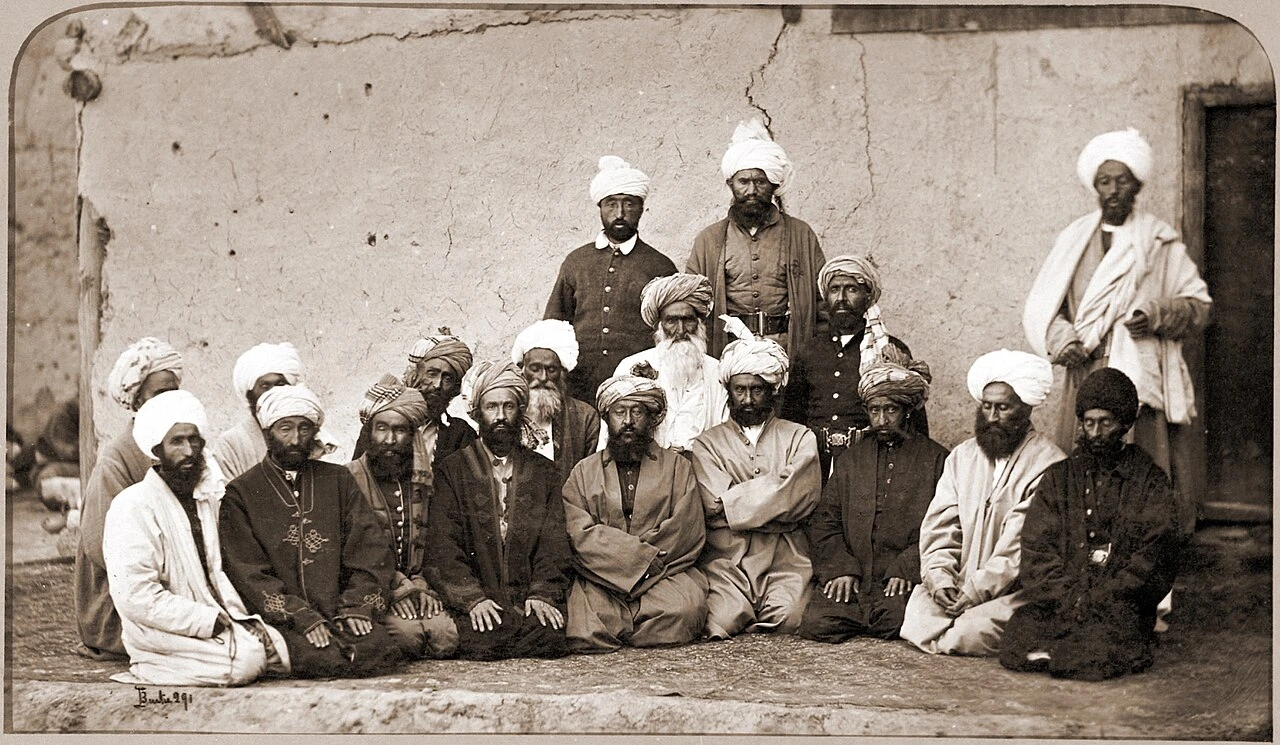
Name and numbers
The Ghilzai call themselves Ghəljī (غلجي) or Ghəlzay (غلزی), and the name reaches English in many spellings: Ghilzai, Ghilji, Ghalzai, Ghalji, Gilzai. M. Jamil Hanifi, in the Encyclopaedia Iranica, argues that Ghalzai is the closest rendering of the Pashto. [1] They are one of the three major Pashtun tribal confederations of Afghanistan. The others are the Durrani (formerly the Abdali) in the west and the Karlanri, who live on both sides of the Afghan–Pakistani border. [1] The first record of the Ghilzai as a distinct people is in early sixteenth-century chronicles, among them the memoirs of Babur. [1]
Writing in 2001, Hanifi estimated that the Ghilzai made up about two-fifths of the roughly eight million Pashtuns in Afghanistan. These are estimates, not census counts. [1]
Ghilzai country
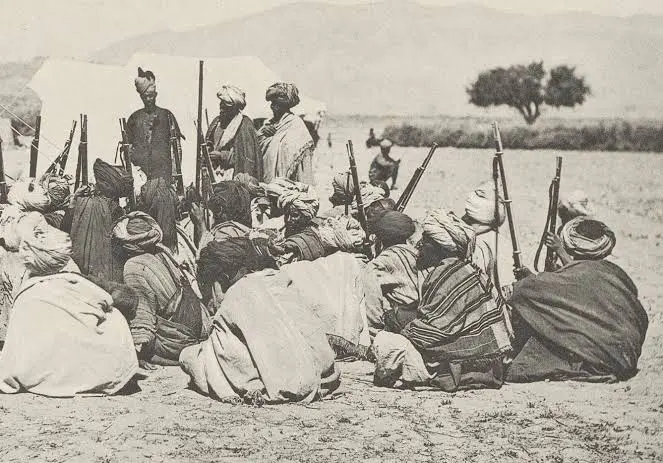
Hanifi places the Ghilzai between the Durand Line on the southeast and a line running from Kandahar through Ghazni to Kabul, and eastwards to Jalalabad. [1] Mountstuart Elphinstone, in his Account of the Kingdom of Caubul (1815), described their country as a parallelogram about 180 miles long and 85 miles wide, colder everywhere than England in winter and hardly hotter in summer, except in the lower Tarnak valley. [7] A 1911 entry written from British India gives the same range: from Kalat-i-Ghilzai in the south to the Kabul river in the north, and from the Gul Koh range in the west to the Indian border in the east. [5]
Within it the tribes lived very differently. Elphinstone found the western Ghilzai, as far east as the meridian of Ghazni, close to the Durrani in dress and custom. The Hotak and Tokhi "exactly resemble the neighbouring Dooraunees" in everything except government, while the eastern clans differed widely from them. [7]
The story of Bibi Mato
The Pashtun genealogies give the Ghilzai a scandalous birth. Nimatullah's Makhzan-i Afghani, compiled at the Mughal court in the early seventeenth century, says that Shah Husain, a prince of the Shansabani family of Ghor, quarrelled with his father and wandered east to the Takht-i Sulaiman, where Shaikh Bait (Bitan), son of Qais, took him in. Husain fell in love with Bitan's daughter Mato. She became pregnant before any marriage, her mother hurried the wedding through, and the boy was called Ghilzai, "ghil in the Afghan language signifying thief, and zai born a son". Bibi Mato's second son was Ibrahim, who earned the name Lodi; from him come the Lodi and Sur, the Afghan dynasties of Delhi. [4] The Pashto is غل (ghal), thief, and زوی (zoy), son. Hanifi records a second version in which the father is Mokarram Shah, a Pashtun prince of Ghor, and the mother the daughter of a Persian notable; there too the child is born before the marriage. [1]
Olaf Caroe read the tale as a memory. The father is a foreigner and the seducer of an Afghan girl, so early Afghan tradition plainly did not count the Ghilzai as Afghans of the true line. Caroe suggested the story mirrors an old belief that the Ghilzai include a foreign stock which imposed itself on Afghan families and took up their language and customs, a stock that "need not necessarily have been Turkish". He also pointed out that the Delhi genealogists had a motive: they served Lodi and Sur patrons and wanted the Lodis to be of Ghilzai blood but somehow more legitimate than other Ghilzai. Caroe counted the Lohani, Marwat, Niazi and related tribes of Bannu and Dera Ismail Khan as settled Ghilzai, who regard themselves so and speak a Ghilzai dialect. [4] More of the genealogy is in Origins of the Pashtuns.
Turks, Khalaj or Pashtuns
A long-running theory makes the Ghilzai Turks. The 1911 Britannica repeated the popular view that they descend from the Kilji, a Turkish tribe brought into Afghanistan by Sabuktagin in the tenth century. [5] Others link them to the Turkic-speaking Khalaj, whom tenth-century chronicles place near Kandahar and Ghazni, or to the Hephthalites; Hanifi names Caroe among those who saw a Hephthalite connection. [1] [4] Some writers also claimed the Khalji (1290–1320) and Lodi (1451–1526) sultans of Delhi as Ghilzai. [1]
Hanifi rejects all of these links. The Ghilzai speak Pashto, an Iranian language, and show cultural and linguistic features unlike those of the Khalaj or other Turkic groups, and he finds no systematic, conclusive evidence tying them to the Hephthalites, the Khalaj or the Khalji and Lodi dynasties. The modern place called Khalaj, a Pashto-speaking market town near Lashkargah, is not Ghilzai at all. [1]
Turan and Burhan
Most genealogies make Ghalzoy the father of two sons, Turan and Burhan (also called Ibrahim). Turan's descendants are the Western Ghilzai, whose main tribes are the Hotak, Tokhi and Kharoti. Burhan is the ancestor of the Eastern Ghilzai, among them the Sulaiman Khel, Ali Khel and Taraki. The Ahmadzai and Jabar Khel are sections of the Sulaiman Khel. [1]
Elphinstone gave figures for the clans, counted in families, as he received them ("are reckoned", "are said to be"), and he doubted some of them. [7]
Sulaiman Khel: 30,000 to 35,000 families, by far the largest clan, divided into four uluses. The northern Ahmadzai were pastoral, living east of Logar and driving their flocks as far as the hills above Jalalabad.
Tokhi: 12,000 families, with Kalat-i-Ghilzai as their main place and the Tarnak valley to themselves.
Taraki: 12,000 families around Mukur, many of them pastoral, some wintering as far away as the Daman.
Andar: 12,000 families, farming the rich district of Shilgar.
Ali Khel: 8,000 families, a figure Elphinstone thought too high, since they held little but the plain of Zurmat.
Kharoti: about 6,000 families, in the hills between the Gomal and the Sulaiman range. Elphinstone noted that the Ghilzai themselves were unsure which branch the Kharoti belonged to.
Hotak: reduced to five or six thousand families.
Kings and viziers
In Elphinstone's account the Turan branch held the honours: the kings of the Ghilzai dynasty came from the Hotak and its viziers from the Tokhi. [7] In the sixteenth and seventeenth centuries the Safavids and Mughals fought over Kandahar. The Abdali backed the Safavids and the Ghilzai led the opposition, and when Shah Abbas I moved the Abdali from Kandahar to Herat, the Hotak became the dominant tribe in the city. [1] Early in the eighteenth century Ghilzai pressure drove the Abdali, or part of them, into the mountains near Herat. [2]
The Hotak chief Mir Wais overthrew Safavid rule at Kandahar in 1709; his son Mahmud took Isfahan in 1722; Mahmud's cousin Ashraf was recognised by the Ottomans as king of Persia, until Nader Shah drove him out in 1729. In 1738 Nader, helped by the Abdali, took Kandahar from the last Hotak ruler, Shah Husayn, and deported him and many Ghilzai to Mazandaran. [1] Nader returned to the Abdali the lands they had lost to the Ghilzai. [2] The full story is in the Hotak dynasty.
Some Ghilzai stayed in Persia. Elphinstone tells of Azad Khan, a Sulaiman Khel, who set himself up as king of Persia and was the most dangerous rival of Karim Khan Zand. [7] At home, he wrote, the Ghilzai "still fondly recal the ancient grandeur of their tribe", and the royalty of the Shah Alam Khel and the hereditary standing of their khans were still acknowledged by all of them. [7]
Powindas on the Gomal
Many Eastern Ghilzai were pastoral nomads, moving between the central highlands of Afghanistan in summer and the Indus plains beyond the border in winter. [1] The nomad traders who came down through the Gomal and Bolan passes were known in British India as powindahs, and farther north, through Kohat and the Khyber, as kuchi. Shah Mahmoud Hanifi's Iranica entry on the Gomal says that in the nineteenth century most of the tent-dwelling powindahs were eastern Ghilzai, above all the Sulaiman Khel, Kharoti and Nasir, who grazed their animals in autumn and winter around Tank, Kulachi and Daraband. From autumn to spring many of the men left their families in the Daman and Derajat and went on to the markets of the Punjab, north India and Bengal to trade and work. [8] The 1911 Britannica also names the Sulaiman Khel, Nasir Khel and Kharoti as the clans that supplied most of the powindah merchants. [5] Until the border closures of the 1940s, the settled people of the Gomal country also lived by the banking, trade and transport that went with this traffic. [8]
Risings against the Durrani
From Nader Shah's death in 1747 until 1978, central power in Afghanistan was held by Persianised Durrani figures, and the Ghilzai were the regular source of opposition to it. [1] Hanifi lists large armed risings in 1801, 1803, 1839–42 and 1886. [1]
Elphinstone gives the fullest account of the first. The rising against Shah Mahmud was planned at Kabul, where many Ghilzai chiefs happened to be. They offered the crown to Abdurrahim, "the representative of their royal family", who had been living on a pension from Shah Zaman and accepted with great reluctance. A Ghilzai army of at least 20,000, almost all on foot, badly armed and some with nothing but clubs, met the Durrani at Sejawand in Logar. It broke one Durrani division, but the rest wheeled onto its flanks. The next day the Ghilzai plundered the villages near Kabul against Abdurrahim's orders, attacked without orders, and were routed; about 3,000 were said to have been killed, and the Durrani raised a pyramid of their heads at Kabul. In the spring of 1802 almost all the Ghilzai clans rose again, said to number 50,000, and lost three battles, all reported to have been fought on the same day in March 1802. [7] Elphinstone's Ahmadzai, obedient to the king, did not join. [7]
During the First Anglo-Afghan War the Jabar Khel inflicted the heaviest casualties on the retreating British army between Kabul and Jalalabad in the winter of 1842, and the Western Ghilzai opposed the British occupation in both wars. In the second, Ahmadzai chiefs were prominent in British operations in the southeast. [1] See the Anglo-Afghan wars.
Under Abdur Rahman Khan the Ghilzai rising was the longest of the many revolts against him, lasting until 1887. [3] It ended in mass deportations: large numbers of Ghilzai were forced to settle in northern Afghanistan by the Durrani government. [1] In April 1929 a Ghilzai attack at Ghazni turned back Amanullah, who had abdicated and fled to Kandahar, from his attempt to retake Kabul. [3]
The twentieth century
The Ahmadzai supported Mohammad Nader when he took Kabul in 1929 and declared himself king. [1] The Khalq coup of 1978 ended Durrani rule and put Nur Mohammad Taraki, whom Daniel Balland describes as a Ghilzai of rural and provincial background, at the head of the new government. [3] [1] Three of the four presidents after 1978 were Ghilzai: Taraki (Taraki tribe), Hafizullah Amin (Kharoti) and Najibullah (Ahmadzai). Hanifi, writing in 2001, also noted that Ghilzai were prominent in the leadership of the Taliban, who had controlled much of Afghanistan since 1996. [1]
Speaking and doing Pashto
The Ghilzai are known in Afghanistan for strict adherence to Pashtunwali. Hanifi gives the three duties as Paxtū larel, having Pashto; Paxtū kawel, doing Pashto; and Paxtū wayel, speaking Pashto: holding the values, acting on them and speaking the language well. [1] Georg Morgenstierne noted that the word Pashto itself also means the Pashtun code of honour. [9]
Their speech sits between Pashto's two main groups. Caroe observed that most Ghilzai speak the soft dialect, with only a few near Jalalabad using the hard one. [4] Morgenstierne found the transitional forms of the language mainly in Ghilzai Pashto. His example is the word for "woman", whose first sound in Ghilzai speech wavers between the soft Kandahari and the hard Peshawari pronunciation. [9] See Pashto dialects.
Tribe or confederation
Scholars disagree on which groups should be called tribes and which confederations. Richard Tapper notes that the many local terms make the definitions harder, and that some very large groups, such as the roughly two million Durrani Pashtuns, have been called tribes because they share an ideology of common descent. [6] The Ghilzai, like the Durrani, are called a confederation here because that is how the Encyclopaedia Iranica and most of the literature describe them. [1] [6] Dates follow the Encyclopaedia Iranica, and in some accounts they differ by a year: Hanifi dates the second rising to 1803, while Elphinstone puts it in the spring of 1802. [1] [7]
Where this tribe sits
- Part of
- Bitan
- Branches beneath it
- Turan
- Burhan (Ibrahim)
Ghilzai tribe profile
Where the sources disagree
Ibbetson and Bellew, and in part Caroe, favour a Turkish (Khalaj) origin, which Longworth Dames doubts and Encyclopaedia Iranica rejects for lack of evidence. The Makhzan-i Afghani gives Ghilzai three sons, Ibrahim, Toor and Poor; the Khulasat al-Ansab gives Ibrahim, Turani and Bular, and Encyclopaedia Iranica two, Borhan (Ibrahim) and Turan.
At a glance
- Population
- about two fifths of an estimated 8 million Pashtuns in Afghanistan (2001, Afghanistan; Hanifi's estimate in Encyclopaedia Iranica)4
- Countries
- Afghanistan, Pakistan
- Where they live
- Kandahar Province, Zabul Province, Ghazni Province, Paktika Province, Logar Province, Kabul Province, Nangarhar Province, Dera Ismail Khan District
- Language
- Pashto
- Religion
- Sunni Islam
- Main clans
- Turan, Burhan (Ibrahim), Hotak, Tokhi, Kharoti, Sulaiman Khel, Ali Khel (Ghilzai), Taraki, Andar, Sahak
- Other names
- Ghilji, Ghalji, Ghalzai, Ghiljie, Khilji, Ghaleji, Galzi, Gilzay
Homeland
- GhazniSeat of Mahmud of Ghazni. The British stormed it on 23 July 1839, and a Ghilzai attack near it on 19 April 1929 ended Amanullah's march to retake Kabul.
- KandaharMir Wais Hotak overthrew Safavid rule here in 1709, and Ahmad Shah Durrani built a new city here as his capital. Roberts beat Ayub Khan outside it on 1 September 1880.
- Gomal PassRoute along the Gomal river through Ghilzai country to the Indus, used by the powindah nomads. Sher Shah Suri's family came from the Gomal country.
- Dera Ismail KhanTown credited by tradition to Ismail Khan I; the Gomal joins the Indus 20 miles south of it. Caroe counted the Lohani, Marwat and Niazi of Bannu and Dera Ismail Khan as settled Ghilzai.
- JalalabadAkbar strengthened and named the town on the road from Kabul to Peshawar. Sale's brigade held it in 1841 and 1842. King Amanullah and Bacha Khan are buried here.
- KabulTimur Shah moved the Durrani capital here from Kandahar in about 1775. Dost Mohammad took the city in 1826, and Burnes was killed here in the rising of November 1841.
Notable people
Mir Wais Hotakd. 1715
Hotak chief who ended Safavid rule at Kandahar in 1709.4
Shah Mahmud Hotakr. 1717–1725
Son of Mir Wais who captured the Safavid capital Isfahan in 1722.4
Azad Khan Sulaiman Khel18th century
Sulaiman Khel commander in Persia who contested the throne with Karim Khan Zand and later lived at his court.9
Abdur Rahim Khan Hotakfl. 1801–1802
Head of the old Hotak royal family, chosen as king by the Ghilzai chiefs in the rising of 1801.9
Nur Muhammad Tarakiin office 1978–1979
President of Afghanistan after the 1978 revolution, of the Taraki tribe.4
Hafizullah Aminin office 1979
President of Afghanistan in 1979, of the Kharoti tribe.4
Mohammad Najibullahin office 1986–1992
President of Afghanistan, of the Ahmadzai.4
Tribes of the Ghilzai
Tribe · Ghilzai
Andar
The Andar are a Ghilzai tribe of Shilgar, around Sharana south of Ghazni. Bellew places them in the Musa branch of the eastern Ghilzai.
Tribe · Ghilzai
Hotak
The Hotak are a western Ghilzai tribe of Kalat-i Ghilzai and Kandahar, and the tribe of Mir Wais. Bellew gives their divisions as Malikyar, Yusuf, Daulat and Arab, and places Mir Wais in the Shah Alam khel under the Malikyar.
Tribe · Ghilzai
Kharoti
The Kharoti live at Paltu and Dwa Gomal, around Urgun and along the western slopes of the Sulaimans to Katawaz, and many were pawindah traders. Encyclopaedia Iranica counts them among the western Ghilzai under Turan.
Tribe · Ghilzai
Nasir
The Nasir are a nomadic tribe with no fixed country, wintering in the Derajat and spending the summer in the Ghilzai country. Elphinstone's account of them is the classic early description of the pawindah migrations.
Tribe · Ghilzai
Sulaiman Khel
The Sulaiman Khel are an eastern Ghilzai tribe holding a long tract through the Ghilzai country, the hills east of Ghazni and Katawaz. They were the most numerous of the pawindah traders. The Makhzan-i Afghani makes Sulaiman a son of Haijub, and Bellew places the tribe in the Isap branch.
Tribe · Ghilzai
Taraki
The Taraki are a largely nomadic Ghilzai tribe of the country around Mukur and Kandahar. Bellew and Encyclopaedia Iranica place them in the eastern half of the confederation.
Tribe · Ghilzai
Tokhi
The Tokhi are a western Ghilzai tribe of the Tarnak valley and the northern Arghandab, centred on Kalat-i Ghilzai. The Khulasat al-Ansab gives Tokhi's sons as Nahmand, Nur, Eyub and Hassan, and Bellew's list is Mahmand, Ayub, Hasan and Nur.
Sources for the tribe profile
- Makhzan-i Afghani, tr. Dorn, Part II pp. 48–49
- Khulasat al-Ansab, quoted in Dorn, Part II annotations pp. 127–128
- Elphinstone, An Account of the Kingdom of Caubul (1839), vol. II pp. 137–162
- Encyclopaedia Iranica, "Gilzi" (M. J. Hanifi), vol. X/6 pp. 670–672
- Bellew, An Inquiry into the Ethnography of Afghanistan (1891), pp. 15–24
- Rose, Glossary of the Tribes and Castes of the Punjab and N.W.F.P., vol. II (1911), pp. 285–286
- Caroe, The Pathans 550 B.C.–A.D. 1957 (1958), pp. 250–252
- Rose, Glossary, vol. III (1914), p. 215 (Ibbetson)
- Elphinstone, An Account of the Kingdom of Caubul (1839), vol. II pp. 146, 328–331
- Rose, Glossary, vol. III (1914), p. 241 (Ibbetson)
- Imperial Gazetteer of India, Provincial Series: North-West Frontier Province (1908), p. 253
Sources
- M. Jamil Hanifi — "Ḡilzī", Encyclopaedia Iranica, vol. X, fasc. 6 (2001), pp. 670–672
Main source. Used for the confederation's size and territory, its attitude to Pashtunwali, the genealogies, the Turkish-origin theories and their critique, the tribal branches, the rivalry with the Abdali, the Hotak revolt, the later uprisings, the Anglo-Afghan wars and twentieth-century leaders. Consulted 11 October 2026.
- Daniel Balland — "Dorrānī", Encyclopaedia Iranica, vol. VII, fasc. 5 (1995), pp. 513–519
Used for the Abdali being driven from the Kandahar area by Ghilzai pressure in the early 18th century and for Nader Shah's return of their lands. Consulted 11 October 2026.
- Daniel Balland — "Afghanistan x. Political History", Encyclopaedia Iranica, vol. I, fasc. 5 (1983), pp. 547–558
Used for Ghilzai opposition to Durrani rule in the 19th century, the insurrection of the 1880s, the Ghazni attack of April 1929 and Nur Mohammad Taraki's background. Consulted 11 October 2026.
- Olaf Caroe — The Pathans, 550 B.C.–A.D. 1957 (London: Macmillan, 1958)
Used for the dialect distribution of the Ghilzai and for Caroe's reading of the genealogy that makes the Ghilzai descend from a foreign prince and an Afghan woman. Caroe was a British colonial official and his views on origins are interpretive, so they are presented as his reading. Consulted 11 October 2026.
- Anonymous — "Ghilzai", Encyclopaedia Britannica, 11th edition, vol. 11 (1911)
A short, dated entry used only for the old geographical description of the Ghilzai, the povindah merchant clans and the once-popular Kilji theory of origin. Its language reflects the colonial period and it is not used for any other claim. Consulted 11 October 2026.
- Richard Tapper — "Confederations, Tribal", Encyclopaedia Iranica, vol. VI, fasc. 2 (1992), pp. 125–128
Used for the lack of scholarly agreement on the terms tribe and confederation and for the example of the Durrani as a very large group called a tribe. Consulted 11 October 2026.
- Mountstuart Elphinstone, An Account of the Kingdom of Caubul (London, 1815), Internet Archive scan
Used for the extent and climate of the Ghilzai country, the western Ghilzai's likeness to the Durrani, the Turan and Burhan clans with their family counts, Hotak kings and Tokhi viziers, Azad Khan and the memory of Ghilzai royalty (Ghiljie country, pp. 485–490), and the Ghilzai rising under Abdurrahim and its defeat in 1801–1802 (appendix, pp. 581–584). Consulted 14 October 2026.
- Shah Mahmoud Hanifi, "Gōmal", Encyclopaedia Iranica, vol. XI, fasc. 2 (2002), pp. 119–120
Used for the terms powindah and kuchi, the eastern Ghilzai tribes that made up most powindahs, their winter grounds at Tank, Kulachi and Daraband, the men's winter trade in the Punjab, north India and Bengal, and the border closures of the 1940s. Consulted 14 October 2026.
- Georg Morgenstierne, "Afghanistan vi. Paṣ̌tō", Encyclopaedia Iranica, vol. I, fasc. 5 (1983)
Used for Pashto as the name of the code of honour and for transitional dialect forms occurring mainly in Ghilzai Pashto. Consulted 14 October 2026.
Noticed a mistake or a missing source? Here's how we correct things
Common questions
Are the Ghilzai the same as the Ghalzai?
Yes. Ghilzai, Ghilji, Ghalzai, Ghalji and Gilzai are spellings of the same Pashto name, غلجي (Ghəljī) or غلزی (Ghəlzay). M. Jamil Hanifi prefers Ghalzai as the closest rendering of the Pashto.
Are the Ghilzai Turkish in origin?
That is an old theory, not a proven fact. Writers have linked them to the Turkic Khalaj or the Hephthalites, and Olaf Caroe thought they included a foreign stock, but M. Jamil Hanifi points out that the Ghilzai speak Pashto and finds no conclusive evidence for any of these links.
What are the main branches of the Ghilzai?
The genealogies divide them into the descendants of Turan, the Western Ghilzai (Hotak, Tokhi and, in most accounts, Kharoti), and of Burhan, the Eastern Ghilzai (Sulaiman Khel, Ali Khel, Taraki and others). The Ahmadzai and Jabar Khel are sections of the Sulaiman Khel.
Related articles
- Abdur Rahman Khan: the amir who unified Afghanistan, 1880–1901
- Amanullah Khan: independence, reform and the crisis of 1929
- Dost Mohammad Khan: the amir who rebuilt Afghanistan
- Gharghasht
- Jalalabad: the valley between Kabul and the Khyber
- Kandahar: an oasis city and its long history
- Origins of the Pashtuns: tradition and evidence
- Pashtunwali: the Pashtun code of honour and conduct
- Sher Shah Suri: the Afghan who drove the Mughals out of Delhi
- The Afridi: Pashtun tribe of the Khyber and Tirah
- The Durrani confederation
- The Hotak dynasty: Ghilzai rule from Kandahar to Isfahan, 1709–1738
- The three Anglo-Afghan wars, 1839–1919
- The Yusufzai: the Pashtun tribe of Swat, Buner and the Mardan plain
Timeline
1709
Hotak revolt in Kandahar
A Ghilzai uprising led by Mir Wais frees southern Afghanistan from Safavid control.
1722
Fall of Isfahan
Ghilzai forces under Mahmud Hotak take the Safavid capital.
1738
Nader Shah takes Kandahar
The last Ghilzai ruler of Kandahar surrenders and many Ghilzai are deported to Mazandaran.
Winter 1842
First Anglo-Afghan War: the retreat from Kabul
The Jabar Khel Ghilzai inflict the heaviest casualties on the retreating British army between Kabul and Jalalabad.
1886–1887
Ghilzai insurrection against Abdur Rahman Khan
The last major Ghilzai rising; many Ghilzai were afterwards resettled in northern Afghanistan.
19 April 1929
Ghilzai attack at Ghazni
An attack by the Ghilzai at Ghazni forces King Amanullah to abandon his march on Kabul.