A Pashtun woman's everyday outfit is a long dress, trousers gathered at the ankle and a cloth for the head. Nancy Hatch Dupree, in her entry on Afghan clothing for the Encyclopaedia Iranica, wrote that men, women and children all wear a loose, long-sleeved shirt outside wide trousers drawn on a cord. For women, she added, the length of the dress, the fullness of the trousers (up to 20 metres of cloth), the width of the sleeves and the choice of prints and decoration are "matters of great consequence". [7] The men's side of the outfit is in Pashtun dress and perahan tunban.
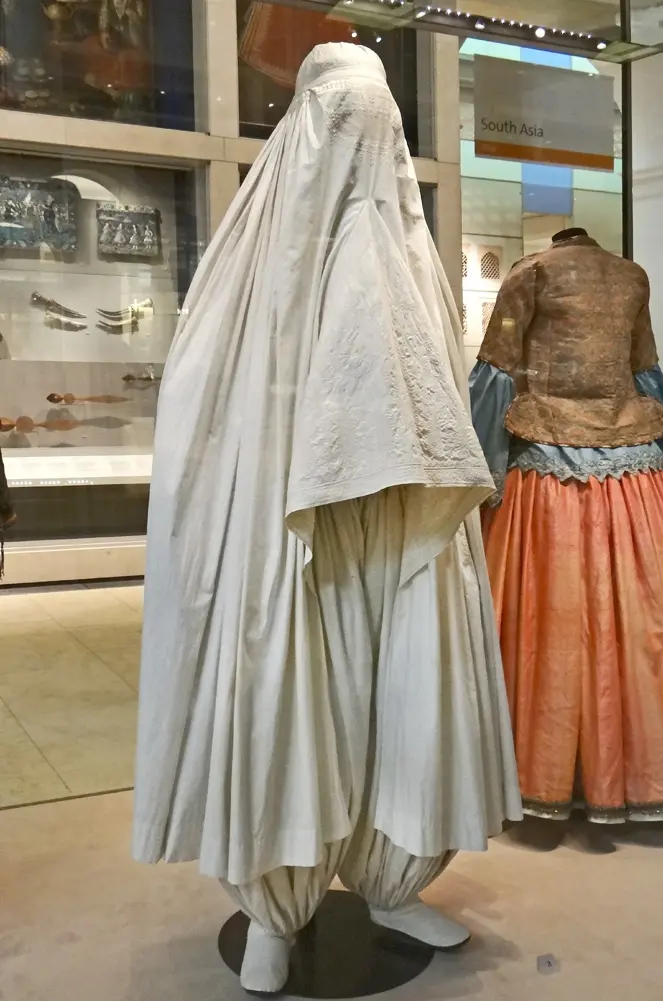
A burqa with trousers that enclose the feet, from Iran or Afghanistan, about 1850, of white cotton with silk embroidery and green felt, in the Victoria and Albert Museum.
Jean-Pierre Dalbéra from Paris, France· CC BY 2.0
The standard outfit is the kamiz (dress), the partug (trousers) and a head cloth, often with a waistcoat. [15]
Most women's clothes are stitched at home, and embroidery is mostly women's work. [7, 18]
Beads, felt roundels, mirrors, silver discs and coins mark Pashtun dresses, and which of them depends on the place and on settled or nomadic life. [7, 15, 18]
The chadari is mainly an urban garment. The state pressed women to unveil in 1928 and 1959, and the Taliban ordered the chadari in 1996 and again in May 2022. [6, 7, 21, 29]
The dress, the trousers and the head cloth
The Textile Research Centre in Leiden, describing pieces collected in Afghanistan, says Pashtun women tend to wear a standard Afghan outfit: trousers (partug), a dress with long sleeves and a full skirt (kamiz), often a waistcoat (waskat) and a head covering (shal or chador). The trousers are usually cut from a different colour, and mid-green is common. Festival dresses are silk or velvet in rich colours, especially deep red, and in hot weather many women prefer bright printed cotton. [15]
Mountstuart Elphinstone, the British envoy who reached Peshawar in 1809, gave the earliest description of the women's outfit used here. Afghan women, he wrote, wore a shirt like the men's but much longer, of finer cloth and often embroidered with silk flowers, in the west often wholly of silk. Their trousers were coloured and tighter than the men's. A small cap of bright silk embroidered with gold thread went under a large sheet, plain or printed, which they pulled across the face when a stranger came near. Married women wore strings of Venetian sequins round the head and chains of gold or silver hooked over the forehead, and unmarried girls were known by their white trousers and loose hair. [1] The jewellery is covered in Kuchi jewellery.
Dresses from Kohat, Bannu and Dera Ismail Khan
Some of the oldest dated women's dresses from the Pashtun country are in the Victoria and Albert Museum, transferred from the India Museum in 1879 with slip-book entries of the 1850s and 1860s.
The slip for a dress from Kohat reads "Dress of Khuttuck Woman of the Bahadoor Khoyl peasants having 16 plain silver Tablets & one Centre ornament Embroidered". The dress is striped cotton with block-printed sleeves and a separate yoke embroidered in floss silk in diamonds, with sixteen silver discs in three rows and a central silver ornament hung with chain tassels. [8] A skirt from Bannu, entered in 1867, is indigo cotton embroidered in yellow silk with a wheat-sheaf pattern and set with mirrors, "worn by Bunnoo women". [9] A dress from Dera Ismail Khan has an embroidered chest and a small triangle at the waistband that the V&A's note suggests comes from an amulet shape. [10] Plain dress was as common: the V&A also has a plain indigo dress from Kohat, which it says was worn with wide gathered trousers and a plain shawl over the head. [8]
The district gazetteers of 1883-84, written by British officials, give the same clothes in words. In Peshawar the women's dress differed from the men's only in a chequered sheet worn in place of the turban cloth. [4] In Dera Ismail Khan the usual women's dress was a shift, a petticoat and a sheet over the head, but "Pathan women" and the better classes in the towns wore loose trousers to the ankle. [5]
Peshawar, the Yusufzai plain and Swat
Of the Yusufzai, Elphinstone wrote that the women wore a gown close over the breast and very wide below, with many gold and silver ornaments, and not the long shirt common among other Afghans. He said they never left the house without a cloak called a boorka, which covered them from head to foot, and that the poorest men's wives fetched water only by night. [2]
In Swat, Mussarat Ahmed Zeb, a princess of the former ruling family, told NPR in 2010 that she was reviving "the Swat stitch" and showed heirlooms passed down from her grandmother, the sister of the second Wali of Swat. She trained hundreds of women, one of whom had to persuade her husband that working at home did not offend Swat's conservative Pashtun culture. [26] The V&A has a woman's dress that mixes styles from across the North-West Frontier: medallions recalling the embroidery of Swat and Hazara, and sleeve bands and skirt inserts that suggest Indus Kohistan. [11]
In Dir, the ethnographer Ismail Khan wrote in Dawn in 2025 that younger women had swapped the heavy burqa for a lighter paronay, a chador or long dupatta pulled round the head, body and face with the eyes left open, and that this was how women "renegotiate purdah gently, but surely". [25]
Waziristan and Ganr Khat
The Waziristan dress is Ganr Khat. The Express Tribune described it in 2016 as the whole of a woman's attire, though the name is mostly used for the shirt worn by brides and married women. It is cut like a frock from some 30 to 35 metres of cloth, with an embroidered front, and a pocket called tapper is stitched inside and tightened with a rope so that it does not hinder work. Namai Bibi, who had made the dress, said women gather at the partowgai, where women sit to talk, and stitch it while singing tappay. Unmarried girls wear a different form, Kundai Khat. [22]
Kandahar and the Kuchi dress
Kandahar's whitework, the subject of khamak, Kandahari embroidery, is mainly worked on men's shirt fronts. [7, 18] For women, Dupree singles out the eastern Pashtun: high-waisted bodices, flared elbow-length cuffs and skirt borders that can take 12 metres of flowered cotton or velvet are covered in embroidery, and wealthier nomads, the maldar, favour red, green and royal-purple velvet. [7]
Leiden says Kuchi women's outfits resemble those of settled women but are darker, with tight ankle cuffs and dresses with very wide sleeves and very full skirts. The bodice, skirt and sleeve hems are edged with couched metallic braid and hung with amulets, pendants and tassels. [15] The nomads are described in Kuchis and Powindas. In 2017 Sher Alam Shinwari reported in Dawn that the "Afghan Kochi dress" with all-over mirror work had been brought in by Afghan refugees in the 1980s and was now sold in Peshawar's Meena Bazaar, mostly for weddings. A storekeeper told him that in the past 80 per cent of the work was done by women at home and now only 20 per cent. [23]
Embroidery, beads, mirrors and coins
Two features mark Pashtun dresses, settled and nomadic: beaded panels on the shoulders and along the seam between bodice and skirt, and pairs of felt roundels (gul-i pirahan) embroidered with signs for luck, prosperity and fertility. [15] Beads and large mirrors are used on Pashtun women's dresses, Leiden adds, and beads, coins and shells are common on nomadic women's. Pashtun and Baluch women put in small mirrors (shisha), an idea it says comes from northern India. [18] Dupree lists silver beads, discs, coins and amulets sewn on, joined among some nomads by mirror work and gold and silver thread. [7]
Museum pieces show how old some of this is. The Kohat dress with silver discs and the Bannu skirt with mirrors date from the 1850s and 1860s. [8, 9] The National Gallery of Victoria holds the bodice of a Pashtun woman's wedding dress of about 1982 in silk, cotton and wool with coins on it, and Indiana University's museum has the front of a "Kuchai or Pashtun" dress with mirrors in a diamond pattern and pom-poms. [19, 20] The V&A notes of an embroidered dress from the Afghan-Pakistan border that such dresses usually have a patch of thicker cloth on the back, and that this one's was striped, with a star of metal-thread ribbon. [14] One museum dress, with its pocket and breast-feeding slits, is described in Pashtun embroidery: a documented Barech dress.
The wedding dress
Guests at an Afghan wedding wear new clothes in traditional forms, Leiden says, and brides traditionally wear red or green, though many now wear a white gown in Western style. The braid on the hem of the bride's trousers matches that on her dress and head covering, and brides often change several times in a day. [17]
In Waziristan the dress is at the centre of the wedding. Two Ganr Khat are made, one by the bride's family and one by the groom's. An engagement ceremony, Losnewai, is held at the groom's house. A finished dress is shown on a day called sandarrah, when men and women dance the attan. A man and a woman of the groom's family carry it to the bride's house, the man firing a shot in the air, and next morning the bride goes to her new home wearing it. The Tribune added that the celebrations had faded and the dress was by then mostly worn on Eid. [22] A Kabul tailor in Peshawar, Raza Sakhi, told Dawn in 2015 that brides traditionally wear green for the nikah and change into a white gown with veil and train. [27]
The chadar, the burqa and the chadari
The chadar (tsadar in Pashto) is a shawl or mantle for the head. Dupree says most women in traditional Afghan communities wear a rectangular headscarf, with or without a small cap, and among some Pashtun tribeswomen the chadar is an ankle-length mantle bordered with heavy gold embroidery. The chadari is a close-fitting cap from which finely pleated silk or rayon falls over the whole figure, with an openwork grid over the eyes, and she wrote that all chadaris are primarily urban garments. [7] The cloth men carry is described in the patu and the chadar.
Leiden separates the Afghan chadari from the Pakistani burqa. The chadari has its eye panel attached to the cap and hundreds of narrow pleats, while the burqa has a cap, a cape with an eye grid and a separate panel lower down, with gathered folds instead of pressed pleats. [16] Raverty's dictionary of 1860 defines bolka'h (بولقه) as "a dress or kind of veil with eye-holes, worn by women, and covering the whole body from head to foot". [3] The V&A has a burqa of blue pleated cotton from Afghanistan of about 1930, with silk embroidery round the head and an openwork eye grill, and gathered blue trousers of the same date that it says would have been worn with it. [12] An older one there is embroidered white linen with a panel of drawn-thread work to see through. [13]
The sources differ on how old the garment is. Elphinstone wrote of the boorka among the Yusufzai in 1809. [2] Of women in Afghan towns he wrote that they were always wrapped in a large white sheet to the feet with a net-work in the hood to see through, that women of rank wore it too, and that they could go out veiled to gardens and spectacles and were "not much more confined than women in India". [1] Leiden says Muslim women in what is now Pakistan and northern India have worn this style for over 400 years and a closely related one has been worn in Afghanistan for about 200, and that to go uncovered in public showed a lack of respectability, honour and status for a woman and her family. [16] In Rawalpindi and Islamabad the Pashtun women who keep the blue burqa call it the "shuttlecock", a name the Associated Press of Pakistan said dated from colonial days. [28]
Governments and the veil
Veiling has been a matter of state policy for nearly a century, and each government met resistance. King Amanullah's reforms asked for Western dress in parts of Kabul and discouraged veiling and seclusion. In 1928 about 1,000 notables rejected his proposals, which included unveiling women. He then called a rump jirga of 100 reformists, and outraged conservatives sought to overthrow him. [21] Dupree wrote that Western dress, introduced in the cities early in the twentieth century as part of government modernisation, came to symbolise emancipation for women. [7] In 1959, at the celebration of Afghan independence, Prime Minister Mohammad Daoud Khan had his ministers' wives appear unveiled. When religious leaders protested he asked them to cite one verse of the Quran that required veiling, and jailed those who went on resisting for a week. [21]
In the 1990s the pressure ran the other way. Human Rights Watch reported in 2001 that Taliban decrees required women to wear the chadari in public under threat of severe punishment, and that breaches could bring public beatings and lashing by the religious police. The women it interviewed described being beaten for wearing the chadari loosely, for wearing the wrong one and for lifting it to see. Meena Akram, a teacher from Helmand, said that before the Taliban "we wore a small chadar even in school". [6] Leiden says urban women were forced rather than required by tradition to wear it, on the grounds that Islam demanded it, a view "not shared by all Afghan men and women". [16] The 1986 Area Handbook records that in some cases veiling and seclusion grew stricter in the refugee camps in Pakistan. [21]
On 7 May 2022 the Taliban leader, Hibatullah Akhundzada, ordered women to wear the chadari or burqa in public. AFP quoted the decree: "They should wear a chadori (head-to-toe burqa) as it is traditional and respectful". A woman's father or nearest male relative would be visited and eventually jailed, or fired from a government post, if she went out with her face uncovered. [29] The United Nations mission condemned it. The Kabul activist Tahmina Taham said she was "being imprisoned", and Azita Habibi, a midwife in Herat, asked "Where in Islam is it said that women's hands and faces should be covered?" A former aid worker, who gave a false name, said she would wear a full covering so that the men of her family were not punished or dishonoured. AFP saw women in Kandahar in the burqa and many in Kabul with faces bare. [30] In August 2024 the ministry published a law whose Article 13, as the Associated Press summarised it, makes it mandatory for a woman to veil her body in public, calls a face covering essential to avoid temptation and says clothing must not be thin, tight or short. [31]
Many women also wear the burqa by choice. In 2018 the Associated Press of Pakistan quoted Shazia Aurangzeb Khan, from Peshawar, and her 81-year-old mother-in-law Sheena Gul, who called it "our licence to women's free movement". A student, Samreena Khan, said her father asked her to wear it when she began college and she did not mind, while Hina Khan from Swat said she was not comfortable in it but had no option. [28] The covering itself is an old custom that many Pashtun women keep and value, and Dupree writes that head coverings for all women are prescribed in Islam. [7] The chadari is mainly an urban garment, and compulsion in either direction has been resisted, and in the Taliban's case condemned by the United Nations mission. [7, 21, 30] For women's lives under the Taliban and in Pakistan see Pashtun women today, and for how Pashtuns reconcile custom with Islam see Islam and Pashtunwali.
What is worn now
Embroidered party dress is still a trade in Peshawar. In 2015 a Saddar Bazaar salesman told Dawn that one outfit took 25 to 35 days to make, mostly by male craftsmen, and the craftsman Rajid Ali said a traditional Pashtun frock never has half sleeves, widens to the cuff and is loose, with a belt to adjust it. [24] Dupree noted that refugees in Pakistan wear traditional garments as a mark of Afghan culture and Islam, while Western dress stayed in fashion in Kabul through the Soviet years. [7]
Common questions
What do Pashtun women traditionally wear?
A long-sleeved, full-skirted dress (kamiz) over gathered trousers (partug), often in a different colour, with a head cloth and sometimes a waistcoat. The Textile Research Centre in Leiden says festival dresses are silk or velvet, especially deep red, and Dupree says most women's clothes are sewn at home.
What is the difference between a burqa and a chadari?
Leiden's textile researchers say the Afghan chadari has its eye panel attached to the cap and hundreds of narrow pleats, while the Pakistani burqa has a cap, a cape with an eye grid and a separate panel lower down, with gathered folds. Raverty defined the burqa in 1860 as a dress or veil with eye-holes covering the whole body from head to foot.
What is Ganr Khat?
Ganr Khat is the traditional women's dress of Waziristan, a frock cut from some 30 to 35 metres of cloth with an embroidered front and a pocket sewn inside. The Express Tribune reported in 2016 that two are made for a wedding, one by each family, and that by then it was mostly worn on Eid.
Did the Taliban invent the burqa for Pashtun women?
No. Elphinstone wrote in 1809 that Yusufzai women never left the house without a boorka, and Leiden's researchers say a related garment has been worn in Afghanistan for about 200 years. Dupree calls the chadari mainly urban. What the Taliban did, in 1996 and again in May 2022, was order women to wear it under penalty.
What do Pashtun brides wear?
Leiden says Afghan brides traditionally wear red or green, with braid on the trousers matching the dress, though many now wear white gowns. In Waziristan the bride wears the Ganr Khat made for the wedding. The National Gallery of Victoria holds a wedding bodice of about 1982 with coins sewn on.
Pictures (3)
Gallery
3 images
Ghilzai nomad women by their black felt tents, sketched by James Rattray on the road from Kabul to Kandahar in 1839–42 and published as plate 6 of his Afghaunistan (1848).
‘Kandahar Lady of Rank, Engaged in Smoking’, a coloured lithograph from James Rattray’s ‘Afghaunistan’ (1848).
King Amanullah Khan and Queen Soraya during their official visit to Manchester on 28 March 1928.
Sources
Colonial records
Gazetteers, glossaries and reports by British officers and travellers, 1815–1947. They describe the tribes as their authors found them, and for the uses of the colonial government.
- Back to textMountstuart Elphinstone, An Account of the Kingdom of Caubul, vol. I (2nd ed., London, 1819), pp. 292-293 and 379-380
Women's dress and ornaments in 1809; town women's white sheet and hood with a net-work; his remark on their confinement.
- Back to textMountstuart Elphinstone, An Account of the Kingdom of Caubul, vol. II (2nd ed., London, 1819), p. 38
Yusufzai women's gown and the boorka.
- Back to textHenry George Raverty, A Dictionary of the Pukhto, Pushto, or Language of the Afghans (2nd ed., London, 1860), p. 123, entry bolka'h
Definition of the burqa as a dress or veil with eye-holes covering the whole body.
- Back to textGazetteer of the Peshawar District, 1883-84 (Lahore, 1884), pp. 84-85
Dress of the agriculturists (kamez, partug) and of the women.
- Back to textGazetteer of the Dera Ismail Khan District, 1883-84 (Lahore, 1884), p. 53
Women's dress in the district and the trousers worn by 'Pathan women'.
Modern scholarship
Books and papers by historians, anthropologists, linguists and geneticists.
- Back to textHuman Rights Watch, Humanity Denied: Systematic Violations of Women's Rights in Afghanistan (October 2001), sections IV and VI
Taliban chadari decrees, punishments and women's testimony.
Reference works
Encyclopaedias, country studies and museum records.
- Back to textNancy Hatch Dupree, 'Clothing xiii. Clothing in Afghanistan', Encyclopaedia Iranica V/8 (1992), pp. 811-815
Basic costume, women's dress and its details, eastern Pashtun embroidery, silver and mirror work, the chadar and chadari, urban Western dress, refugees in Pakistan.
- Back to textVictoria and Albert Museum, dress of a Bahader Khel woman, Kohat, c. 1855, 05520(IS) (and plain indigo dress, Kohat, 4815(IS), https://collections.vam.ac.uk/item/O69958/)
Description, India Museum slip-book entry and silver discs; the plain indigo dress from Kohat and how it was worn.
- Back to textVictoria and Albert Museum, skirt, Bannu, 1867, 05668(IS)
Indigo skirt with phulkari and mirror-work; slip-book entry 'worn by Bunnoo women'.
- Back to textVictoria and Albert Museum, dress, Dera Ismail Khan, 05603(IS)
Indigo dress with embroidered chest and a triangular amulet-like element.
- Back to textVictoria and Albert Museum, woman's embroidered cotton dress, North-West Frontier Province, 20th century, IS.39-1996
Mixed embroidery styles recalling Swat, Hazara and Indus Kohistan.
- Back to textVictoria and Albert Museum, burqa, Afghanistan, ca. 1930, ME.2-2012, and trousers ME.3-2012 (https://collections.vam.ac.uk/item/O1256563/)
Blue pleated cotton burqa and the trousers worn with it.
- Back to textVictoria and Albert Museum, burqa of embroidered linen, Afghanistan, 1800-1900, T.24-1964
Earlier burqa with drawn-thread panel to see through.
- Back to textVictoria and Albert Museum, woman's dress, Afghan-Pakistan border, mid 20th century, IS.140-1965
Patch of thicker cloth on the back of embroidered dresses.
- Back to textTextile Research Centre, Leiden, Afghan Dress digital exhibition, '8. Pashtun traditional dress'
Standard women's outfit, colours, beaded panels, roundels, Kuchi women's dress.
- Back to textTextile Research Centre, Leiden, Afghan Dress digital exhibition, '13. Burqa or chadari?'
Chadari and burqa compared; age of the garment; custom of covering; the Taliban's compulsion.
- Back to textTextile Research Centre, Leiden, Afghan Dress digital exhibition, '14. Wedding outfits'
Bridal colours, matching braid and changes of dress.
- Back to textTextile Research Centre, Leiden, Afghan Dress digital exhibition, '12. Afghan embroidery'
Embroidery done by women at home; beads, mirrors, coins and shells; shisha mirrors from northern India; Kandahar whitework for men.
- Back to textNational Gallery of Victoria, Pashtun people, bodice of a woman's wedding dress (c. 1982), 2012.339
Materials of a wedding bodice including coins.
- Back to textIndiana University Mathers Museum of Anthropology, 'Dress front', Kuchai or Pashtun, DB-6023
Mirror work and pom-poms on a Kuchai or Pashtun dress front.
- Back to textRichard F. Nyrop and Donald M. Seekins (eds), Afghanistan: A Country Study (Washington, DC: Foreign Area Studies, American University, 1986), pp. 45, 58, 133, 269
Amanullah's reforms and the 1928 assembly; Daoud and the 1959 unveiling; veiling in the refugee camps.
News and magazines
Newspapers, broadcasters and magazines, for recent events and life today.
- Back to text'Fading out: Ganr Khat, whirling relic of Waziristan's culture', The Express Tribune (2-3 April 2016)
Ganr Khat, Kundai Khat, the pocket, the partowgai, the wedding rituals and the decline.
- Back to textSher Alam Shinwari, 'Afghan Kochi dresses gain popularity in KP, Fata', Dawn (2 April 2017)
Kochi dress with mirror work in Peshawar bazaars and the shift away from hand work.
- Back to text'Traditional dresses with delicate handiwork fascinate women', Dawn (6 July 2015)
Peshawar party wear: time to make, craftsmen, and a craftsman's description of the Pashtun frock.
- Back to textIsmail Khan, 'Gender, mobility and shopping: the changing norms in Dir', Dawn (2 April 2025)
Younger women in Dir changing from the heavy burqa to the paronay.
- Back to textJulie McCarthy, 'Princess Revives Swati Culture One Stitch At A Time', NPR (30 December 2010)
Swat embroidery heirlooms and training of women.
- Back to textShiza Malik, 'The displaced dressmakers of Kabul', Dawn (25 January 2015)
A Kabul tailor in Peshawar on bridal green and white.
- Back to text''Shuttlecock' burqa retains its popularity in Pakistan', The Express Tribune, from APP (29 October 2018)
Pashtun women who wear the blue burqa, in their words, and the name 'shuttlecock'.
- Back to text'Taliban supreme leader orders women to wear burqa in public: decree', Dawn, from AFP and Reuters (7 May 2022)
The May 2022 decree and its wording.
- Back to text'Afghan women defiant, feel imprisoned by order to cover faces', Dawn, from AFP (9 May 2022)
Reactions to the 2022 decree, the UN mission's condemnation and Kandahar and Kabul.
- Back to text'The Taliban publish vice laws that ban women's voices and bare faces in public', Associated Press (22 August 2024)
Article 13 of the 2024 vice and virtue law.
Related articles
- Islam and Pashtunwali: where they meet and where they differ
- Khamak: the counted-thread embroidery of Kandahar
- Kuchi and powinda nomads of Afghanistan
- Kuchi jewellery: Pashtun silver, coins and glass
- Namus: the honour of women and land in Pashtunwali
- Pashtun dress: shirts, turbans, caps and sandals
- Pashtun embroidery: a documented Barech dress
- Pashtun women today: education, work and public life
- Perahan tunban: the Pashtun man's shirt and trousers
- The patu and the men's chadar: Pashtun blanket and shawl
Improve this article
- Suggest an edit
Know something we missed, or a better way to put it? Suggest a change; an editor reads it before it appears.
- Report an error
Think a fact, date or name is wrong? Tell us which and why, with a source if you have one.
- Add a source
Have a book, paper or document that backs up a claim? Add it.
- Translate into Pashto
Read both Pashto and English? Help put this article into Pashto.
Noticed a mistake or a missing source? Here's how we correct things


