The Zadran (Jadran) live on the eastern slopes of the Sulaimans east of Zurmat, between Paktia and Khost. The Khulasat al-Ansab and Caroe trace them through Mangholi, son of Kodai.
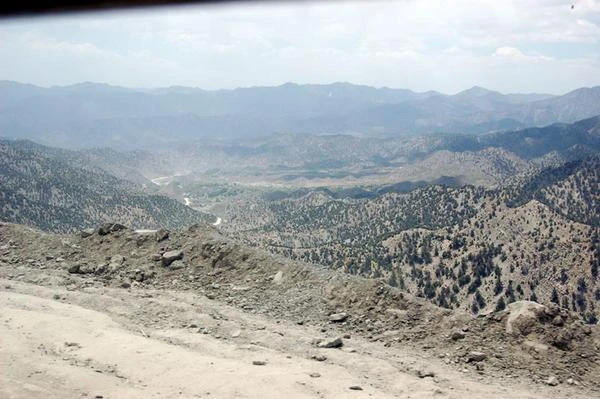
Looking south towards Khost from the top of the Khost–Gardez pass, Paktia, May 2007.
Snow-covered mountains in Paktia Province, February 2009.
Where the sources disagree
Bellew and Longworth Dames place the Zadran under Kakai; the Khulasat al-Ansab, Caroe and Rose's vol. II put them under the Mangal in Kodai.
Name and place in the genealogies
The name is written Zadran, Jadran and Dzadran; Raverty gives Jzadrarn or Jzandrarn and Elphinstone Jadraun. The Khulasat al-Ansab, quoted by Dorn, counts the Zhandran among the descendants of Mangholi, one of the seven sons of Kodi, together with the Mughbal (Muqbil) and Bahadurzai, and says all three live next to Khost. Raverty (1880) and Rose's Glossary give the same three sub-tribes of the Mangal, and a genealogical table printed in Rose's second volume puts Jadran under Mangalai in the Kodai line. Caroe's table follows the same placement.
Bellew (1891) and Longworth Dames put the Zadran under Kakai instead. Bellew also wrote that the Zadran were not reckoned Afghan at all, and he derived their name from the Gadrosoi of the Greek writers, a guess with no support in the Pashtun sources. Khushal Khan Khattak's own table, as reported by Rose, groups Jadran with the Khattak and Utman; the printed text names their ancestor as Kodai, which may be a misprint for Kakai.1,6,7,4,2,3,12
The forested Sulaiman slopes
The Zadran hold the east slopes of the Sulaiman range east of Zurmat, between Paktia and Khost. Elphinstone, writing from reports in 1809, put them on the west face of the range from about the latitude of Sirufza to near the source of the Kurram, with the Wazirs on the east face, the Kharoti and the Ghazni country to the west and the Jaji to the north. Near the Kurram they grew grain; towards the Kharoti they herded goats through thick pine forest. He noted that travellers never visited their country.
Bellew reckoned them at 10,000 families on the forested hills between Khost and Zurmat, with their main section, the Akhtun, in the Shamal district on the western edge of Khost. In winter many came down to British territory as day labourers and were known as skilled diggers and well-sinkers. The Afghan gazetteer compiled by the British Intelligence Branch adds that they lived in small villages, partly in houses and partly in tents, sold wool and cheese at Gardez for cloth and grain, and had a strong fort at Kala Nak.5,3,8
Under the Afghan amirs
While British troops were in Khost during the war of 1878–80, the Zadran and the Mangal assembled in the hills north-west and west of the district but stayed on the defensive. In 1882 the Zadran fought Amir Abdur Rahman's troops; the gazetteer reports that they were subdued and that three Afghan posts were set up in their country.
In the Khost rebellion of 1924 against King Amanullah's reforms, a Zadran elder, Boland Khan, helped the pretender Abdul Karim cross from Waziristan, and the Zadran and Mangal swore allegiance to him as amir. The rebellion's leader, Mullah Abdullah, came from Utmani, a village of the Sepahi Khel of the Dari Khel Zadran, where his father had been given land to serve as imam; the Zadran writer quoted on this says the family was not Zadran by origin. When the other tribes gave up in late 1924, only the Zadran and the Sulaiman Khel kept fighting; Zadran leaders came to Kabul to negotiate on 22 December 1924. The historian Ghobar writes that local Zadran caught Mullah Abdullah and handed him over; he was executed with other leaders in Kabul on 25 May 1925.8,9
The Zadran since 2001
A 2009 study in the CTC Sentinel placed most of the Zadran in Spera district of Khost, Zadran district of Paktia and Gayan district of Paktika. It described the Haqqani family as prominent Zadran and an open contest for leadership of the tribe after 2001 between the Haqqanis and Padcha Khan Zadran, who later sat in the Wolesi Jirga.10
Homeland
Shaded areas are present-day districts and provinces, drawn from geoBoundaries. They are administrative lines, not tribal borders, which have never been surveyed. Khost, Paktia, Paktika.
Notable people
Boland Khanfl. 1924
Zadran elder who helped the pretender Abdul Karim cross into Afghanistan during the Khost rebellion of 1924.9
Jalaluddin Haqqani1947–2018
Mujahideen commander backed by the United States in the 1980s and briefly justice minister afterwards, who joined the Taliban in 1996 and founded the Haqqani network.11
Padcha Khan Zadranfl. 2001–2009
Zadran leader who contested control of the tribe with the Haqqanis after 2001 and later sat in the Wolesi Jirga.10
The genealogy follows the Makhzan-i Afghani and the Khulasat al-Ansab, as Caroe tabulates them. It records tradition: where sources place a tribe differently, the note above says so.