The Niazi are a Lodi tribe of Isa Khel and Mianwali, on both banks of the Indus, who earlier lived at Tank and in the Marwat country. The Makhzan-i Afghani gives Niazi three sons, Bahi, Jam and Khaku, and the Khulasat al-Ansab places the tribe from Makhad as far as Dera Ismail Khan.
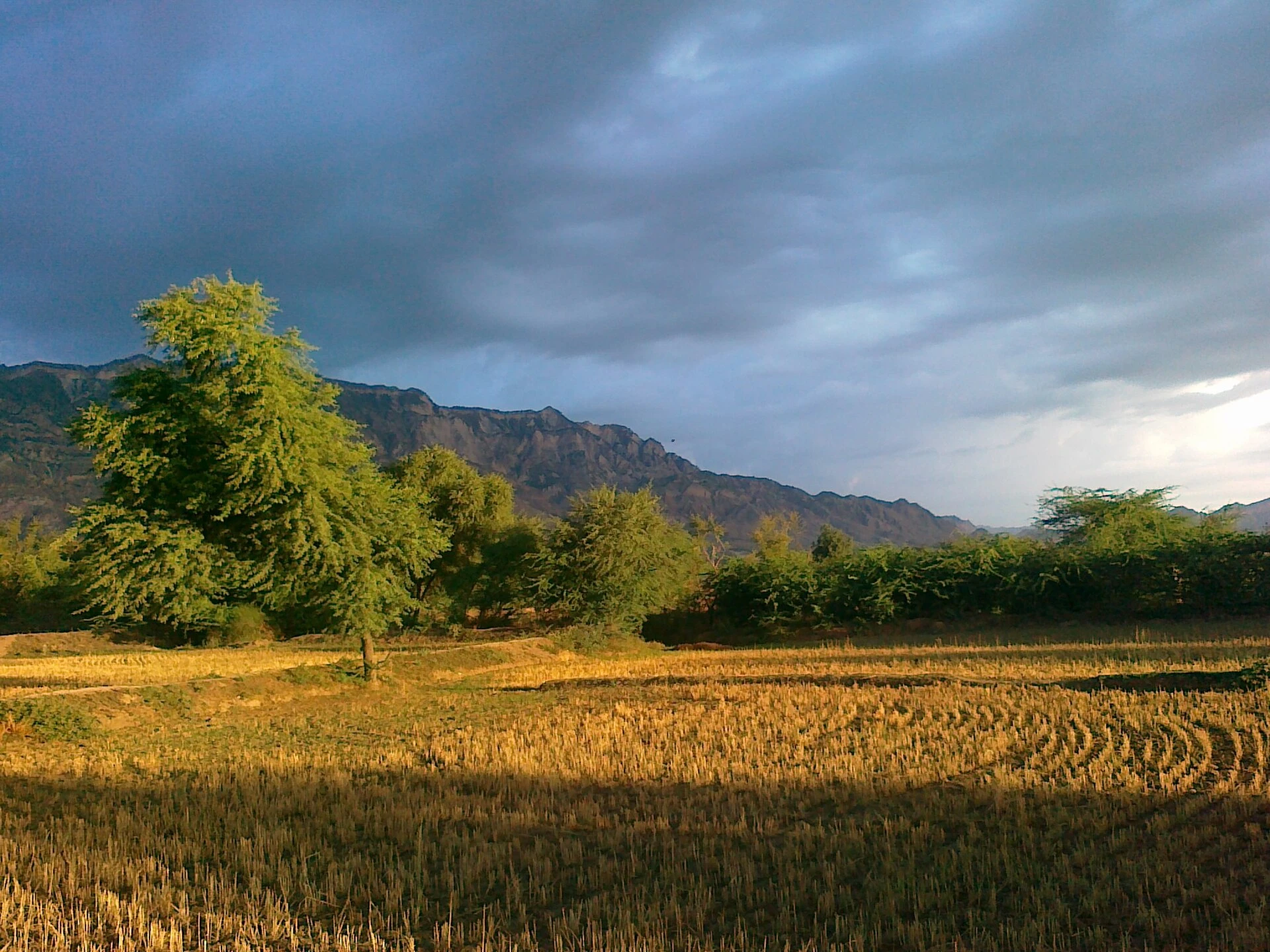
Fields in Isa Khel tehsil, Mianwali district, April 2011.
The Indus at Kalabagh, in Isa Khel tehsil, with the red hills of the Salt Range, May 2018.
In the garden of Isa Khan Niazi's tomb (1547–48), Humayun's Tomb complex, Delhi, February 2017.
Mianwali district, with Isa Khel west of the Indus, from The Panjab, North-West Frontier Province and Kashmir (1916).
Sons of Lodi
The Makhzan-i Afghani gives Lodi three sons, Niazi, Siani and Dotani, and Niazi three sons, Bahi, Jam and Khaku; among Jam's sons it names Sambal and Isakhail. Ibbetson gives the three sons as Bahai, Jamal and Khaku and says the Isa Khel of the Jamal line and the Mushani and Sarhang of the Khaku line had overshadowed the rest. The Khulasat al-Ansab names the Musa Khel, Isa Khel, Sambal and Saharang and places the tribe from Makhad on the Indus as far as Dera Ismail Khan. Caroe (1958) calls the Niazi a settled tribe of Ghilzai, which departs from the older genealogies.
Rose's Glossary says the Niazi were first nomads, driven from Shilgar south of Ghazni by the Andar; Thorburn's Bannu tradition says the Ghilzai drove them out. They moved to Tank at the foot of the Sulaimans early in the fifteenth century and lived there as Powindahs for nearly a century.1,4,2,8,5,7
In the service of the Lodi and Sur sultans
Many Niazi took service with the Lodi sultans of Delhi and then with Sher Shah Sur. Haibat Khan Niazi was Sher Shah's governor of the Punjab, including Multan, and received the title Azam Humayun. His brothers Isa Khan and Said Khan held high office. Rose's Glossary says Haibat Khan distinguished himself at Humayun's defeat in 1540 and that Isa Khan pursued the Mughals to the Indus. When a Sur governor of the Niazi country tried to force a Sumbal girl into marriage, the Sumbal killed him, and Haibat Khan, on Sher Shah's orders, lured 900 Sumbal men in under safe-conduct and had them killed.
Islam Shah, Sher Shah's son, distrusted the great Afghan nobles. Haibat Khan revolted when his brother Said Khan fled to him, and marched with 40,000 horsemen, 12,000 of them Niazi by Rose's count, but was defeated near Ambala. The Makhzan says the Niazi then held out for two years in the hills of the Kakars; Rose places their refuge in the Gakhar country north of Rawalpindi. When they tried to reach Kashmir, the Kashmiris stopped them at the frontier, killed the brothers and sent their heads to Islam Shah, in or about 1550.5,6,8,3
Isa Khel and Mianwali
The Niazi who stayed in Tank crossed the Salt Range into the plain south of Bannu, where Babur found them farming in 1505. Late in Akbar's reign the Marwat drove them east across the Kurram. The Isa Khel took the southern part of the land between the Kohat Salt Range and the Indus, after expelling the Awans and reducing the Jat cultivators to serfdom; a mulla, Shaikh Farid, divided it into sixteen shares, four each for the Mamma Khel, Badinzai, Zakku Khel and Abu Khel. The Mushani settled to the north, and the Sarhang crossed the Indus. After a century and a half of struggle with the Gakhars, the Sarhang settled in Mianwali once a Durrani army destroyed the Gakhar stronghold of Moazzamnagar in 1748.
Elphinstone, writing from reports in 1809, described the Isa Khel country as a strip about thirty miles along the Indus and twelve broad, well watered and thickly settled, with wheat as its main crop and large cultivated islands in the river. The Nawab of Mankera annexed Isa Khel in 1818 and the Sikhs took it in 1836. Under British rule Isa Khel and Mianwali were tahsils of Bannu district until 1901, when they became part of the new Mianwali district of the Punjab.4,7,8,9,10
Language and way of life
Ibbetson noted that the Niazi, unlike the other trans-Indus Pathans of Bannu, spoke Hindko, especially east of the Indus. They were strict Sunnis. One section still lived as Powindah traders in his time, spending the summer above Kandahar and the winter in Dera Ismail Khan; the Intelligence Branch gazetteer of Afghanistan counts this Powindah clan at about 600 families in four sections. Rose adds that Niazi were still fairly numerous in Kohat.4,12,5
Homeland
Shaded areas are present-day districts and provinces, drawn from geoBoundaries. They are administrative lines, not tribal borders, which have never been surveyed. Kohat, Mianwali.
The genealogy follows the Makhzan-i Afghani and the Khulasat al-Ansab, as Caroe tabulates them. It records tradition: where sources place a tribe differently, the note above says so.