The Mandanr hold the Yusufzai plain of Mardan and Swabi, Chamla, and Gandgarh in Hazara. In the Makhzan-i Afghani their ancestor Mandar was a son of Omar who married his uncle Yusuf's daughter, and so was also called Yusufzai. Their clans are the Usmanzai, Utmanzai, Razar and Saddozai.
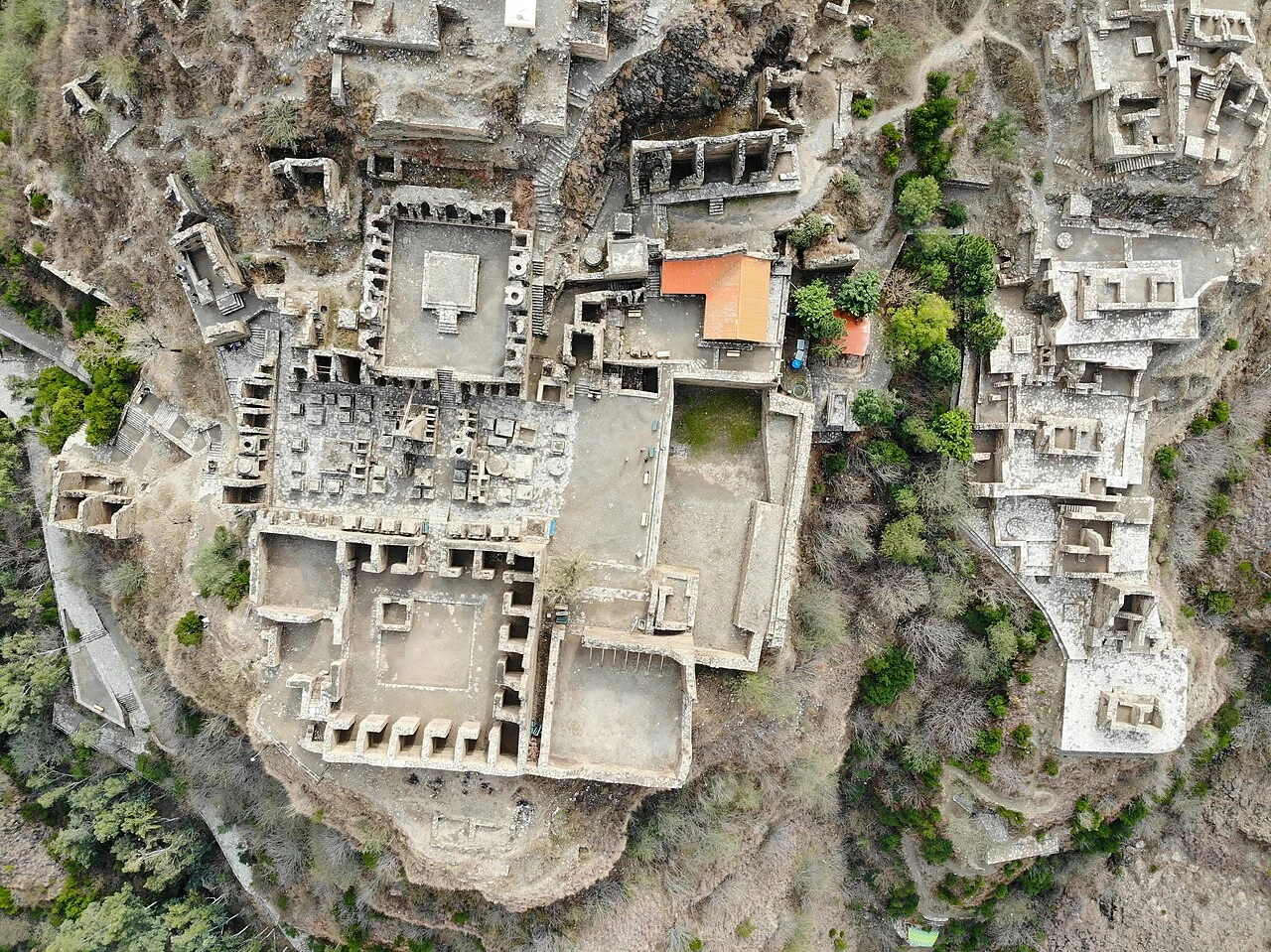
Aerial view of the Buddhist monastery ruins at Takht-i-Bahi near Mardan, an older layer of history in the Yusufzai plain.
The Kundal stream at Maini in Swabi District, 2010.
Where the sources disagree
Elphinstone, Bellew and Ibbetson treat the Mandanr as part of the Yusufzai in the wide sense, and the Khulasat al-Ansab makes Mandar the father of Omar and Yusuf. The Makhzan-i Afghani and Caroe show them as Umar's line beside Yusuf's.
Descent and clans
In the Makhzan-i Afghani the Mandanr descend from Mandar, son of Omar, son of Sheikha (Khakhay). Mandar married the daughter of his uncle Yusuf and so was also called Yusufzai. His sons were Manur, Khidar, whom the Makhzan calls a saint, Rajar and Mamu. The Khulasat al-Ansab instead makes Mandar the son of Khakhay and the father of Omar and Yusuf. Elphinstone, Bellew and Ibbetson treat the Mandanr as a branch of the Yusufzai in the wide sense, and Caroe writes of the "Mandanr Yusufzais".
Ibbetson lists four clans: the Usmanzai, divided into the Kamalzai and Amazai; the Utmanzai; the Razar; and the Saddozai, a branch of the Utmanzai through a second wife of Utman. Bellew names the Usman, Utman and Rajar. The names of Otman's sons in the Makhzan, Saddo, Aka, Kana and Ali, reappear in the Saddozai, Akazai, Kanazai and Alizai sections that Ibbetson records.1,2,3,4
Chiefs of the Yusufzai confederacy
The first leaders of the Yusufzai movement into the Peshawar valley were Mandanr. Caroe identifies Malik Ahmad, who escaped Ulugh Beg's massacre at Kabul as a youth and led the tribes into the Doaba and Swat, as a Mandanr of the Razzar clan, with Shaikh Mali as his chief mulla. Malik Ahmad died about 1535 and was followed by Khan Kajju, also a Mandanr. The Makhzan traces Khan Kaju from Otman through Saddo, Bahzad and Kara, and says he joined Sher Shah's rebellion.
About 1550 Khan Kaju, at the head of a confederation of Khakhay tribes, defeated the Ghoria Khel at Shaikh Tapur, and in 1552 he besieged Humayun's new garrison in Peshawar without success. Malik Ahmad is buried near Allahdand in Swat; Khan Kajju lies in the Samah on the Badrai stream between Swabi and Maneri.7,1,6
From the hills to the plain
Both Yusufzai lines first held land in Swat as well as the plain. Some time after Shaikh Mali's survey the Yusufzai proper took Swat, Panjkora, Buner and the hills, and the Mandanr were left with the Samah, the plain north of the Kabul river. Ibbetson puts the split early in the seventeenth century and says the Mughals fomented it; the Imperial Gazetteer adds that the Mandanr in turn drove the Yusufzai from the eastern plain. The Baezai valley was the main battleground, and the Utman Khel and Khattak fighters hired by both sides ended by taking most of it.
In 1667 the Yusufzai and Mandanr together crossed the Indus and were defeated near Attock. Early in the eighteenth century the Utmanzai were called across the Indus by the Gujars of Hazara against the Tarin, and took the Gandgarh tract from Torbela southward; their Tarkheli section spread into Attock.7,5,6,4
Under Sikh and British rule
Ibbetson found the Mandanr living almost wholly inside British territory and "long subject to the rulers of Peshawar". The Kishranzai held Hoti and Mardan, the Razar the country between the Amazai and the Khattak, the Utmanzai and Saddozai the eastern edge on the Indus, and a mixture of clans, mostly Amazai, the Chamla valley beyond the border. The Imperial Gazetteer (1908) describes the Swabi tahsil, once called Utman Bulak, as Razar in the north-east, Saddozai in the centre and Utmanzai in the east. With the Mardan tahsil it formed the Yusufzai subdivision, which had 281,728 people of all communities in 1901.
The Khans of Sudhum, an Amazai valley, came from the Mir Babu Khel family. Mir Babu Khan had known Sayyid Ahmad Brelwi, farmed revenue for the Sikhs and then helped the first British officers, and his sons Ajab and Aziz acted as go-betweens with Buner. In 1877 Ajab Khan brought Buner men into Sudhum to burn the villages of rival Khans, hoping to gain credit by driving them off; he was tried for making war on the Crown and executed. Mardan, the Guides' cantonment, was the home of the leading Mandanr families, and Caroe sketches Nawab Muhammad Akbar Khan of Hoti, one of two Frontier men nominated to the central legislature at Delhi after 1919.4,6,7
Homeland
Shaded areas are present-day districts and provinces, drawn from geoBoundaries. They are administrative lines, not tribal borders, which have never been surveyed. Mardan, Swabi.
The genealogy follows the Makhzan-i Afghani and the Khulasat al-Ansab, as Caroe tabulates them. It records tradition: where sources place a tribe differently, the note above says so.