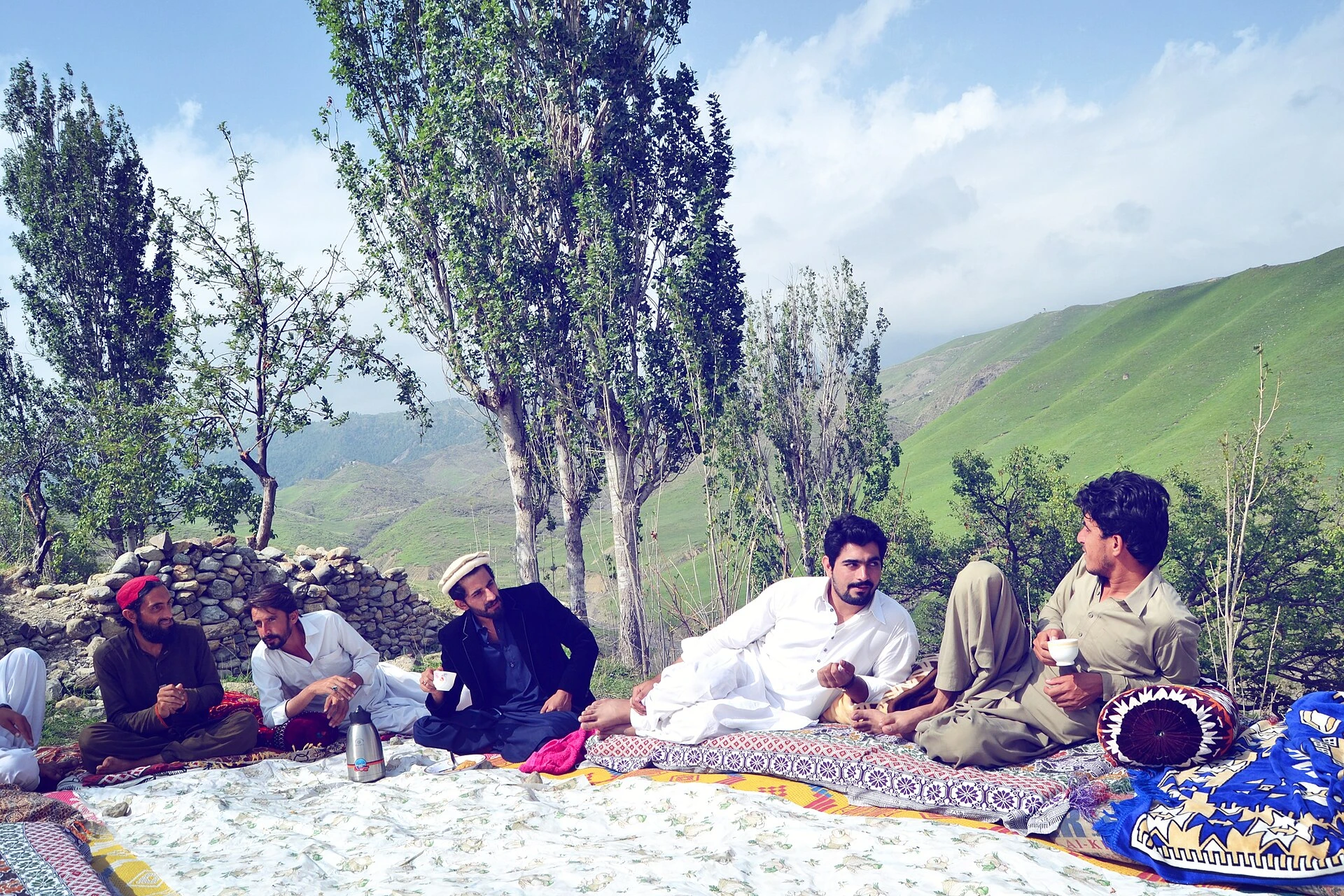
The Mahsud hold central and South Waziristan around Kaniguram and Makin. They claim descent from Mahsud, son of Mahmud, son of Khizri, son of Wazir, and the Imperial Gazetteer gives three branches, Alizai, Shaman Khel and Bahlolzai.
Sina Tiza in the Baddar valley, South Waziristan, August 2017.
Pir Ghar (Pir Ghal, 11,600 feet) above the Baddar valley, South Waziristan, July 2017.
A Mahsud man photographed in Waziristan about 1919 by Randolph Bezzant Holmes.
Origins and organisation
The Mahsud claim descent from Mahsud, son of Mahmud, son of Khizri, son of Wazir, and are the southern of the two great Wazir branches. The Glossary records a view that they were originally Hazaras, but notes that they do not have the Hazara cast of features. The Imperial Gazetteer gives three branches, the Alizai, Shaman Khel and Bahlolzai, which split all tribal gains and liabilities into three equal shares whatever their numbers; Bellew gives two divisions, Ali and Bahlol.
Tradition makes Kaniguram the birthplace of the tribe, though the town is lived in mostly by Urmar. Makin, a cluster of twelve Bahlolzai villages, is called the true capital. The Mahsud had no khan khel: any man could rise to be a malik. Caroe describes the nikat, the inherited scheme of shares by which every clan, section and family took its part in tribal allowances and burdens.1,2,3,5,6
Country and livelihood
The Mahsud country lies in the south of Waziristan, enclosed by the Utmanzai Darwesh Khel to the north and west, the Ahmadzai of Wana to the south-west and the Bhittanni to the east. Its streams, the Tank Zam and its tributary the Shahi, drain the whole of it, and its peaks include Pir Ghal at 11,600 feet. The Mahsud took the land from the Urmur, who fled towards Afghanistan, and they always counted the Gomal pass as theirs, though it lies outside their limits.
Iron was smelted in the hills above Makin and was once made into matchlocks at Kaniguram, by craftsmen almost all of the Nazar Khel section. Potatoes, introduced about fifty years before the gazetteer of 1908, were grown round Kaniguram, and the Wazirs carried timber, mats and hides down to Tank, Bannu and Kalabagh.1,4,5
Expeditions and the Mulla Powinda
In 1860 a Mahsud lashkar about 3,000 strong tried to sack Tank and was turned back by Resaldar Saadat Khan of the 5th Punjab Cavalry; a force under Brigadier-General Neville Chamberlain then reached Kaniguram the same year. The Mahsud agreed to keep the peace in 1863, burnt Tank in 1878 and faced a second expedition to Kaniguram in 1881. From 1889 Sir Robert Sandeman opened the Gomal pass and paid the Mahsud nearly Rs 50,000 a year to guard it.
In November 1894 about 2,000 Mahsud attacked the British demarcation escort at Wana, led in council by the Mulla Powinda and in the field by Jaggar. The gazetteer puts their losses at 350 killed and 700 wounded and the British at 45 killed and 75 wounded. Sir William Lockhart's expedition of 1894–95 crossed the Mahsud country from end to end. The Mahsud stayed out of the frontier rising of 1897, but after raids in 1898–99 they were blockaded in 1900–01 until a full tribal jirga accepted the government's terms. The Mulla Powinda, a Shabi Khel Alizai, remained the leading opponent of British control until his death in 1913.4,6
From 1919 to the present day
After the Third Anglo-Afghan War the Mahsud refused the government's terms at a jirga at Kirghi on 11 November 1919. General Andrew Skeen advanced from Jandola in December up the Tank Zam towards Kaniguram and Makin; the five-day fight for the Ahnai Tangi gorge cost his force over 2,000 casualties, 43 of them officers killed, and the campaign ended with British posts and roads across the country and the occupation of Razmak. Caroe counts six full-scale expeditions against the Mahsud between 1860 and 1921.
In 1929 Mahsud and Wazir lashkars helped Nadir Khan take Kabul. In 1938 a Syrian known as the Shami Pir settled near Kaniguram and raised Mahsud lashkars to march on Kabul for the deposed king Amanullah, until the Government of India secured his surrender and removal. During the rising of the Faqir of Ipi, Captain J. A. Keogh of the South Waziristan Scouts was killed in Mahsud country on 6 February 1937. South Waziristan remained a tribal agency until the Twenty-fifth Amendment of 31 May 2018 merged the tribal areas into Khyber Pakhtunkhwa.6,7,8,9
Homeland
Shaded areas are present-day districts and provinces, drawn from geoBoundaries. They are administrative lines, not tribal borders, which have never been surveyed.
The genealogy follows the Makhzan-i Afghani and the Khulasat al-Ansab, as Caroe tabulates them. It records tradition: where sources place a tribe differently, the note above says so.