The Bangash hold Kohat, the Miranzai valley and lower Kurram: Upper Bangash is Kurram and Lower Bangash is Kohat. The Nawabs of Farrukhabad were Bangash. Rose's table traces them from Kakai through Sulaiman to Bai and Malik Mir, and they split into the Gar and Samil factions.
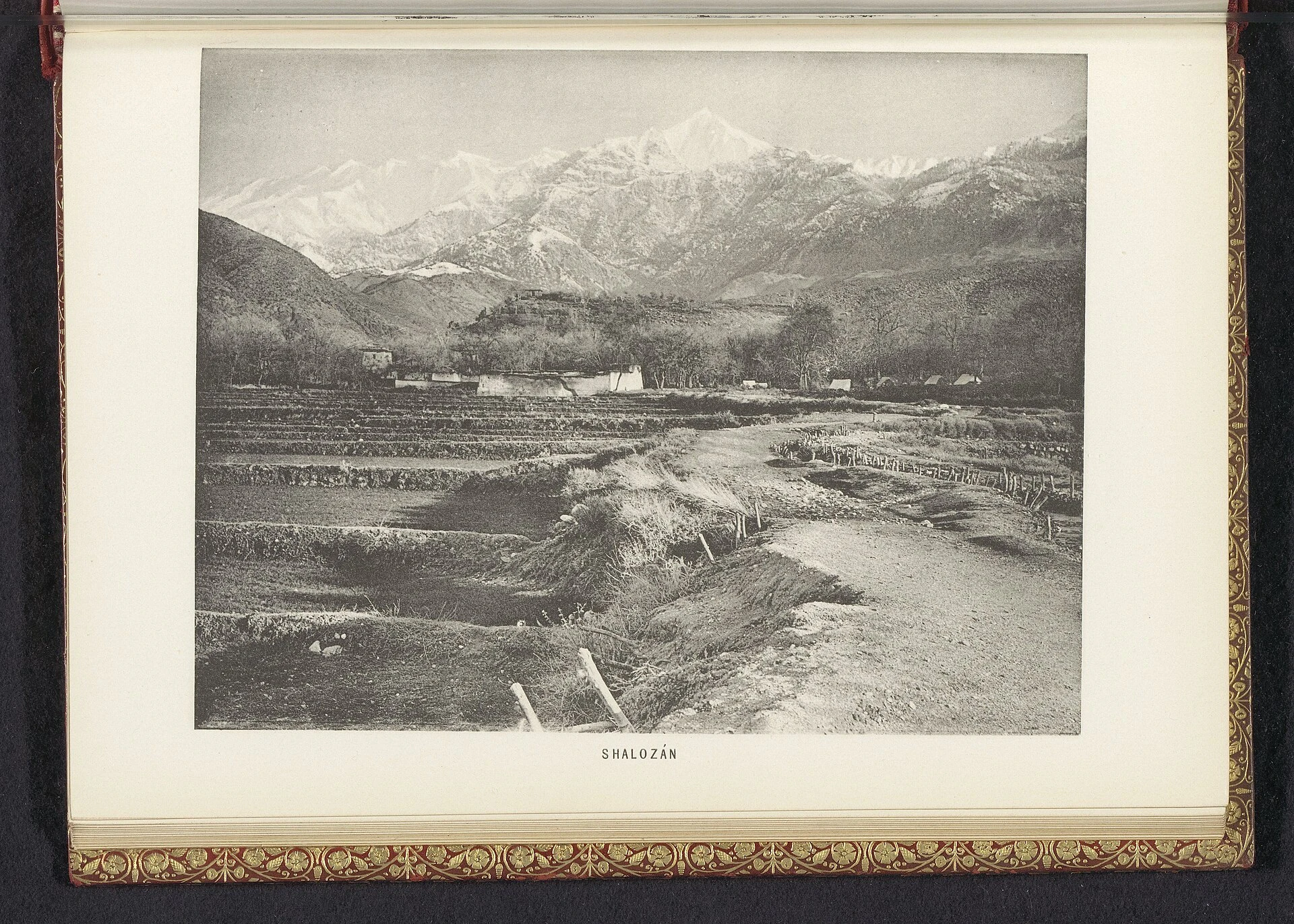
Shalozan in upper Kurram, the westernmost Bangash village, photographed by Frederick St John Gore about 1890–95.
Ahmad Khan Bangash, nawab of Farrukhabad (1750–1771), in an eighteenth-century painting bought at Fatehgarh in 1794.
Tomb of Nawab Muhammad Khan Bangash (died 1743), Farrukhabad, photographed in 2016.
Kohat district in 1916, including the Bangash country of Kohat and Miranzai, from James Douie's The Panjab, North-West Frontier Province and Kashmir.
Where the sources disagree
The Khulasat al-Ansab, Raverty, Rose's vol. II and Caroe place the Bangash in the Karlanri line under Kakai. Ibbetson records their claim to descend from Khalid ibn Walid as Quraysh Arabs, and Bellew suggested a Scythian origin.
Origins and genealogy
The Khulasat al-Ansab, Raverty and Rose's Glossary place the Bangash in the Karlanri line. Rose gives the descent as Karlarnai, Kakai, Sulaiman, and then Sulaiman's sons Bai and Malik Mir: the Baizai descend from Bai and the Miranzai (Malik-Miri) from Malik Mir, with the Kaghzi attached through Malik Mir's daughter. The chiefship first lay with the Malik-Miris and later passed to the Baizai.
The Bangash tell a different story of themselves. Ibbetson recorded their claim to descend from Khalid ibn Walid, so to be Quraysh Arabs, and their tradition that their ancestor's two sons, Gar and Samil, were such bitter enemies that they were nicknamed bunkash, root-destroyers. Gar and Samil are also the names of the two factions into which the Afridi, Orakzai, Khattak, Turi and other Karlanri tribes were divided. Balland, in Encyclopaedia Iranica, notes that Raverty rejected the root-destroyer etymology and that the tribe's own tradition traces it to one Ismail, who came from Persia to the Sulaiman range. Bellew was told the Bangash came from Sistan and settled near Gardez, and connected the name Ismail with the Ismaili sect; Balland argues the same Ismaili link from the Multan episode of the legend. Bellew also suggested a Scythian origin.1,2,3,4,6,7
From Gardez to Kohat
By the tradition recorded in the Kohat gazetteer and by Ibbetson, the Bangash lived about Gardez until the late fourteenth century, when the Ghilzai pressed them out and they moved east into Kurram. From Kurram they joined the Khattak against the Orakzai, who then held Kohat, and after nearly a century of fighting drove them into the hills by the end of the fifteenth century. The Bangash took the Kohat and Miranzai valleys up to the foot of the Samana, and the Khattak the south and centre of Kohat; the hills between Gada Khel and Ilachi became the boundary between them. The old town of Kohat is said to have been founded by the Bangash in the fourteenth century.
The country took its name from the tribe. Under the Mughals it was the tuman of Bangash in the province of Kabul, divided into Upper Bangash, which was Kurram, and Lower Bangash, the country round Kohat. In Kurram the Bangash lost ground to the Turi and Jaji. Ibbetson places this early, soon after the Bangash arrived; Balland says they gave up most of upper Kurram to the Turi in the eighteenth century.3,5,7,8
The Mughals and Farrukhabad
Babur raided through the district in 1505 and sacked Kohat and Hangu. He wrote that the tribes of Bangash lay out of the way and did not willingly pay taxes, and that he never found time to settle the district. The Bangash, like other Karlanri tribes, followed the Roshani teaching, and Kurram was one of the Roshani strongholds; the Mughals governed the tract only loosely through faujdars of Bangash at Kohat. After Aurangzeb's accession in 1659 Sher Muhammad Khan of Kohat, chief of the Malik-Miris, rose against the Mughals. He was captured, released and became their ally, and his wars with Khushal Khan Khattak ended in Khushal's defeat and the final settlement of the Bangash in their present seats.
Bangash soldiers served the Mughals and later the British in India. In 1713 one of them, Muhammad Khan of the Samilzai lineage, was granted a principality in the Ganges Doab and founded the nawabs of Farrukhabad, named after the capital he built. He ruled until 1743; his son Ahmad Khan held Farrukhabad from 1750 to 1771. Elphinstone was told that the family came from a peasant of Upper Bangash. The last nawab was exiled to Mecca in 1859 for his part in the rising of 1857.3,7,8,9,10,11
Durrani, Sikh and British rule
Kohat became part of the Durrani empire in 1747, ruled through the Bangash and Khattak chiefs. Elphinstone, who gathered his information in 1809, describes Lower Bangash as a fertile plain round Kohat, the residence of the chief, whose people were obedient to their khan and to the king, while Upper Bangash was less so. Early in the nineteenth century Kohat and Hangu were a governorship of the Barakzai sardar Samad Khan, whose sons the Peshawar sardars drove out about 1828; Ranjit Singh then granted Kohat, Hangu and Teri to Sultan Muhammad Khan.
Upper Miranzai was annexed by the British in 1851 and administered from 1855. In Kurram the Bangash who remained had become hamsaya, or clients, of the Turi: Bellew says every Bangash there had to attach himself to a Turi patron who protected him and inherited his land if he died without a Bangash heir. In 1876 the Bangash of lower Kurram fell into a boundary dispute with the British village of Thal, and in 1880 the Bangash joined the Turi in asking the British to take over the valley.6,8,9
Religion and the tribe today
The Bangash are divided by religion. Bellew called them mostly Shia, the Imperial Gazetteer names some of the Bangash of Kurram as Shia, and Balland states that the majority are Shia and a minority Sunni. Raverty held that Pashtun Shiism was a remnant of the Roshani movement, a view Caroe, who served among the Orakzai and Bangash Shia, says he never heard put openly.
Balland, writing in 1988, describes the Bangash as settled farmers, living mainly along the route through the Miranzai and Kohat valleys, with a few villages left in upper Kurram, Shalozan being the westernmost. The tribe is divided into the Gar, made up of the Baizai of the Kohat valley and the Miranzai of the Miranzai valley, and the Samil (Samilzai), in the north of Kohat, at Shalozan and in Kurram.4,6,7,8,11
Homeland
Shaded areas are present-day districts and provinces, drawn from geoBoundaries. They are administrative lines, not tribal borders, which have never been surveyed. Hangu, Kohat, Kurram.
The genealogy follows the Makhzan-i Afghani and the Khulasat al-Ansab, as Caroe tabulates them. It records tradition: where sources place a tribe differently, the note above says so.
,_RP-F-2001-7-437-65.jpg)